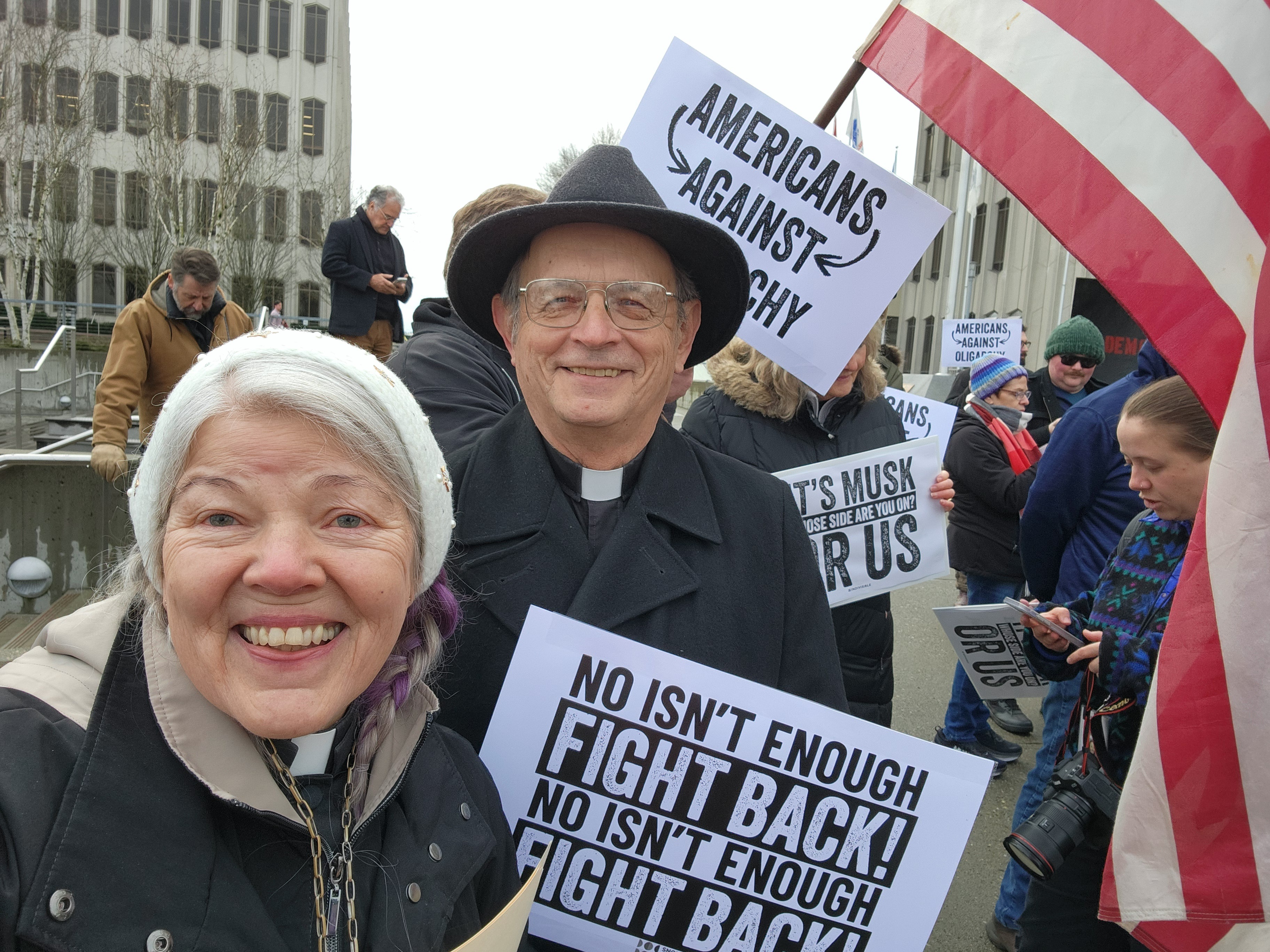
Public Address Given at “Freeze the Senate” rally, Snohomish Indivisible – February 5, 2025; Photo Credit R. Taber-Hamilton, with The Rev. Allen Hicks – Trinity Episcopal Church, Everett, WA
In less than two weeks from now, America will celebrate Presidents Day on Monday, February 17th. The observed federal holiday is officially called “Washington’s Birthday.” The holiday Presidents’ Day helps us reflect on not just the first president but also our nation’s founding, its values, and what Washington calls in his Farewell Address the “beloved Constitution and union, as received from the Founders.” Also, Abraham Lincoln’s birthday is February 12, so by calling the holiday “Presidents’ Day,” we can also include another remarkable presidents in our celebrations.
Since 1862 there has been an often forgotten tradition in the United States Senate that George Washington’s Farewell Address should be read on his birthday. I would like offer the following sampling taken from his speech:
George Washington’s Farewell Address
Your Union ought to be considered as a main prop of your liberty, and that the love of the one ought to endear you to preserve the other.
To put in the place of the delegated will of the nation the will of a part, often a small but artful and enterprising minority of the community, are likely in the course of time and things, to become a potent engine by which cunning ambitious and unprincipled men will be enabled to subvert the power of the people and to usurp for themselves the reins of government, destroying afterwards the very engines which have lifted them to unjust dominion. The domination of one faction over another, sharpened by the spirit of revenge, natural to party dissension…the disorders and miseries which result gradually incline the minds of men to seek security and repose in the absolutely power of an individual, and sooner or later the chief of some prevailing faction, more able or more fortunate than his competitors, turns… to the purposes of his own elevation, on the ruins of public liberty….
The continual mischiefs of the party are sufficient to make the interest and duty of a wise people to discourage and restrain it. It serves always to distract the public councils and enfeeble the public administration. It agitates the community with ill-founded jealousies and false alarms, kindles the animosity of one part against another, and foments occasionally riot and insurrection. It opens the door to foreign influence and corruption, which finds facilitated access to the government itself through the channels of party passions. Thus, the policy and the will of one country are subjected to the policy and will of another.
It is important, [therefore] that the habits of thinking in a free country should inspire caution in those entrusted with its administration to confine themselves within their respective constitutional spheres, avoiding in the exercise of powers of one department to encroach upon another. The spirit of encroachment tends to consolidate the powers of all the departments in one, and thus to create, whatever the form of government, a real despotism. To preserve reciprocal checks in the exercise of political power must be as necessary as to institute them.
Real patriots who may resist the intrigues of the favorite are liable to become suspected and odious…while it’s tools and dupes usurp the applause and confidence of the people, to surrender their interests.
My friends, our union as a nation was not created by the mere signing of a declaration and writing of a constitution. Rather, our union has been forged from the iron of the blood of millions of Americans who have died in service to the ideals and values they believed in, who fought to institute and sought to preserve the principles of liberty. From this nation’s founding and the Revolutionary War, through the domestic turmoil of our Civil War, and in the two world wars in which we fought beside allied nations against forces of tyranny and fascism, the blood of this nations ancestors is speaking to us now.
Our ancestors are with us today, they stand beside us and fill our hearts and minds with their wisdom, their foresight, and their ongoing commitment to those who have followed them and who are gathered here today. I say this as both a Shackan First Nations woman in the heritage of my mother and as a descendent of revolutionary soldiers and soldiers who served in the Union Army of the Potomac within my father’s American lineage dating back to the 17th century.
In our generation, through the words of Abraham Lincoln, “We the people are the rightful masters of both Congress and the courts; not to overthrow the Constitution but to overthrow the men who would pervert the Constitution.” Lincoln also said, “I am a firm believer in the people. If given the truth, they can be depended upon to meet any national crisis. The great point is to bring them the real facts.”
The words spoken by Abraham Lincoln on November 19, 1863 to commemorate the memorial monument area on the battlefields of Gettysburg, Pennsylvania contain an important message to us today. Listen; hear it word for word beyond the din of current events that are even now circumscribing the national and global battlefields of our time. Listen:
Four score and seven years ago our fathers brought forth on this continent, a new nation, conceived in Liberty, and dedicated to the proposition that all men are created equal.
Now we are engaged in a great civil war, testing whether that nation, or any nation so conceived and so dedicated, can long endure. We are met on a great battlefield of that war. We have come to dedicate a portion of that field, as a final resting place for those who here gave their lives that that nation might live. It is altogether fitting and proper that we should do this.
But, in a larger sense, we can not dedicate — we can not consecrate — we can not hallow — this ground. The brave men, living and dead, who struggled here, have consecrated it, far above our poor power to add or detract. The world will little note, nor long remember what we say here, but it can never forget what they did here. It is for us the living, rather, to be dedicated here to the unfinished work which they who fought here have thus far so nobly advanced. It is rather for us to be here dedicated to the great task remaining before us — that from these honored dead we take increased devotion to that cause for which they gave the last full measure of devotion — that we here highly resolve that these dead shall not have died in vain — that this nation, under God, shall have a new birth of freedom — and that government of the people, by the people, for the people, shall not perish from the earth.
Col. Joshua Lawrence Chamberlain, Commander of the 20th Maine Regiment of the Union Army said to his troops before marching to Gettysburg:
[We] are here for something new. This has not happened much in the history of the world. We are an army out to set other men free. America should be free ground — all of it. Not divided by a line between slave state and free — all the way, from here to the Pacific Ocean. No man has to bow. No man born to royalty. Here, we judge you by what you do, not by who your father was. Here, you can be something. Here, is the place to build a home. But it’s not the land. There’s always more land. It’s the idea that we all have value — you and me. What we’re fighting for, in the end, we’re fighting for each other.
26 years later during the commemoration of a monument to those members of the 20th Maine who fell during the battle of Little Round Top within the larger strife of the Battle of Gettysburg, Chamberlain concluded his memorial speech with these remarks:
Honor and sacred remembrance to those who fell here, and buried part of our hearts with them. Honor to the memory of those who fought here with us and for us, and who fell elsewhere, or have died since, heart-broken at the harshness or injustice of a political government. Honor to you, who have wrought and endured so much and so well. And so, farewell.
Today, you and I have come to this place from all walks of life, representing a diversity of heritage and culture, of origin and experience. Yet we are here united and indivisible in the face of forces that would seek to divide us and plunder this nation. We are also united by the common ancestors of every kind who have forged this nation and given it unto our keeping for its preservation. We are here for something that our first president seems to have anticipated, we are here for something new that has not existed before. We have each of us been set in this time and in this place to answer a call that none of us thought would be laid upon us – we are the inheritors of the urgings and lessons of those who have gone before us in the aspirational but slow and painful process of freedom for all. We are those who have been summoned across time and place to take up their call to action in our time.
Across the four centuries of American history that unite us in a shared experience of pain and struggle, sacrifice and hope, we are those who have inherited the legacy of preserving the union that is the foundation of our nation’s liberty. Indeed, we are here to fight for one another, to stand beside one another even as they did, with courage of heart and determination of will in order to assure that a “government of the people, by the people, for the people, shall not perish from the earth.”
Trinity Episcopal Church, Everett, WA – Sermon given on January 26, 2025
Episcopal Diocese of Washington DC, Bishop Mariann Budde, in her sermon at Washington National Cathedral’s Service of Prayer for the Nation on January 21st, called on all Americans to strive for a renewed unity based in honesty, humility and respect for human dignity – and she directed her final words to the newly inaugurated President, who was seated in the front row.
A segment of Bishop Budde’s sermon included this message:
Millions have put their trust in you. And as you told the nation yesterday, you have felt the providential hand of a loving God. In the name of our God, I ask you to have mercy upon the people in our country who are scared now. There are gay, lesbian and transgender children in Democratic, Republican, and independent families, some who fear for their lives. And the people who pick our crops, and clean our office buildings; who labor in poultry farms and meat packing plants; who wash the dishes after we eat in restaurants and work the night shifts in hospitals. They…may not be citizens or have the proper documentation. But the vast majority of immigrants are not criminals. They pay taxes and are good neighbors. They are faithful members of our churches and mosques, synagogues, gurudwaras and temples. I ask you to have mercy, Mr. President, on those in our communities whose children fear that their parents will be taken away. And that you help those who are fleeing war zones and persecution in their own lands to find compassion and welcome here. Our God teaches us that we are to be merciful to the stranger, for we were all once strangers in this land. May God grant us the strength and courage to honor the dignity of every human being, to speak the truth to one another in love and walk humbly with each other and our God for the good of all people of all people in this nation and the world.
As Tom Pepinsky noted in his reflection, “We Kneel to No Pope, We Kneel to No King,” Bishop Budde was quickly disparaged by the President and his followers, with Senator Josh Brecheen of Oklahoma even filing a House resolution (H. Res. 59) condemning Bishop Budde’s sermon at the National Cathedral as “a display of political activis and condemning its distorted message.” Yet, my friends, as Pepinsky observes, “Bishop Budde was acting from her solemn responsibility as the embodiment of America’s political and religious establishment, reminding the new administration of the values upon which the United States was founded and its responsibility to uphold them. This was not an act of resistance. It was an act of leadership on behalf of the closest thing that the United States has to a national church”.
Pepinsky’s essay reminds us that the separation of church and state is a foundational principle of our nation as articulated by our nation’s founders and embodied in our national history. Many Christian nationalists today find the separation of church and state to be an obstacle and appeal instead to a version of Christianity very much associated with the principles of empire, the same Christian empires that came to these shores from the Roman Catholic principalities of Portugal, Spain and Protestant England, legitimating slavery, genocide, and commercial destruction of vast natural resources as God’s will for providing for God’s chosen people.
The Constitution of the United States was drafted by wealthy, landowning white men, many of whom were slave owners. However, their faith was not Christian nationalism. Their aspirations reflected the conditions of the founding of this nation. Namely, they kneeled to no pope, and they kneeled to no king. That is because they were mostly Episcopalians. The Episcopal Church of the United States of America is, as Pepinsky notes, is the closest thing that the United States has to a national church, “This is a historical fact, and a living contemporary practice.”
There is an institution in Washington, DC called the National Cathedral. It is truly a national cathedral, established by an Act of Congress, aligned with the vision of the Founders for our national capital. The denomination of the National Cathedral is Episcopalian. Bishop Budde is the bishop of the Episcopal Diocese of Washington and as such, the National Cathedral is her seat as bishop of that diocese. The establishment of the United States of America coincides with the establishment of the Episcopal Church, because the Episcopal Church is the Church of England in the United States.
Pepinsky’s essay additionally reminds us of our church’s unique history. Anglicanism is the belief system and liturgical practices based on the Church of England. As everyone who has learned European history knows, the modern Church of England emerged through a schism between King Henry VIII of England and the Pope Clement VII, which produced the English Reformation. Driven by various spiritual and worldly matters, Henry refused to recognize papal authority over religious affairs in England. Anglicanism recognizes apostolic succession, but it does not recognize papal supremacy. The King of England is the supreme governor of the Church of England. As head of the church, though, and bishop of the See of Canterbury, the Archbishop of Canterbury kneels to no pope, and we in the Episcopal Church – reminding you again – kneels neither to the King of England nor to the Archbishop of Canterbury.
At the conclusion of the Revolutionary War, a newly independent United States of America had rejected the King’s authority over the thirteen colonies and subsequently separated from the Church of England, which required an oath of Supremacy to the King by all clergy. An early American Anglican clergyman could not take the Oath of Supremacy, because it was essentially an oath to the monarchy. The Church of England was disestablished in the United States, and the Episcopal Church was founded through a series of events that preserved apostolic succession and conceived a system of governance very similar the newly established nation. From that time forward, the Episcopal Church in the United States operated independently of the Church of England. In later generations, it joined with the Anglican Communion – a relationship of international expressions of the Anglican/Episcopal provinces around the world, the remnant leftover of past Christian Empires come and gone.
Finally, as Pepinsky underscores, in Bishop Budde’s sermon, she “articulated a national understanding of the responsibility of faithful leadership towards the American people – the faith tradition of a republic that welcomes all those seeking new opportunity and the chance of a new life for themselves and their children.”
Bishop Budde’s sermon additionally echoed the concerns of the Executive Officers of The Episcopal Church in a letter they issued on January 21st letter to the church, issued in response to the President issuing a barrage of executive orders within the first hours of having taken office, many orders targeting migrants, refugees and other peoples.
The letter released by the Executive Officers of The Episcopal Church urges “Our new president and congressional leaders to exercise mercy and compassion, especially toward law-abiding, long-term members of our congregations and communities; parents and children who are under threat of separation in the name of immigration enforcement; and women and children who are vulnerable to abuse in detention and who fear reporting abuse to law enforcement.”
The letter concludes by encouraging congregations to use the resources of the Office of Government Relations and the Episcopal Public Policy Network and to embody the Gospel through direct witness on behalf of immigrants in our communities. This letter was written in response to the executive orders, The order included measures seeking to suspend the federal refugee resettlement program, declare a national emergency at the U.S-Mexico border, block an “invasion” of migrants into the United States, end the right to birthright citizenship that is guaranteed by the Constitution and resume a policy of making asylum-seekers wait in Mexico for their cases to be heard. Other executive orders were related to the federal work force, the economy, energy policy and the environment and they included some measures targeting transgender people. The government, intends to recognize only two sexes, male and female, and seeks to end protections for transgender inmates in federal prisons.
A growing number of Episcopal bishops are speaking out in response to the new administration’s threat to fulfill a campaign promise of mass deportations of undocumented immigrants, possibly including raids in churches and other places that previous presidents had deemed off-limits for such enforcement. These bishops speaking out include the bishops of Arizona, New York, Massachusetts, Western Massachusetts, and Southern California. Now, the President of the United States has suspended the country’s 45-year-old program of refugee resettlement, which has long enjoyed bipartisan support. In addition, the Department of Homeland Security issued directives reversing the Biden administration policies that avoided immigration enforcement in “sensitive” or “protected” areas, including schools, hospitals and houses of worship.
I want to say to you that Trinity Everett will remain a spoke in the wheel of our diocesan commitment out of the hub of St. Mark’s Cathedral in Seattle to provide sanctuary, protection, and advocacy to immigrants and refugees. Without a warrant signed by a judge, we will not permit entry of federal ICE agents into our buildings. Bishop Budde is correct when she says that people are afraid now. This is not in the abstract. These orders directly affect people seated in this sanctuary today, maybe even the person sitting next to you. For example, initiatives approved by the new Presidential administration includes a directive that unless both sets of grandparents were born in this country, you are at risk for deportation. Refugees from war that this church sponsors – right here – and that we support are at risk for deportation. Trans people known and beloved by members here and now are and will be subjected to having trans identities revoked. Same gender couples married before God at this altar are at risk of having their marriages invalidated. Even Indigenous Americans are being threatened with loss of US citizenship our their lands are even now being reclassified, opening them for mineral and resource extraction. Removing the cap on the cost of insulin and other medications and life prolonging procedures threatens the health of elders right now sitting in this space and in our community.
It is hard enough for women and LGBTQ persons and people of color in this country to endure the daily onslaughts of racial and gender discrimination, much less experiencing the additional burden of a racist, sexist national leaders informed by an imperial version of Christianity. After my personal experience of the bishop search process in the Diocese of Rochester last year, I posted this message on social media:
Resume, experience, expertise, competency, integrity, values and commitment seem less relevant than the state of my hair in the bishop search processes in which I’ve participated. In one instance, I was wearing four braid loops pinned up (a style of my traditional Indigenous tradition) when a young male search committee member remarked while laughing, “What’s going on there? That’s wild! Ha! Ha! Ha!” In a different interview process, I was wearing two braids with a small feather ornamenting one. An older white woman on the search committee who contacted my references then asked each of them, “Does she always dress like that with her hair?” In the most recent discernment process, I decided to wear just one plain braid over my shoulder (as in my profile picture). One clergy person queried of another, “Why does she wear her braid like that?” They were quite troubled by it. My friends, cultural competency means understanding and respecting other cultural values and ascetics while not expecting others to conform to dominant culture assimilation (racial biases often referred to as “professional” and is essentially racist). In my culture, long hair and braids are a hallmark of cultural pride and connection to ancestors, community, identity, spiritual values and honor. If being a leader in dominant culture church means cutting my hair or making my hair less “wild”, then it’s not a church I want to lead.
With their permission, I would like to share an email that I received from parishioner Linda Gabourel and her husband Po that emailed privately to me in response to my post:
Dear Rachel:
Having heard about your recent Facebook post regarding the comments about your hair style during the Rochester discernment I believe voices need to be raised. I don’t have Facebook, but Kate copy-pasted your comments and sent them to me. (Thank you, Kate).
My initial response was to be angry on your behalf and yes I am angry and dismayed that comments like that would come from people who should know better and do better. There was nothing subtle or veiled about the insult to your indigenous heritage from those few petty individuals. I am so sorry for the pain and discouragement it is causing you. I have some thoughts to share for whatever they are worth. First and foremost, don’t ever let them win! This is where the strong stand up, continue to speak out, lead the way and continue to educate those who need their eyes opened. [Ironically, I say] You are one of the strongest women I have known in my lifetime. If leaders like you give up our church will suffer. Never forget that you are extraordinary, strong, and your voice and example are indispensable to the Episcopal Church moving forward.
When I was in medical school and in training, women like myself, put up with a lot of sexist comments and harassment and we never felt we had the power to change that. It was work hard and keep your head down. What we did do was to stay, keep coming and fight for our place. My husband had a patient during his residency at the Seattle VA hospital, that refused care from him as he, quote, didn’t want a “gook” touching him. He assumed Po was Vietnamese. Po wrote basic admission orders and a note including “patient refused care from a gook”. It hurt. He kept moving forward and physicians of color kept coming. I have great faith in people and believe that they can learn and they can change. With leadership like yours and people like those at Trinity, we will keep coming and swarm the church with love, inclusion and tolerance. To do that they need to hear from people like you. You can change people one at a time. You have a voice. You be who you are. No conformity required!!! Loud and proud right? The fight is a hard one so what can I do to help and support you?
My friends, I do not get emails like this.
Last weekend, I wasn’t here. Father Allen presided and preached in my place, because I was away attending an annual gathering of Indigenous Episcopalians called Wintertalk, which has traditionally been held on the weekend of the Martin Luther King Jr. holiday. We experienced the presidential inauguration on MLK Monday and the release of the executive orders that followed, including an order opening up long-protected Indigenous lands for mineral and fossil fuel extraction and the removal of any mention of climate change science from the White House webpages. The events and conversations of this past Wintertalk caused me to face a terrible reality – I have not ever in my professional life felt safe enough to share my full self within the predominantly white spaces in which I have worked and which characterize The Episcopal Church, including here at Trinity Episcopal Everett. There is much for us to explore about that which we might chose to do as we go forward together. For now, I would simply remind you that the Episcopal church’s statement that “All are welcome” needs to apply to clergy in our diocese, as much as anyone else. Allen Hicks who is Citizens Potawatomi and me – a Shackan First Nation woman – are granted the authority and responsibility by the canons of this church to lead this congregation in the teachings, values, and practice of our faith. Yet, I am challenged; I am not seen as an Indigenous woman. I disappear in the words of people who continually say that they do not see color. You must see color. I guarantee you that we see your whiteness.
The actions of the new national leadership are disheartening, and the actions of our government will likely continue to brutalize the vulnerable and further privilege those who are already abundantly privileged within a racist and sexist society. However, Bishop Steven Charleston (Choctaw elder and retired bishop of Alaska) reminds us of the ultimate mission of our church in the following reflection that he posted this past week:
“Shock and awe is a military tactic. Comfort and awe is a spiritual alternative. The military option supports the will to dominate. The spiritual option supports the commitment to liberate. We share with all people an awesome grace: the path to peace, on the walk of truth and reconciliation, with justice lived for the sake of all creation. We do not seek control, but something much more transformational and enduring. We seek kinship.”
My friends – my kin – the Episcopal Church is a faith tradition formed by and for revolution, rooted in the teachings of a brown-skinned socialist Jew living in the Middle East under occupation of Empire. This is our Messiah. His message of love of one’s neighbor and faithfulness to teachings of mercy, compassion, and peace were so threatening to those in power in his day that he was executed by the Roman government for sedition. St. Paul and eleven of the apostles followed in his steps through their own journeys of resistance, service, and hope until they, too, were martyred and their faith was ultimately retooled to fit the purposes of empire under Constantine I.
Resurrection, like revolution, is threatening to those who would rule by force and reject the spiritual and divine quality of mercy. Violence and death have never had the last world, not in our wisdom traditions and not in world history. The Episcopal Church – in case you are Episcopo-curious or you have friends who are Episcopo-curious – the Episcopal Church takes seriously, what it means to be the Body of Christ; we hold dear the responsibility of our Baptismal Covenant to strive for justice and peace among all people and to respect the dignity of every human being. We are dedicated to the commandments of the Savior we follow – to love God with all our heart and mind and being, and to love our neighbors as ourselves; and finally, in fidelity to the core principles of the Episcopal founders of the United States of America, we kneel to no ruler but Jesus Christ alone.
We follow the liberating strength of God’s love and come together every week to celebrate the true freedom that is to found in unconditional acceptance and mutual support as a spiritual community equal before the eyes of God. We are a people born of both spiritual and social revolution. We are the Episcopal Church, and in the face of all those who would exclude and deride, harm, who would endanger emigrants, LGBTQ persons, women and children, the elderly, the ill, the hungry, the homeless, the jobless, the poor, the addicted, the imprisoned, the Indigenous, the foreigner, the vulnerable. More than a logo, more than a slogan, more than a glib bumper sticker – we say on behalf this nation and of our church, “All are welcome!”
East Wall Stained Glass Over High Altar – Trinity Episcopal Church, Everett WA
Over a period of five months in the spring and summer of 1892 [April to August], Trinity Episcopal Church grew from an idea in the minds of a few business owners into an incorporated parish with its own lumber-built church on the corner of Wetmore and California Avenues in what is now downtown Everett.
In 1911, the Trinity Vestry called The Rev. Edgar M. Rogers, who lead the Vestry in purchasing the current property at 23rd and Hoyt, breaking ground on the (former) parish hall on March 25, 1912. However, the work on building the church itself was halted as the working men of Snohomish County and many of its clergy went off to join the armed forces in support of the Great War. After Armistice was declared on November 11, 1918, survivors returned home picking up the remnants of old lives and building new ones as best they could.
Work resumed on building the church sanctuary, and the first mass was held in it the Sunday after Easter of 1920 – 100 years ago today. The final dedication of the new building was held the following year, presided over by Bishop Keater on Trinity Sunday, May 22, 1921. On that occasion a plaque was placed in the original entry dedicating the sanctuary as a Victory Memorial to those who died in the Great War.
At the time when the old church property at Wetmore and California was sold, the funds helped to support the work of the architect of the new building, E. T. Osborne. Meanwhile, the stained glass windows were designed and executed by Charles J. Connock, who designed the stained glass windows overlooking our high altar. Connock designed the windows with the theme of Resurrection in mind.
The risen Christ is depicted on the center panel, with Mary his mother to the left and Mary Magdalene and Mary mother of James on the outside left panel. To the right of Christ is Peter and to the far right is Joseph. The middle panel – depicting the resurrected Christ – was given by the children of the parish in honor of mothers. Surrounded by doves and angels, with Roman soldiers giving up arms at his feet, the resurrected Christ raises a hand in blessing – etched in glass, immortalized in color and light. This blessing reminds us every time we behold it that there is no challenge so great that together we cannot overcome it.
The ancestors of this place dedicated (and gave) their lives to challenging global injustice and to upholding values of international peace and unity. During the years of WWI, Trinity’s parish hall had served as an active hub for community organizing in response to the war efforts – hosting Red Cross meetings, adopting war orphans, selling Liberty Bonds, and hosting an array of guest war time speakers and faith leadership dignitaries from all over the world, including Belgium, France, Greece and Russia. We have multiple photos of rows of scowling clergy to prove it.
Over the years that followed Fr. Roger’s time, the pursuit of justice took different forms in each generation. In the 1960’s issues challenging The Episcopal Church reflected the changing times. The movement for women’s rights, social justice concerns related to in human sexuality, and women’s birth control were foremost issues in international and domestic church meetings.
Voices were also being raised in the streets and in the pews calling for the formulation of environmental laws and policies that would address the then unregulated pollution of the air and water ways – including the use of chemicals developed during wars being used commercially as insecticides and herbicides that were poisoning ecosystems and towns. The early environmental movement in The Episcopal Church was in part informed by the Scriptural tradition of the Genesis – a story we heard just last Saturday evening during the Easter Vigil service. In the Genesis story of Creation, God created the heavens and the earth, as well as everything in them, each bit of Creation concluding with the refrain, And God saw that it was good. When finally all things in the heavens and the earth and their multitudes were finished, we hear that, “God saw everything that he had made, and indeed, it was very good.”
From the perspective of many faiths, philosophies, and sciences, Earth Day was a unified response to an environment in crisis — oil spills, smog, rivers and lakes so polluted they literally caught fire.
On April 22, 1970, 20 million Americans — 10% of the U.S. population at the time — took to the streets, college campuses and hundreds of cities to protest environmental injustices and demand a collective new way forward. It is still recognized as the largest civic event on our planet.
This year, this Wednesday on April 22nd, marks the 50th anniversary of Earth Day. The theme for Earth Day 2020 is climate action. Every thinking person with feet firmly planted in scientific reality, comprehends that climate change represents the biggest challenge to the future of humanity and all life on Earth.
The Clean Air, Clean Water and Endangered Species Acts were created in response to the first Earth Day in 1970, as well as the creation of the Environmental Protection Agency (EPA). Many countries soon adopted similar laws. Earth Day continues to hold major international significance: In 2016, the United Nations chose Earth Day as the day when the historic Paris Agreement on climate change was signed into force. At the end of this year, nations will be expected to increase their national commitments to the 2015 Paris Agreement on climate change.
The Paris Agreement entered into force on 4 November 2016.
However, the Creation that God judges as good, very good, has throughout the course of human history been subjected to much human action that is bad – very, very bad.
On November 8, 2016, four days after the Paris Agreement entered into force in the United States, a new President was elected President of the United States. Only seven months later, on June 1, 2017, the new President announced that the U.S. would cease all participation in the 2015 Paris Agreement on climate change mitigation.
In accordance with Article 28 of the Paris Agreement, a country cannot give notice of withdrawal from the agreement before three years of its start date. So, on November 4, 2019, the new administration gave formal notification of intention to withdraw, which takes 12 months to take effect. So, the earliest possible effective withdrawal date by the United States cannot be before November 4, 2020. [The election for the next president of the United States is to be held the day before, on November 3rd. ]
When the President made his preliminary announcement on June 1, 2017, that afternoon the governors of several U.S. states formed the United States Climate Alliance to continue to advance the objectives of the Paris Agreement at the state level despite the federal withdrawal. The formation of the Alliance was announced by three state governors: Jay Inslee of Washington, Andrew Cuomo of New York, and Jerry Brown of California. The founding statement noted that: “New York, California and Washington, representing over one-fifth of U.S. Gross Domestic Product, are committed to achieving the U.S. goal of reducing emissions 26–28 percent from 2005 levels and meeting or exceeding the targets of the federal Clean Power Plan.”
To date 24 governors both democrat and republican have signed onto the statement, including Michigan, Wisconsin, Puerto Rico, Minnesota, Maryland, and Massachusetts among others. Several mayors and businesses have also signed onto the agreement.
Beginning with federal withdrawal from the Paris Agreement, the current administration has since rolled back 95 environmental regulations that effectively remove oversight of oil, natural gas, and methane and power production. All previous targets for standards set to reduce greenhouse gas emissions have been abandoned by the administration in its gutting of the environmental policies and the Environmental Protection Agency itself.
On January 9th of this year, the administration announced its proposal to obliterate the National Environmental Policy Act, or NEPA. NEPA is the nation’s first major environmental law, signed by President Richard Nixon in 1970. That law requires that our government consider the environmental consequences of its major actions, including those that impact our climate.
The current administration wants to ease up on fuel efficiency regulations and has subsequently increased the amount of permitted poisonous nitrogen oxides in the air. As air quality is goes down, respiratory illnesses go up. If the Earth is not healthy, life upon it doesn’t have a chance.
With regard to protected public lands, the current administration is responsible for the largest reduction in the boundaries of protected land in US history, including shrinking protected land at the Grand-Staircase Escalante National Monument and Bears Ears National Monument, both significant sites in Utah. The changes open up both areas to mining and oil and gas development. Additionally, the administration is expanding more than 180,000 acres of the Tongess National Forest in Alaska, the country’s largest national forest, known as America’s Amazon, for logging and fossil fuel exploration and mineral extraction. The administration is actively seeking to open oil and gas lease sales in the environmentally sensitive Arctic National Wildlife Refuge. The administration seeks to change the Forest Service’s Roadless Area Conservation Act to allow logging in our country’s largest and most pristine old growth forest and to allow the massive proposed Pebble Mine to move forward with catastrophic effects on the world’s largest fishery of wild sockeye salmon.
The federal administration currently managing the EPA announced that it will additionally rescind Clean Water Act protections from critical streams and wetlands. This follows on last year’s announcement by the Interior Department that significant changes are being made to the Endangered Species Act to allow for more oil and gas drilling, placing a cap on how much regulators consider the impacts of the climate crisis.
The administration has made changes to the Migratory Bird Treaty Act, which has severely limited any penalties for bird deaths across the United States, allowing the destruction of millions of birds and marking a radical departure from decades of federal policy that protected more than 1,000 migratory species.
The administration has increased the allowable levels of the herbicide Atrazine, which is used commercially to kill weeds on crops and lawns and which has the proven added effect of contributing to the loss of pollinators, bird populations, and contaminating water supplies and that has been linked to reproductive abnormalities including premature birth.
While our nation reels from the coronavirus pandemic, the current administration is accelerating an agenda that is extraordinarily harmful to all life on the planet — rollbacks that dismantle critical health and environmental protections, and that will inevitably deepen the climate crisis. The lives of American citizens are being impacted right now by a vindictive leadership that seems intent on taking vengeance on the governors and citizens of the states that dared to contradict the President on June 1, 2017 by supporting the Paris Agreement in the face of federal withdrawal. I believe the administration’s actions have been and are now intentional and malicious, constituting not only crimes against humanity but crimes against all life on Earth now and for generations to come.
The sanctuary of our church is 100 years old on its anniversary today. The stained glass windows of Christ’s resurrection are also 100 years old but carry the same message for our community today as they did for those who lived through the Great War and built a new world afterwards – there is no challenge so great that together we cannot overcome it.
Though we are not able to gather to celebrate in our church sanctuary today, we yet share the greater sanctuary of God’s Creation that shelters us all. Just as we few are tasked with caring for the heritage of our church building in memory of the sacrifices of those who have gone before for principles of liberty, fellowship, and peace, so we are bound as God’s stewards to protect the sanctuary of Creation on behalf of the liberty, fellowship, and peace of all the Earth. The national struggle in which we find ourselves today is not a matter of party affiliation or religious affiliation, it is not confined to our national boarders or even to our species – what we are called to confront in this present moment is a matter of life and death – whether the Earth as we know it can survive the impact of humankind or not.
I believe this Earth is the only one we have, I do not believe in the myth of a new Earth or new Creation that is anything other than made manifest in how we live together on this one. This. Is. It. And in the one mortal life we have upon the Earth, we must chose every day whether we stand with her or against her, whether we work with God as stewards of all that God has made or whether we turn our backs on God and let the sacred earth burn with human greed, with corruption, with the unrelieved fever of human illness in so many forms that must be challenged by every generation.
This church sanctuary is very beautiful, and we care for it as those entrusted with its care. How much more should we then care for the greater sanctuary of Creation where the God that unites us by the Spirit that rejoices in all that God has made, this sacred and glorious Creation where the Spirit of God entrusted to us truly lives – still.
Dr. Martin Luther King Jr. spoke often of a vision for this country that he called the “Beloved Community.” Dr. King envisioned the Beloved Community as a society based on justice, equal opportunity, and love of one’s fellow human beings.
The Civil Rights movement, like the Beloved Community, is an ongoing venture belonging to each successive generation. Historically, the Civil Rights Movement referred to efforts toward achieving true equality for African Americans in all facets of society, but today the term “civil rights” is also used to describe the advancement of equality for all people regardless of race, sex, age, disability, national origin, religion, or orientation of love.
While civil rights revolve around the basic right to be free from unequal treatment, civil liberties are more broad-based rights and freedoms that are guaranteed by the Constitution – such as the right to vote, the right to free speech, or the right to privacy. Protecting and promoting our Civil Rights and Civil Liberties is essential to a functioning and healthy democracy. Therefore, foreign and domestic powers intent on destabilizing a democratic society in order to control the people work against Civil Rights to curtail Civil Liberties. In the face of such an attack as we are currently experiencing, the salvation of the nation will depend on the true source of its super power – We the People.
The ideals and goals that informed the founding of this country are rooted in an essential morality that does not belong to any faith or philosophy but which was understood to be self-evident and therefore essential to the preservation and ongoing livelihood of this nation. Morality simply defined concerns beliefs about what is right behavior and what is wrong behavior.
Multiple studies in early childhood psychology show us that children identify morality with those actions that positively affect the welfare of others. Children understand that harming another being is wrong and acting fairly is right. No one needs to tell them this is the case; they know it inherently, without rules telling them that it is so. Morality is independent of social or religious rules regarding proper behavior, and so it is a common ground in our civic life that can and should inform our collective understanding for determining benefit or harm, fairness or unfairness that any given action would cause.
The evidence of harm caused by the current administration includes examples far too numerous to list here and now in full. But, you know them; you read about them and hear about them in an endless barrage of catastrophes unfolding before us every day – perpetrated by many yet revolving around one man.
In 2016, counties in our nation that hosted the president’s rallies experienced in the aftermath of his visit a 226% rise in hate crimes perpetrated by white nationalists. The president’s rhetoric of ridicule and prejudice speaks to white nationalist leaders including Richard Spencer and David Duke, who have publicly supported the president’s candidacy and administration. The New Zealand shooter who murdered 51 Muslim men, women, and children referred to our president as a “renewed symbol of white identity.”
I will say what our president refuses to say. Any doctrines or political strategies that use racist resentments, fears, or language must be named for what they are – immoral and intolerable injuries to our democracy that are regressive to the hard-won lessons of our national history. We must reject the language and legislation of leaders who oppress, denigrate, and abandon people, eroding Civil Rights and Civil Liberties by placing entire populations at risk.
Truth is morally central to our personal and public lives. The regular purveying of falsehoods and consistent lying by the nation’s highest leaders can change the moral expectations within a culture, the accountability for a civil society, and even the behavior of families and children. The normalization of lying presents a profound moral danger to the well being and security of this nation.
This past week, we heard anew the serious crimes against the American people documented in Special counsel Robert Mueller’s report. The report concludes that our 2016 presidential election was corrupted, our democracy was assaulted, and our sovereignty and security violated by Russia’s “sweeping and systematic” attack and our president’s subsequent obstruction of that investigation. If the leadership representing the people abandons the security of the people, then we are morally obliged to elect new leadership. Our elected officials are called to public service, not public tyranny. We the People we must protect the limits, checks, and balances of our democracy.
The Beloved Community can only be fully realized by people who value diversity as a moral good and are genuinely committed to caring for one another and thereby resisting any action that does not care for the dignity of every human being. Love has the power to persevere through any challenge. On the level of society, the practice of love for neighbor looks like justice. And, as Dr. King said, “Justice at its best is power correcting everything that stands against love.”
The Beloved Community recognizes our kinship as people who frame justice as a vision we hold in common, a society that values its diversity and works in myriad ways to realize that vision – working for racial equality, working for the care of creation, working for equal access to healthcare, working for housing and fair wages, working for the humane support of those who come to these shores seeking safety for their children and those yearning to breathe free.
The work that each of us must do requires civic engagement. Civic engagement is absolutely instrumental to a healthy and effective democracy. We must resist the forces of division that the current administration is peddling. We must resist its discrimination, its racism, its fear, and its destructive hatred. Further, the malignant religiosity that undergirds it must never replace the moral spirit of our democracy. For those committed to the Beloved Community, our faith must be placed in one another as the embodiment of whatever other faith we may hold.
By civic engagement through three basic actions, we have the power to change the course of this nation and our world. To do this, we the people must use our voices, volunteer our time and skills, and vote like our lives and the life of the planet depend on it, because they do.
Your vote is your way of being represented in our government. That means that when you vote you are making your needs and values known to the leaders of your country, state, and city. Being able to vote means having the right to make a choice. You are choosing who will make decisions that will affect your life, the lives of those you love, and the lives of people you will never meet who need you to change their world. But when you do not vote, you are still making a choice. You are choosing to not take part in democracy. You are choosing to give up your most important right and responsibility as a citizen. You are choosing to be silent and to give over your power to those who will make decisions for you and in your name.
The people of our nation are collectively in need of healing from societal ills and cultural trauma. The latest data from the General Social Survey, life in America keeps getting more miserable. Since the fall of 2016, many have shared with me the struggle of their depression, stress, and anxiety directly related to the actions of our current administration that is unconcerned by our civil unwellness but it fact relies upon it for purposes of control and power over the people rather than leading a government that is by and for the people.
Recently, the United States Department of Energy started to refer to fossil fuels as “molecules of freedom.” In Christian mainline traditions, we also have oil – pressed from olives, to be sure, but oil nonetheless. We mix the olive oil with various resins and scents. Then, we bless it and use it in rites of healing. By faith, I have been inspired to rename my Holy Oil contained in the oil stock that I use. Today, I am calling it Holy Particles of Resistance.
For all who have been made weary, for all who are downhearted by what is happening, for all who feel powerless, for all who mourn, and for all who are committed to wellness within the American condition, see me, and – with the Spirit of Rebellion in my heart, whatever your creed or faith – I will joyfully anoint you (my neighbors and my Beloved Community) with Holy Particles of Resistance. For, we must rise and be well.
From the ancient legacy of my priesthood, I tell you that if our faiths do not inspire us to serve others and seek justice on behalf of the oppressed then what we believe has become the coin of propaganda on behalf of an unjust empire.
Jesus of Nazareth was born into a time and place of tyrannical rule, violent occupation, and subjugation by the wealthy elites of a self-serving empire. Following the birth of Jesus, the domination system tried to kill him in his infancy. However, the narrative of Christ’s birth is at its core a story of civil disobedience. The wise men – the magi – receive an unjust order from a vindictive tyrant. Instead, they defy him.
The theme of resistance against unjust authority and the commitment to create a new kind of society dedicated to justice is also central to the founding principles of these United States, expressed in our Declaration of Independence.
So, then, by faith or by declaration, in the face of tyranny and deceit, for We the People patriotism looks like resistance. In the face of those who would attempt to create division among peoples, the most radical action we can take is to love one another. The most loving action we can take is to strive for justice. The most just action we can take is to vote for a nation and a government that truly reflects the best of our moral values – “the better angels of our nature” – as diverse peoples and engaged citizens of a country bound not by race or religion but by the shared values of freedom, liberty, and equality.
In the mid-1940s, environmentalist Rachel Carson became concerned about the broad use of synthetic pesticides in the United States. Many synthetic pesticides had been developed through the military funding of science following World War II, and Carson’s friends living on Long Island noticed that while the local application of DDT was killing insects, it was also killing birds.
Because of the impact on bird populations, the Audubon Naturalist Society actively opposed chemical spraying programs and recruited Carson to help publicize the U.S. government’s spraying practices and related research. Carson then began a four-year project gathering examples of environmental damage attributed to DDT. By the end of her research, she had investigated hundreds of individual incidents of pesticide exposure and the resulting human sickness and ecological damage. Her conclusions were published in 1962 as the book entitled “Silent Spring,” a metaphorical title suggesting a bleak future for the entirety of the natural world, not only the literal predicted absence of birdsong.
The development of chemical and herbicidal warfare gave rise to the domestic application of the same chemicals by the corporations that developed them. On September 20, 2016, top executives from Bayer, Monsanto, DuPont, Dow Chemical, and Syngenta testified before the US Senate Judiciary Committee in Washington D.C. asking federal regulators to approve mega-mergers between the corporations, which have today fundamentally reorganized global agriculture. (Executives from the sixth company involved in the consolidation, China National Chemical Corp., declined an invitation to appear at the hearing.)
The worldview that allows for and supports the exploitation of natural resources is linked with patriarchal socio-cultural systems of Christian/Western Civilization that are characterized in part by competition for land and resources, control of women and children, domination over competing empires, and subjugation peoples from other cultures considered to be threatening to nationalistic concepts of spiritual, racial and biological purity. Social goals within patriarchal systems is all about self-interested power over people, resources, economies, leaderships, and over nature itself. The patriarchal system is preoccupied with structures of dominance and submission, a dynamic that has put both human societies and Earth’s ecosystems in peril. Environmental degradation is emblematic of the patriarchal influence of Western Civilization and the imperial version of Christianity providing its justification.
Carolyn Merchant is an American ecofeminist philosopher and historian of science. She is most famous for her theory presented in her book, “The Death of Nature: Women, Ecology, and the Scientific Revolution” (1980), in which she identifies the Enlightenment as the period when science began to objectify nature as an inert resource for exploitation that needed to be forcibly dissected in order to be made to give up its riches and power. Her book and theory continue to be relevant in today’s Anthropocene era of globalization and global climate change. I highly recommend Merchant’s book, and she is currently Professor of Environmental History, Philosophy, and Ethics at UC Berkeley.
Just a few days ago, I read an article by Catwhipple in “The Circle” (an online magazine for Native American news and arts). The article, Sex, Fossil Fuels, and Matriarchal Economics, connects the dots between exploitation of the environment by the oil industry with the phenomenon of missing and murdered indigenous women plaguing the United States and Canada.
Catwhipple writes:
The man camps and the consistent violence against Native women which occurs at the hands of the fossil fuels industry is a huge issue, and it’s also the metaphor. “Let me shove this pipeline down your throat”. That’s basically what the MN PUC [Minnesota Public Utilities Commission] just said to Native people, with the approval of the permits for Enbridge’s Line 3. That’s what $11 million worth of lobbying will buy you in Minnesota. The rape of the north and the rape of Native women. How much more graphic than “let me shove this down your throat…” do I have to be? Consent is consent. Consent is about sex and consent is about pipelines and megaprojects. In the old days, the company men and their governments used to just rape and pillage. That was how it went. It’s not supposed to be those days now.
Sadly, most people realize that the social forces of colonialism, racism, and patriarchy are not relegated to world history but remain a powerful influences in our time. However, I believe that the current national and global struggles indicate the last stand of a system that perceives its imminent demise. The truth revealed by climate change is that our current dominant/patriarchal socio-cultural system must be radically transformed or this planet will die by our collective hand.
Affecting many nations, men and women who identify with the toxic system of patriarchal authority and privilege have girded their collective loins today for what seems to be a 12th hour stand against those who don’t see nature or women as ultimately expendable. Women and nature are inextricably linked within the patriarchal worldview, which long has been the dominant system informing resource exploitation and the oppression of peoples. What once may have contributed to the aggressive survival of our species is now condemning all other species to death, along with our own.
The origin of the term ecofeminism is attributed the French writer Françoise d’Eaubonne in her book “Le Féminisme ou la Mort” (1974). Ecofeminist theory posits that a feminist perspective of ecology does not place women in the dominant position of power, but rather calls for an egalitarian society in which there is no one dominant group.
As d’Eaubonne defines the approach, ecofeminism relates to the oppression and domination of all marginalized groups (women, people of color, children, the poor) to the oppression and domination of nature (animals, land, water, air, etc.). The author argues that oppression, domination, exploitation, and colonization from the Western patriarchal society has directly caused irreversible environmental damage. With the rate of species extinction growing exponentially with each successive generation of humans, the impact of human habitation has had a catastrophic impact on every habitat. As ecofeminism makes clear, any positive change of course requires an accompanying change of the basic socio-cultural structures and economic practices informed by the patriarchal influences in many developed nations.
Socially conservative and militant expressions of the Abrahamic faiths in particular need to be challenged. The development of Judaism, Christianity, and Islam each substantively arose within patriarchal societies as ideologies under-girding and legitimating the subjugation of women that accompanied the conquering of lands, including the habitats with all the species and resources therein.
Progressive Christian theologians and writers have long championed a rediscovery or socio-cultural archaeology of early Christian belief and context. We frame an understanding of the ministry and teaching of Jesus that emphasizes the transformational nature of love for one’s neighbor, care of community, and liberation from systems of oppression. The resistance to forces of empire calls for the social movement away from patriarchal structures and norms to those that emphasizes human equality, care of creation as a vital imperative, equitable economy, and governing principles that assure the same.
Recently, the current United States administration’s opposition to abortion has led to the watering-down of a United Nations Security Council resolution condemning rape as a weapon of war and reaffirming the UN’s opposition to sexual violence. However, the US – along with China and Russia – insisted on removing all references to women’s sexual and reproductive health or else the three countries would veto the resolution.
The US administration opposed all mentions of reproductive health on the grounds that health services for women victimized by rape during times of war implied support for abortion. The administration has taken measures to avoid supporting efforts and organizations that provide abortion services to women, including victims of rape.
CNN reported that the US move against the UN resolution is “just another expression of the contempt that this administration has for women’s rights and reproductive health and rights,” said Stacie Murphy, Director of Congressional Relations at Population Connection Action Fund. “It’s certainly typical of this administration when it comes to anything having to do with reproductive rights, sexual assault,” Murphy said.
The presidential administration of the United States from 2017 to 2021 is a casebook example of how the patriarchal worldview – supported in this instance by a conservative Christian belief system – is operating at this moment and in our generation to obliterate those voices, lives, and landscapes most affected by its consequences. Violence against women is not only aided and abetted, it is sanctioned through our current federal legislative and legal systems. Our once-upon-a-time eras of social progress in Civil Rights, Women’s’ Rights, and Environmental Protection are intimately linked within our current period of social regression.
Those people whom patriarchal cultural norms would classify as female are not the only ones negatively impacted and subjugated within patriarchal systems. Patriarchal norms place men at risk in terms of their physical, mental, and spiritual health. Emerging literature on toxic masculinity illuminates our country’s current struggles with gun violence, the prison industry, violence towards women, and racism – just to name a few examples. Those people who are transgender, bisexual, asexual and known by any other non-binary nomenclature are considered anathema when viewed through the patriarchal lens. The non-binary literally no place within a binary cultural values system. Non-binary gender is not sanctioned within a religious system based in a so-called natural law invented to support the divine mandate of men to procreate and to promote the enslavement of female bodies.
An article in the New York Times by Wil S. Hylton describes how as a young man he was influenced by the behavioral modelling of a male cousin. The author was drawn to cousin’s strength, his bravado, his violence until his cousin physically assaulted him, placing his life in jeopardy. As Hylton shares his story, we learn how the episode forced him to come to terms with how that idea of masculinity poisoned his cousin’s life and his own. Reading Hylton’s story is like watching someone, with their last breath after a harrowing climb, plant a flag in the top of an unfathomable cultural iceberg. It’s chilling, and no man should have to endure it, but Hylton makes us have to look.
Jared Yates Sexton has written about the challenges that men have to “detoxify their masculinity” in his newly released book, “The Man They Wanted Me to Be: Toxic Masculinity and the Crisis of Our Own Making.” Sexton addresses toxic masculinity as, “An especially potent and toxic system of power and control that has subjugated women and minorities for generations via methodical and organized actions powered by misogyny and racism, a unique brand of maleness that has held sway over the United States of America since before its founding.”
Perhaps, the results of our 2016 national election and the resulting societal destruction over the subsequent years have helped to illuminate the psychology behind patriarchy. Additional social factors such as the unrelenting phenomenon of mass shootings in schools and in places of worship are social symptoms of a common cause affecting our entire national life and role on the world stage.
Our previous presidential administration made legislative incursion into our national parks, lands previously set aside as wilderness areas, and treaty lands held by Native American communities. The language of climate change was deleted from government websites and reports, while traditional energy corporations continue dangerous resource extraction methods and alternative energy resources are resisted. Incursions have been made into legislating control over women’s bodies, depriving LGBTQ persons of basic benefits and employment, consolidating control over natural resources, jeopardizing long-standing peace negotiations and historical alliances, criminalizing refugees, and protecting gun rights ownership over the rights of children.
The voices of scientists, physicians, ecologists, progressive theologians, journalists, park rangers, Native leaders, human rights advocates, international representatives working for peace and social justice – all of these voices are being vilified by those invested in preserving the worldview that is now killing all of us and all of life on earth. We must keep speaking, writing, resisting, and insisting on justice and equity for all and for Nature herself.
The ongoing patriarchal culture of conquer and divide must be replaced with the loving movement of resist and unite. We are in the midst of a critical historical moment of social transformation, and we must be willing to take the reins of our social direction and not accept the bit being forced upon us by those who claim that life is sacred when all their actions speak otherwise. We must strive beside one another for the change that brings greater justice to all people as well as to our waterways, lands, and air.
The desperate ultimate landscape presented in Rachel Carson’s “Silent Spring” has haunted my fears since I was a child and first encountered her prophetic work. I need the birds to sing, which is why I pledge to them every morning – as they greet the rising sun – that I will do all that I can so that their song will not be lost, that every spring will hold their voices of hope, endurance, and perseverance. If they can speak with such resolve, so must I – and so must we all.
American broadcast journalist, Edward R. Murrow, was an astute observer of the media realm in which he worked. Murrow shared, “We have currently a built-in allergy to unpleasant or disturbing information. Our mass media reflect this. But unless we get up off our fat surpluses and recognize that television in the main is being used to distract, delude, amuse, and insulate us, then television and those who finance it, those who look at it, and those who work at it, may see a totally different picture too late.”
The book, Mockingjay, recently made into a trilogy of movies under the title, Hunger Games, tells the tale of a world (and people) so thoroughly shaped by media, that society is governed (and experiences revolution) through the manipulation of message and image. Within the scenario, the wealthy government controls media, and success of the people’s revolution includes strategies of gaining control of the communication assets as well as control over the messaging. When the rebellion’s heroine, Katniss Everdeen, realizes that rebel leader simply intends to maintain an oppressive status quo while hiding behind Katniss’ heroic image, Katniss assassinates the rebel leader.
In an interview with the novel’s author, Suzanne Collins, it was noted that the series “tackles issues like severe poverty, starvation, oppression, and the effects of war.” Collins replied that the inspiration for these themes was from her father. A veteran of the Vietnam War, Collin’s father made sure that his children understood the consequences and effects of war.
All too often, the ideals that inspire military service are challenged by a reality that falls far short of those ideals, and soldiers become casualties of moral harm and the effects of emotional ambiguity, as well as physical injury. And yet, those who have served and returned home can, perhaps, best appreciate Murrow’s insight, “Anyone who isn’t confused really doesn’t understand the situation.”
Throughout Collin’s novel (and subsequent movie trilogy) a central question of “Real or not real?” is asked repeated by the character Peeta, who has suffered the effects of torture and post-traumatic stress. Within the context of a war, loyalties are unclear within a reality that destroys illusions even as it destroys a populace and the lives of those who fought in the war. Media communication has a long history of being used as the tail that wags the dog, and those who can best afford to manipulate the resources of communication can insulate the populace from truth by providing a more appealing alternative in its place. Rome burns, but Nero plays his fiddle.
Recent changes in the news programming of a local television station in Seattle have concerned me a greatly. Since February of this year, I have observed significant changes in the production and messaging of what is categorized as “news.” Women evening newscasters have gone from previously wearing business attire to wearing a shared uniform of figure-fitting dresses and high heals. Accompanying the visual of professional to vapid, appears to be a correlative change from investigative journalism to sharing opinions about large cookies and small dogs. Meanwhile, priceless works of art are at risk of flooding in Paris and nearly 600,000 people are besieged in 19 different areas in Syria, with two-thirds trapped by government forces, the rest by armed opposition groups and Islamic State militants.
Admittedly, topics of Climate Change and global war are challenging to cover, analyze and present to the public. They are also hard sells to sponsors who want to sell gas-fueled cars and network owners with ties to corporate global interests. However, it’s really not possible to single out producers of news media as the source of our social ills. Rather than stepping on their heads, I’m aware that I actually feel a great deal of empathy for journalists and broadcasters. The public consumer is an important partner in shaping what they prefer to consume – in both subtle and not so subtle ways.
I have a similar challenge when preparing sermons. I consider impact as well as content, because even if I believe that what I’m saying contains important truth, the reality is that the financial bottom line of our congregation can be impacted by who may be unhappy with what I’m saying. That doesn’t necessarily keep me from speaking, but I am aware that I engage in the phenomenon of “choosing my battles,” a self-inflicted censorship which at times serves to preserve some other good – my parish budget, my relationships with parishioners, or my own mental health.
Now, with all of this said, there is one word – one name – that I will share here and which will not be spoken by me within any sermon, and that name is, “Trump.”
I believe that the phenomenon of Donald Trump in our current presidential race is a direct result of a collective failure to speak the truth, and thereby break bullies and stop a social/political process of the objectification and persecution of the marginalized “other.” There is, by this point, no minority or underprivileged group that Donald Trump has not held in contempt or denigrated in thought, word or action.
This past week, our nation and our church recognized Memorial Day – an occasion in the United States to honor and remember the people who have died while serving in our country’s armed forces. This Memorial Day, I could not help but remember another quote by Edward R. Murrow, “We cannot defend freedom abroad by deserting it at home.” As citizens, whenever we fail to defend any instance and every insult inflicted on the diverse peoples who call this country home, we fail those whose lives were given to defend what they gave their lives to preserve – the opportunity to be a better world for all people.
As people of faith, we cannot abdicate our responsibility to call out every bully, whether that bully be in a house of government or in a house of God. We must renew a quality and practice of moral courage that the world and our country have engaged before in our history under the persecution of Senator McCarthy. In Murrow’s words, “We will not walk in fear, one of another. We will not be driven by fear into an age of unreason, if we dig deep in our own history and our doctrine and remember that we are not descended from fearful men. Not from men who feared to write, to speak, to associate, and to defend causes that were, for the moment, unpopular…. There is no way for a citizen of the Republic to abdicate his responsibility.”
“No one can terrorize a whole nation, unless we are all his accomplices,” said Murrow then, and we must not be accomplices now.
What Donald Trump lacks in social empathy, moral character and global awareness is precisely what our country and others must uphold today if we – all of us – are going to create together a world in which future generations will thrive. Through mutual understanding, collaboration and commitment to shared principles of governance, that all people – being equal before God – “are endowed by their Creator with certain unalienable rights, that among these are life, liberty and the pursuit of happiness.”
About the nature of the American politician, Murrow has said, “The politician in my country seeks votes, affection and respect, in that order. With few notable exceptions, they are simply men who want to be loved.” The ego of Donald Trump is such that he is bottomless pit of narcissistic need which we – as citizens of this country – are under no obligation to meet. We will love him best by being tough with our love, by holding him accountable to the basic principles upon which this country was founded; by holding him accountable to those we have sent to war in every age and who have not returned; by holding him accountable for the utter lack of compassion which he inflicts on every other person but desires most especially for himself.
By holding him accountable, we do our most basic duty as citizens – whether we are journalists and reporters or whether we are teachers and preachers. Donald Trump is only aided by our silence. Therefore, let us not be silent.
If this were a sermon, I would conclude here with the words, “In Christ’s name – Amen.” If this was a homage to Edward R. Murrow, I could end with, “Good night and good luck.” However, my friends, I feel strongly that this time in our life as a country requires great things from all of us, and there is no easy blessing to give for the work we must do.
Let us courageously create the world that we would have come upon the earth, the world that has not yet come but which is relying fully upon us alive now to make possible. Love and hope must dare today and every day to compete with hate and despair in the market place and in the political forum. Let us speak again and always of the value and imperative of truth, and let us absolutely insist upon it from those who would lead this nation.


 Greening Spirit