On Being Discovered – A First Nations Theological Reflection on the Doctrine of Discovery

2 Comments

Many of the stories were lost when the wooden masks were burned.  Each mask told a unique story, but European missionaries didn’t like our stories.  They didn’t like our dances that were our way of telling each story, and they definitely didn’t like our medicine people who told the most sacred stories – who wore the masks of the Spirit People and told about how Creator made them and why. The fire we once danced around in celebration became a funeral pyre of stories we no longer remember.

Some masks escaped the flames, when European traders found some that were buried for protection or bought them in exchange for guns, alcohol or even just food. Some masks they simply took. They sold the masks to museums and collectors.  Now some of our most ancient stories are locked away in museum collections, scattered all across the world – their carved and painted mouths are mute and waiting for the next dance circle that will not come. The elders say that it takes a medicine person to heal the divide between the Creator and those who have not honored Creation. This is why I know that if Christ walked the earth today, he would be Native.

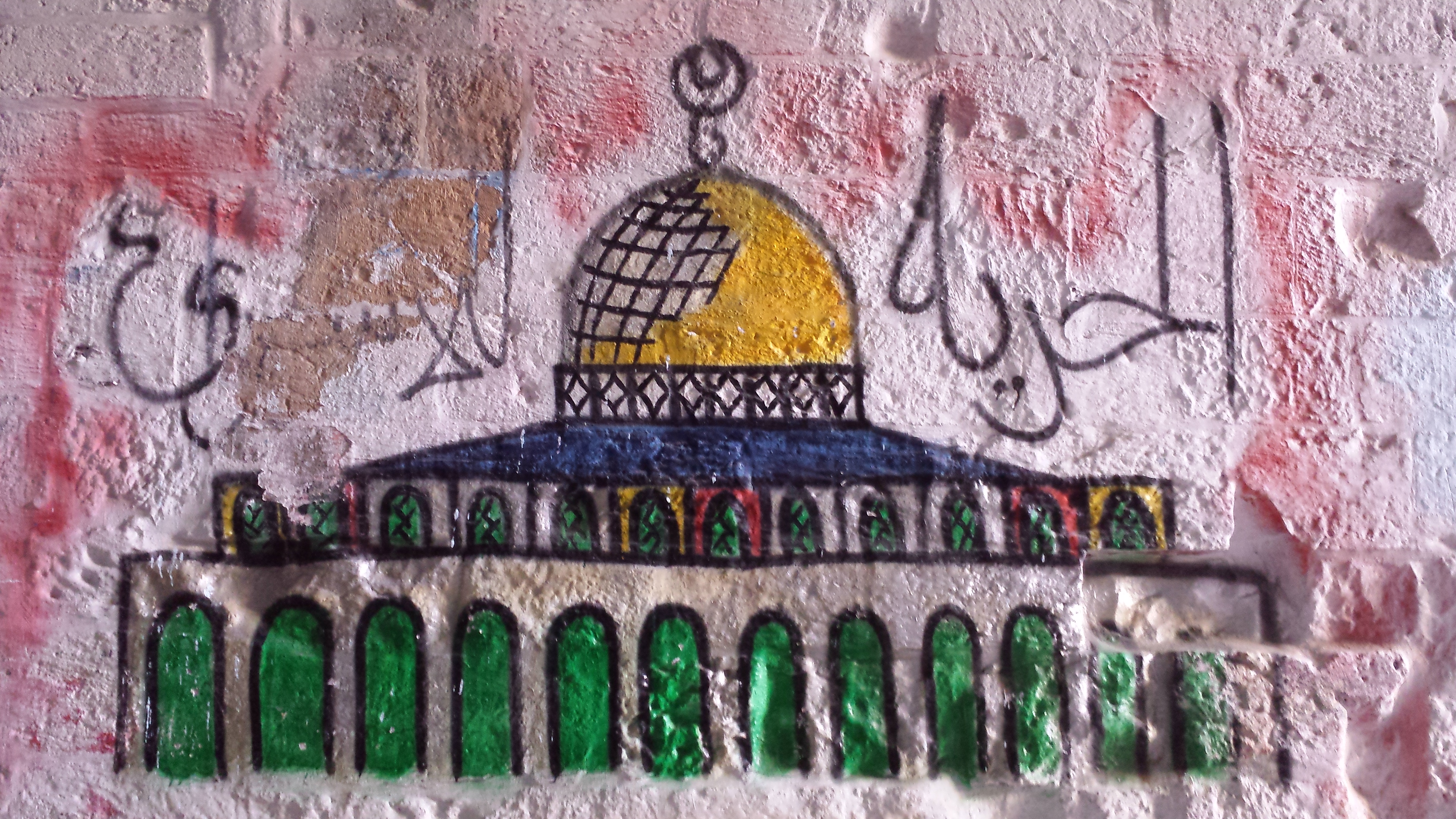
In our tradition, masks of the Spirit People have some traits in common, which is how you can tell that they are sacred texts and Creator stories. The central face of the mask is a familiar animal, one that we traditionally rely on for food or clothing – a beaver, a bird, a deer or a fish, for example. The face is then surrounded by two or three concentric hoops that are spaced apart.  The outmost hoop will have two small human hands, one protruding from each side.  The hands have holes in the center of each palm – these signify Creator’s hands. The Creator is, therefore, understood to be dressed in the animal form depicted in the center of the mask.

The hoops represent the ability that souls and Creator have to move between the spheres of the human world and the realms of the sacred. It is said that both the souls of the animals (i.e. Spirit People) and Creator observe humans to see how well animals are honored when they have been hunted and to see how well resources are distributed among the human community. If the Spirit People see that they have been treated well, they return to earth (through spiritual rebirth) in the next hunting season so that they can provide for the human community again.

Creator is responsible for the lives of all the Peoples, of the various animal and insect peoples as well as the human community. The holes in Creator’s hands employed on the mask signify divine generosity. We are to understand that while Creator holds all life in divine care,  Spirit Beings have the freedom to give their lives so that humans and other animals may live – they can choose to leave the Creator’s hold through the holes in Creator’s hands so that they can give their lives to support other Peoples.

In Shackan Native cosmology (and that of other indigenous peoples), there is a sacred collaboration or reciprocity between all beings as well as between the earthly and heavenly realms.  Creator masks tell the stories of human relationship with the divine – they speak eloquently of the sacred relationships on which we depend and of which we must take care to maintain.

In contrast to the Shackan image of God, the Christian immigrants, who came from Europe to the shores of this land, brought with them an image of Creator that was very different from ours:

Then God said, ‘Let us make humankind in our image, according to our likeness; and let them have dominion over the fish of the sea, and over the birds of the air, and over the cattle, and over all the wild animals of the earth, and over every creeping thing that creeps upon the earth.’ (Genesis 1:26)

When the ancient Israelites entered the Promised Land, they did so with varying degrees of war and assimilation of indigenous Canaanite civilizations in order to gain that land, which was no more vacant than when Europeans immigrated to the shores of this country. The Israelites and the Europeans – though separated by time and cultures – shared a common image of God as a dominating being with whom they had an exclusive contract, a relationship the quality and guarantees of which no other human community or creature could possibly have.

Over many generations and across the Native world, the legacy of the Doctrine of Discovery has brought death to indigenous peoples and societies in the form of a pyramidal cultural cosmology.  In stark contrast to a circular hoop of spiritual equality and recognition of interdependence, the pyramidal domination system is one in which God is depicted as an exclusive, entitled narcissist. It should not be surprising, therefore, that those who believed that they were created in this image of God behaved like exclusive, entitled narcissists. Unfortunately, this particular image of an elitist God seems to continue to inform social elites today.

However, I am fairly certain that the first century reform movement initiated by Jesus of Nazareth was meant to offer an alternative image of God. For example, the first thing I note about the risen Christ is that he has holes in his hands.

By the holes in his hands, Christ grants freedom and choice to all beings; he understands and respects the nature of self-sacrifice so that others may live; and like a mask of Creator, he is a being that the human community can see and touch and that can bridge the spiritual world to the human by the sustenance of his body and blood. He reconciles all of Creation to the Creator.

Is Christ not the Lord of the Dance and did he not have many stories he shared about God and heaven? Are we not called to gather around the Light of Christ, who gifted us with the Spirit – an eternal fire at the center of the Community, around which all Peoples recognize their language and way of being and are called to share of their unique expression?

From the beginning, Christ was with the Creator and came to teach people how to live in a good way, how to care for one another and not to measure their worth by things but to aspire to other values — of courage, generosity, compassion and love. This image of God is one that I recognize, for he has been with my people from the beginning of our generations.  The Europeans did not bring him to us – he was already here.

However, this image of Christ looks like us. So, perhaps it was hard for some to recognize him in our mask.  Perhaps, this truth is what many still need to discover.

Modern Yupik Dance Mask

This modern Yu’pik dance mask by Phillip John Aarnaquq Charette  shares much in common with lost masks once depicting the cultural cosmology of the interior British Columbia Shackan people

A New Spiritual Discipline of Food: Replace Fasting with Food Sovereignty

3 Comments

Organic Flowers and Vegetables

Many religious and spiritual traditions include seasons and occasions that practice abstinence from food and drink for periods of time or deferring meals until the end of the day. Fasting is often considered an important spiritual discipline, calling for mastery over one’s own will in order to make one’s self sufficiently receptive to or focused on the Sacred.

Within a faith context, humanity’s relationship with food is understood both figuratively and literally as epitomizing life’s dependence on God. As essential as breath and water, without food – without sustenance – life dies. So, when people (acting from spiritual discipline) fast from food, they are engaging an ancient trust that God will sustain them nonetheless.

In a way, fasting is a re-enactment in miniature of agricultural famine – something usually very much beyond human control. Fasting, as a spiritual humility, is actually very much within the practitioner’s control as a type of self-sacrifice offered for the sake of greater wisdom or more intimate connection with the Divine.

In actual practice, then, fasting is really only a spiritual discipline for those who have the ability to acquire food readily and eat it whenever they want. Fasting is, by definition, a choice. People who are genuinely without access to food, who suffer hunger and poor nutrition on a daily and protracted basis, don’t have that choice. They go without food, because there is no other option – there is no sustenance. Prayers go up, but no manna comes down.

The sad reality is that not only do we have issues of hunger in the United States, most of us aren’t actually eating food – healthy, natural food that can sustain our health and our world.

I propose that rather than practicing fasting (which impacts an individual life, that of the practitioner), those seeking a spiritual discipline around food make choices in consumption that will enhance the quality and freedom of all life on Earth. Eat, but eat to empower others – even other forms of life and lives in other countries.

In the global landscape of agriculture, the United States is the number one producer of both corn and soybeans. The USDA estimates that in 2014 alone, the US produced a record level of 14.4 billion bushels of corn for an average of 171.7 bushels an acre. In 2014, the US also produced a record level of 3.91 billion bushels of soybeans for an average of 46.6 bushels an acre. However, 90% of US corn production is made up of genetically modified corn, while over 95% of US soybean production is made up of genetically modified soybeans.

Sixty-four countries around the world have banned the import of Genetically Modified Organisms [GMOs] and require consumer labeling of GMOs, so that consumers have an informed choice about what they are consuming. The labeling is required, so that consumers know when they are consuming the chemicals that are genetically bonded to genetically modified corn and soy, which cause the crops to be pest resistant. Additionally, over 99% of GMO acreage is engineered by chemical companies to tolerate heavy herbicide (glyphosate) use and/or produce insecticide (Bt) in every cell of every plant over the entire growing season.

GMO systemic insecticides include neonicotinoids (neonics) which are extremely powerful neurotoxins that destroy non-target pollinators and wildlife such as bees, butterflies and birds. Two neonics in widespread use in the U.S. are currently banned in the EU because of their suspected link to Colony Collapse Disorder in bees, while ever-increasing amounts of older much more toxic herbicides like 2,4 D and Dicamba are being sprayed on GMO crops in the US, along with huge volumes of Glyphosate to deal with the superweeds which have arisen and are GMO resistant.

The main chemical companies involved in GMO production are the US firms Monsanto, DuPont/Pioneer and Dow Chemical, as well as Germany’s Bayer and Syngenta of Switzerland. Also, the Rockefeller Foundation is heavily invested in genetically modified organisms, having created the ‘gene revolution’ with over $100 million invested in GM science since the 1970’s.

Unfortunately, genetically modified corn and soy are not only involved in direct human consumption, they are included in the majority of livestock and poultry feed in the US. Additionally, 60-70 percent of processed foods have ingredients derived from GMOs. It’s no accident that each of the chemical companies listed above are stakeholders in multiple grocery manufacturers that produce the vast majority of processed foods, household cleaners and personal cleaning products on the market.

In order to better control non-GMO competitors in the market place, the big players have bought up conventional/heritage seed companies. For public sector breeders, who used to produce most of the seeds that farmers used, government funding has been reduced under the pressure of powerful GMO lobby interests. Furthermore, cross-pollination of conventional fields by GMO strains has become so widespread it is difficult to produce “pure” seeds that are not contaminated. Farmers whose conventional crops have been accidentally crosspollinated with nearby GMO fields are taken to court by Monsanto for violating proprietary laws, while the farmer’s crops are burned.

The problem of GMO crosspollination is so bad, that Bill Gates is spending $30 million in a remote island called Svalbard (located approximately 1,100 kilometers from the North Pole) to build a heritage seed bank. Corporate moguls such as the Rockefeller Foundation, the Monsanto Corporation, the Government of Norway, the Syngenta Foundation, and Dupont/Pioneer are building a ‘doomsday seed bank’ officially named the Svalbard Global Seed Vault on the Norwegian island of Spitsbergen, part of the Svalbard island group.

Ostensibly, these groups are saying that they want to assure that, “the genetic diversity of the world’s food crops is preserved for future generations.” I can’t help but wonder exactly which parts of whose populations will benefit from the seed lockers of the wealthy and those who have profiteered from the environmental Armageddon they created.

In her seminal work, Silent Spring (1962), Rachel Carson wrote, “A Who’s Who of pesticides is therefore of concern to us all. If we are going to live so intimately with these chemicals eating and drinking them, taking them into the very marrow of our bones – we had better know something about their nature and their power.”

Writing thirty years prior to the US dominance of GMOs, Carson seems to have anticipated the use of the herbicidal chemicals developed for war time use on the jungles of Vietnam as they would be applied to domestic agriculture. Her plea for environmental stewardship remains a clarion call for those in the trenches struggling for food sovereignty.

Last month the Grocery Manufacturers Association (working in partnership with GM producers) attempted to block a GMO labelling law passed in the State of Vermont, on the heels of Governor Peter Shumlin signing Act 120 into a law last year. The lawsuit has not been successful so far, however, and the Vermont label law is set to go into effect on July 1, 2016.

In the face of corporate monopolies of food production and the use of chemically laced genetically modified foods, the grassroots efforts of the non-GMO consumer awareness campaign called ‘The Non-GMO Project’ is supported by the US Organic Consumer Association. A new generation of young farmers is committed to growing heritage crops (non-GMO) through organic and sustainable farming practices, while a new breed of ranchers are feeding herds and flocks with non-GMO feed in humane settings.

A global organization called the International Planning Committee for Food Sovereignty (IPC) is an autonomous and self-organized global platform of small-scale food producers and rural workers. Their organizations and grass root/community based social movements are dedicated to advancing the Food Sovereignty agenda at the global and regional levels. More than 800 organizations and 300 millions of small-scale food producers self-organize themselves through the IPC, supported by several non-governmental organizations (NGOs).

The most important action that any individual can take in response to agri-corporations attempting to control global food production (especially in the poorest countries) is to take personal steps towards becoming less dependent on GMO foods. In effect, hit them with your pocketbook by buying organic.

Here are some consumer tips for shopping and eating in support of food sovereignty:

• Pay the extra money for foods that are Certified Organic in your local grocery stores: your dollars will go towards sustainable practices, and that’s the goal – Certified Organic foods are also non-GMO, though they might not always have the Non-GMO project label because they may simply not be participating in that campaign
• Look for foods with the Non-GMO Project label, which means those products are organic
• Become familiar with the processed foods that contain GMOs, such as Nabisco, Kellogs, Proctor & Gamble, and Unilever – if a product has soy or corn syrup in it and it doesn’t have an organic or non-GMO label, then it’s probably derived from domestic GMO soy or corn.
• Check out your local food coops, farm stands and farmers markets for organic foods and products
• Shop and eat locally to minimize the production process of your food
• If you eat out, research for restaurants that specialize in organic foods – even some chain restaurants like Chipotle’s are serving non-GMO foods
• Engage in your own food sovereignty project by turning your lawn into an organic vegetable patch of heritage seed producing crops that are pollinator friendly
• Participate in community gardens and hunger-reduction community feeding programs that strive to provide nutritional organic meals to those in need
• If you contribute food stuffs to community pantries, be sure to purchase non-GMO options for those who cannot afford to purchase those on their own
• Write to your congressional representatives, if they are pro-Monsanto or pro-GMO
• Put pressure on your local stores that sell pesticides with glyphosate and other neotnic toxins (such as are in “Round Up”) that kill pollinators
• Work with non-chemical fertilizers and pest control options in your garden
• If you live in the city, consider becoming an urban bee keeper or create an organic vegetable container garden
• If you eat meat, buy grass-fed non-GMO beef, and non-GMO organic poultry. Avoid farmed salmon, and buy dairy and eggs that are certified organic
• If you keep a flower or vegetable garden, research local seed-saving programs where you can shop and contribute to cooperative reserves of heritage seeds. Purchase organic, non-GMO seeds and grains.
• If you keep a few chickens in your yard or goats, provide them with non-GMO feeds and grains in order to avoid GMO chemicals in your eggs, milk and meat.

Below are some key websites for obtaining information that may be of help to you as you turn your personal fasting into a spiritual discipline of food sovereignty:

https://www.organicconsumers.org/campaigns/millions-against-monsanto – This is the website of the Organic Consumers Association, the organization that launched the Millions Against Monsanto effort to challenge the strong corporate lobby and food production control of Monsanto and its partner organization in charge of consumer food distribution, the Grocery Manufacturers Association [GMA]. Both Monsanto and GMA are insidious corporations, whose demonstrable and detrimental role and impact on environment and food production of which most consumers are unaware. The Organic consumers Association website provides several useful links, including information about the nature of GMOs and the actions and history of Monsanto. Any product made by Round Up, for example, contains a chemical called “glyphosate” engineered by Monsanto and singularly responsible for the destruction of whole colonies of pollinating insects including Monarch butterflies and honey bees. The benefit to destroying pollinators for Monsanto is to make food growers reliant on genetically modified seed that is incapable of producing viable seed such that the consumer must purchase new seed every growing season.

http://www.rareseeds.com/resources/non-hybrid/ – This is one of several websites, and a good one, dedicated to maintaining organic, non-GMO and naturally pollinated seeds through seed saving programs which assure non-hybrid organisms (plants that have not been crossed with GMO organisms).

http://www.nongmoproject.org/find-non-gmo/search-participating-products/ – This website is the home of the Non-GMO project, providing links to non-GMO consumer products – everything from bread and cereal to wines and beer, frozen foods and baby food, skin cream and shampoo.

http://gmo-awareness.com/shopping-list/ – This website contains both lists of non-GMO food products but also provides links to GMO food products to avoid when shopping, many of which are very popular food brands. What is challenging about shopping non-GMO is that many products include oils or sugars which are made from genetically modified organisms. The problem about genetically modified organisms is that food-based GMO additives are bonded to pesticide chemicals such as glyphosate. When consumers eat GMO products or put them on their skin and in the environment in an ongoing way, toxic chemicals are able to build genetically modified bonds within our organic system (our bodies) – the root cause of many types of cancers, diseases associated with hormone imbalances, fatal allergies, as well as fatigue and depression. The effects of long-term exposure to human life are currently being documented, and the early results are genuinely horrific. GMO’s and glyphosate products have been banned in countries on every continent of the globe, including the UK, all of Scandinavia, Germany and New Zealand. For more on what countries are doing to ban GMO’s, go to http://www.gmo-free-regions.org/

The topics of food democracy and ecologically healthy food production are real passions of mine, so I hope that I’ve been helpful in providing you with resources for more information. Whether you want to plant healthy non-GMO seed in your garden or buy organic non-GMO milk to go with your organic non-GMO breakfast cereal, these websites can guide you. Our collective hope is in the efforts of organizations like the Organic Consumers Association and in our young people, a new generation of young adults who are feeling called to organic and sustainable farming.

Humanity’s choices on this earth ought not to be between eating and hunger but between what gives life to the few and what gives life to all. As Rachel Carson knew, “In nature, nothing exists alone.” Certainly, whatever our faith traditions, God has shown us this as well.

The Bus Ride to Sheol

Leave a comment

Efrat 2

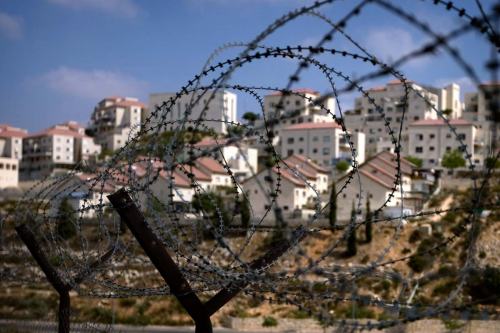
[January 26, 2015 – Middle East Monitor]. The Israeli government has approved the expansion of Efrat settlement near Bethlehem, a report in Israeli newspaper Haaretz today revealed. PM Netanyahu had previously shelved a plan to build on ‘Eitam Hill’ after international outcry following an announcement in November 2013. However, last October, the Housing and Construction Ministry allocated 850,000 shekels for the purposes of planning construction on a slope located east of Efrat and close to the southern edge of Bethlehem. The paper described the area as “a strategic target of settlers for the past decade.” Last week, Israeli forces destroyed a Palestinian wheat field at the site, which they described as ‘state land’.

Our Israeli Arab Christian bus driver, Nael, slowly navigated the winding road up into the hill country of Jewish settlements on the West Bank. Bruce, a late middle-aged American Jew who had immigrated to Israel, spoke in terms of justification with a plaintive tone as he narrated over the bus’ sound system. We had headed south, between Hebron and Bethlehem, to the Jewish settlements of Tekoa (338 acres, and 1808 people, established in 1977) and Efrat (568 acres, 7454 settlers, established in 1980). Bruce was at the microphone.

“The media, with their agenda of spin, calls these ‘settlements,’” he shared, “but what they are is neighborhoods, just like any you’d see in the states, and they don’t call THOSE settlements – they’re neighborhoods! They’re suburbs! “

As we came to the check point entrance of what Bruce referred to as his “gated community,” armed Israeli guards asked Bruce a few questions in Hebrew. At certain locations on the West Bank (such as the Gush Etzion Bloc where we were), a particular Israeli Defense Forces (IDF) regulation applies.  Namely,  an armed guard must accompany Palestinian workers who enter the area, who live in the West Bank. Many of the workers who came to work in what Bruce called “Jewish Tekoa,” for example, lived in nearby “Arab Tekoa.” Bruce told us that he stopped into the small grocery store in Arab Tekoa from time to time – “They have good food, and the people are as nice as you’d expect to find anywhere, really.”

Though the IDF regulation did not apply in the case of our tour bus, Bruce was armed.  As an Israeli citizen qualified as a security guard,  he referred to  himself as one of the many “Jews with guns” in his Jewish neighborhood whom Palestinian workers would call from the security gate to ask for armed escort into the area to work, in compliance with the IDF regulation.

As our bus pulled away from the checkpoint and continued its journey, Bruce assured us how wearing a gun was essential in order to provide West Bank Palestinians  with work opportunities in his town – building Jewish homes, keeping their gardens and lawns, and cleaning their homes. “We love Arabs,” Bruce gleamed, “The majority of them are really fine people. Every group has people in it that want to do harm, though. So, it’s also a security issue.”

One of our pilgrims respectfully challenged the idea that all groups have those who intend to do harm, that we were a bus load of Episcopalians and a group ourselves (and wasn’t he being a little paranoid?). Bruce responded, “Thank you for reminding me that I’d better carry a gun whenever I’m with a group of Episcopalians.”

As my gut churned, I tried to focus on the landscape of the hill country passing along outside my bus window. Semi-nomadic Bedouins had once roamed the area freely, finding pasture for herds of goats and sheep, but (we learned from an earlier presentation) they were now relegated to a category of land that the Israeli army uses as firing ranges. Palestinian families, for whom the area had been home to ancestral olive groves, grape arbors and grain crops have experienced their trees chopped down and crops burned, as recently as last fall (2014) and last week (January 2015).

As I contemplated these things, trying to tune out Bruce’s ongoing narrative, the words he was currently speaking arced into my consciousness and pierced my heart, “We only build where there isn’t anything. It’s just wilderness here.”

My mind began to reel in that instant, as I recalled exactly this sentiment expressed in numerous journals and legal documents of those who colonized North America. “It’s just wilderness here – no one lives here. There was no civilization here before we came. It is God’s will that we occupy this land. These people will behave in a civilized fashion, or they will die.”

I realized that what I was hearing from Bruce was exactly the same ideological narrative that my great-grandparents encountered in the European invasion of interior British Columbia – when their people, the Shackan, had their land and resources stripped from them because all the settlers saw was “wilderness.” And Natives were a part of that wilderness, just another resource to either exploit or destroy as being in the way of real progress.

Suddenly, in my mind, I was no longer on the bus. I was reviewing once again the emotional legacy of the First Nation’s part of my family, a heritage mostly of loss. The precious bits of it, through stories and rare items, are preserved in my identity as surely as mayflies in amber. In my blood and bones, I knew how Bruce’s story would end and the role that he would play in that story for the Palestinian people of the West Bank.

I felt nauseous, sick in body and spirit. Grief overwhelmed me to such an extent that I was embarrassed by my tears and hid them from my bus mates by staring fiercely out my window. I thought of my mother and grandmother and on how they taught me that pain ought to be born in silence, without attention to the self. I could no longer hear what Bruce was saying, I was so occupied in gaining control of my feelings. However, I’ve never been especially good at maintaining that particular cultural value, especially (ironically) with regard to my Native identity and heritage.

I was surprised when the bus finally came to a stop in front of the house we had come to visit. However, because its owner, our host, had been out on a nature walk with her children, she was not home when we initially arrived, so Bruce guided our bus to the home of his ex-wife so that we could see the wind turbine roof he had designed there.

He praised the greening initiatives of his community and told us how the construction of 277 homes on a third hill in Efrat had been approved by the Israeli government as a reaction to the UNESCO’s accepting Palestine as a full member. Bruce blamed President Obama for making the Arabs work harder by having to complete the homes faster, after the US had asked for a moratorium on Israeli building in the West Bank.

When our host was finally back at her home, we returned so that we could hear more about the Israeli settler perspective. However, Bruce had told us earlier, “I don’t like the term ‘settler.’ It sounds like the American Old West idea of cowboys and Indians, as though we are somehow the cowboys invading the land and the Palestinians are the Indians. Nothing could be further from the truth! We are the Indians! We are the Indians! This is our land, and others are trying to take it from us!”

I didn’t want to get off the bus.

Mostly, I didn’t want to get off the bus, because I didn’t really want to be bawling my eyes out in front of our Jewish hosts – I didn’t want to explain myself or talk about it, nor did I think I could take on any additional interaction that would add to my emotional load. So, I asked one of group, Jesse Junior, to please go get my bishop, The Rt. Rev. Greg Rickel, who had already disembarked.

I don’t know what I wanted of him other than to explain or excuse my absence…or maybe, simply to grab on to someone and scream, “This is horse shit!” Maybe I just wanted someone to hear my tree falling in the woods.

Moments were passing, and I was the last one on the bus. I felt ridiculous and ashamed…and alone. Except there was Nael, the bus driver, who I felt even worse for than my own self, Nael having to hear and silently bear all that Bruce was saying, but having it all directed at Nael’s race.

I shook my head of tears like a sheep dog of rain water and determinedly pulled myself together. I put my face into what I hoped was a neutral setting and got off the bus. Once across the street, however, I met Bishop Greg coming out of the house towards me. I turned away from the house front, and he put an arm around my shoulders. My hastily gathered reserve gave way with equal haste.

“I’m not sure I can do this,” I confessed, “This is so horrible. It’s exactly the same. It’s exactly the same…” That’s all I could get out.

“You don’t have to do this, you know. I can…or maybe I can’t imagine…what you must be going through. You can get back on the bus, if you need to. It’s okay,” He assured me.

As I looked up hopefully, the bus drove away.

There seemed no escape, then, and I suppose the spiritually inclined part of my brain decided that God must have put me in this “opportunity” for a reason. So, then, in the next instant, I suppose that I resolved to enter into the experience fully (though I had been resisting it with every fiber of my being).

I wiped my face, set my jaw, and we went into the house. I stayed unmoving, like a wooden Indian, just inside the front door.

Our group had crowded into our hostess’ living room. Her two teenage children stood in the kitchen. She said that her husband was in their home office working on a computer problem. He never did come out while we were there. We were offered water, and Bishop Greg got some for me.

Our hostess, like the other adults we had seen in Bruce’s community, was packing heat. The handle of a handgun bulged beneath the waistline of her blowsy shirt.

She talked about her time living in California and the call she felt to immigrate to Israel and live in a settlement on the West Bank. “I like being here and wanted to raise my children here. I think anyone should be able to live wherever they want to live,” she said. By that point in our tour, I was pretty sure that she didn’t really mean anyone.

Like Bruce had before her, she spoke of the land she was on as her ancestral home, the “home of her fathers,” the place that both God and the European community (in 1948 and 1967) had promised would be the Jewish homeland.

In the household in which I had been raised, the term “Zionist” was considered impolite, and I was taught that one did not use it to apply to Jewish people. My parents considered the term to be pejorative, I think, and thereby contributing to negative and racist stereotypes. Imagine my shock, then, to hear our hosts self-describe as Zionists; to hear members of our pilgrim group apply the term openly and freely to both certain types of Jews and certain types of Christians.

Wikipedia describes Zionism as, “A nationalist and political movement of Jews and Jewish culture that supports the reestablishment of a Jewish homeland in the territory defined as the historic Land of Israel (also referred to as Palestine, Canaan or the Holy Land).” Certain evangelical Christian groups also see the return of Jews to Palestine as signaling the End Times and the return of the Messiah, so they encourage the occupation as well.

And that’s what it really is; It’s not a movement of religion, but unlawful occupation by a state, the State of Israel – an emerging nation engaging in the genocide of peoples, the destruction of homes and the appropriation of land and resources in order to create a civilization where some seem to believe none had previously existed. In such instances, religion is just a useful justification of racist crimes against humanity within a theological cosmology that judges who is among the elect and who is disposable. In short, it is colonialism.

After our time in Efrat, we went on to visit with an American Jewish lawyer.  He came onto the bus, as the engine idled outside of his home, and talked about his work in land claims. At various times in his career, he represented both Israeli and Palestinian land claims.  He did not see any way that the current situation could improve. His own desire was that all Palestinians should be removed to Iraq or Iran, “Where they can be with their own people – Muslims and Arabs.”

One of our group asked how he could reconcile representing both Israelis and Arabs in land claims, when it was clear that he believed that Palestinians have no legitimate claim.  The lawyer raised his voice indignantly, “Lawyers represent criminals all the time. It’s our job.”

What I learned from our pilgrimage visit to the Jewish settlements and from listening to both Israelis and Palestinians who are struggling against occupation and for a solution of peace and justice is that: 1) my concerns around Israeli claims of indigeneity have been in discussion among activists and legal/political circles for decades and 2) our government is complicit in supporting exactly what’s taking place – we are in great part funding the Separation Wall that has turned the West Bank into a very large prison, and we are funding the arms of the soldiers who guard it. Meanwhile, our aid agencies are funding some of the food and medicine which gets into the West Bank.

A powerful Jewish lobby interest in the United States, known as America’s Pro-Israel Lobby (AIPAC), is funding the election campaigns of many of our congressional representatives. To go against AIPAC is to risk much, including being labeled as anti-Semitic.

However, as Rami Elhanan (one of our Israeli Jewish pilgrimage speakers) said, “Go home and tell your people that being pro-Palestine is not being anti-Semitic.”

Or, as Hanan Ashwari (a member of the Palestinian National Council and an Anglican Christian) said in our meeting with her, “The critique is not of a religion but of the actions of a state.”

The political landscape of Israel is like traveling a winding bus route through time and history. We see the impact on the land and people of the colonial powers of Britain, modern Europe and the United States. Ashwari looks to the global community for restraint of Israel and support of Palestine. She gazes intently at the land of her people through a window of war and a veil of tears. She still hopes that her colonizers will come to her aid, even as I called out for my bishop to support me. For, make no mistake, he represents the faith of a colonizing power. Yet, I think her hope – and mine – is not misplaced.

Ultimately, we are – all of us – on the bus.

Where we go from here is truly up to us.
Henry Goes to the Holy Land – Day 10, The Last Day to Home

Leave a comment

January 22, 2015

Our final morning in Israel began with a quick drive to Abu Ghosh, a town about six miles west of Jerusalem that is (one of many) locations believed to be the site of the first century town of Emmaus. Abu Ghosh is one of the earliest areas of human habitation in Israel, with archaeological remains of three Neolithic settlement phases, the middle phase is dated to the 7th millennium BCE.  It is also the sight associated with the location of the Arc of the Covenant, which King David later moved to Jerusalem. If this is the sight of Emmaus, it lends a nice symmetry to the traveling nature of the Spirit of God as on the move and meeting people where they are.

Met a friend at the Crusader church in Abu Ghosh

Met a friend at the Crusader church in Abu Ghosh

The Crusader Church of the Resurrection in Abu Ghosh was built in 1142 as a French monastic community of monks and nuns following the Benedictine rule. Our Pilgrim group was fortunate to have the opportunity to have our final Eucharist in this beautiful space, the walls of which are filled with the remnants of frescoes that were mainly destroyed by Muslims who took over the area after victory over the Christian Crusaders.

Crusader church in Abu Ghosh

Crusader church in Abu Ghosh

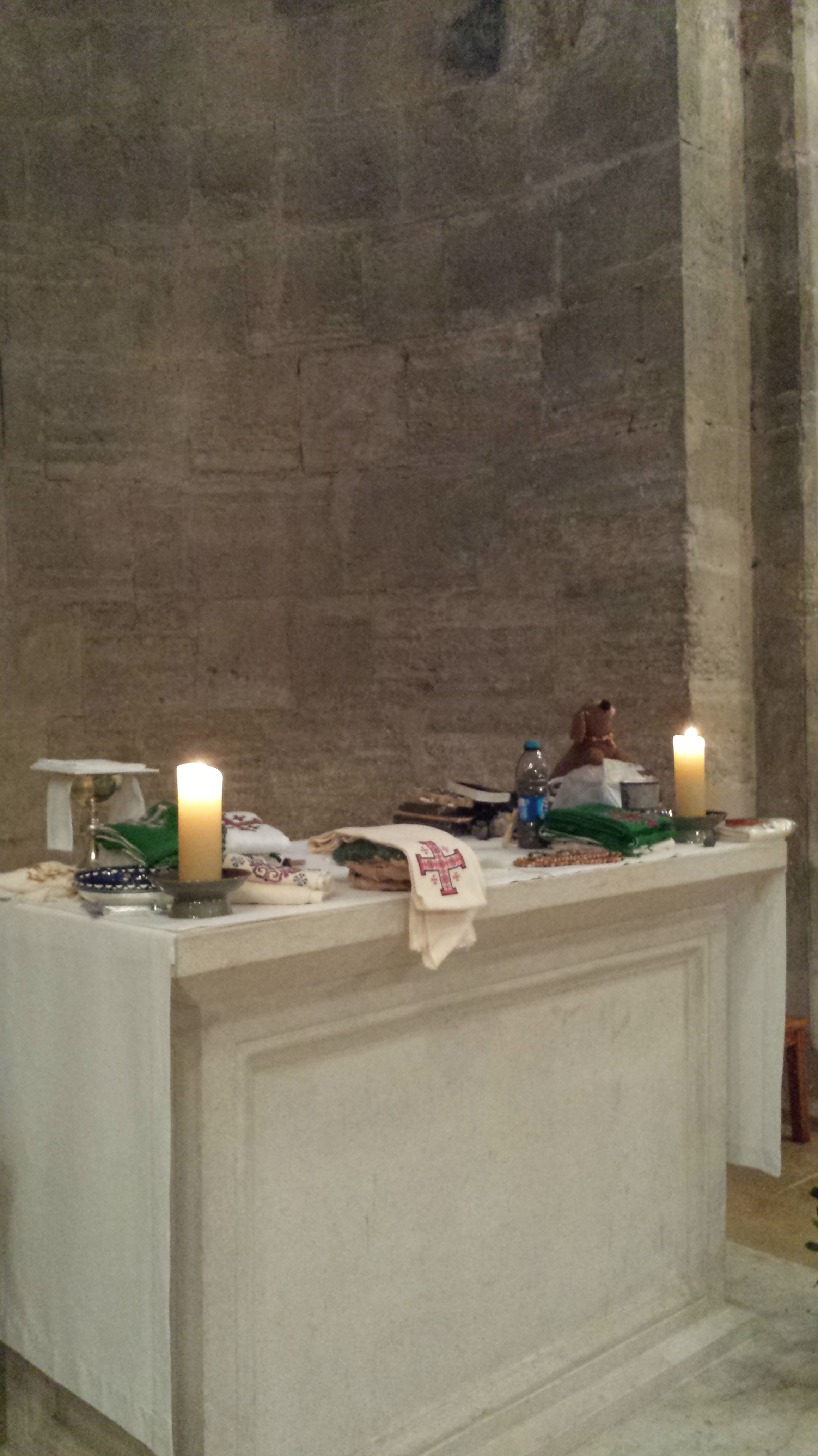
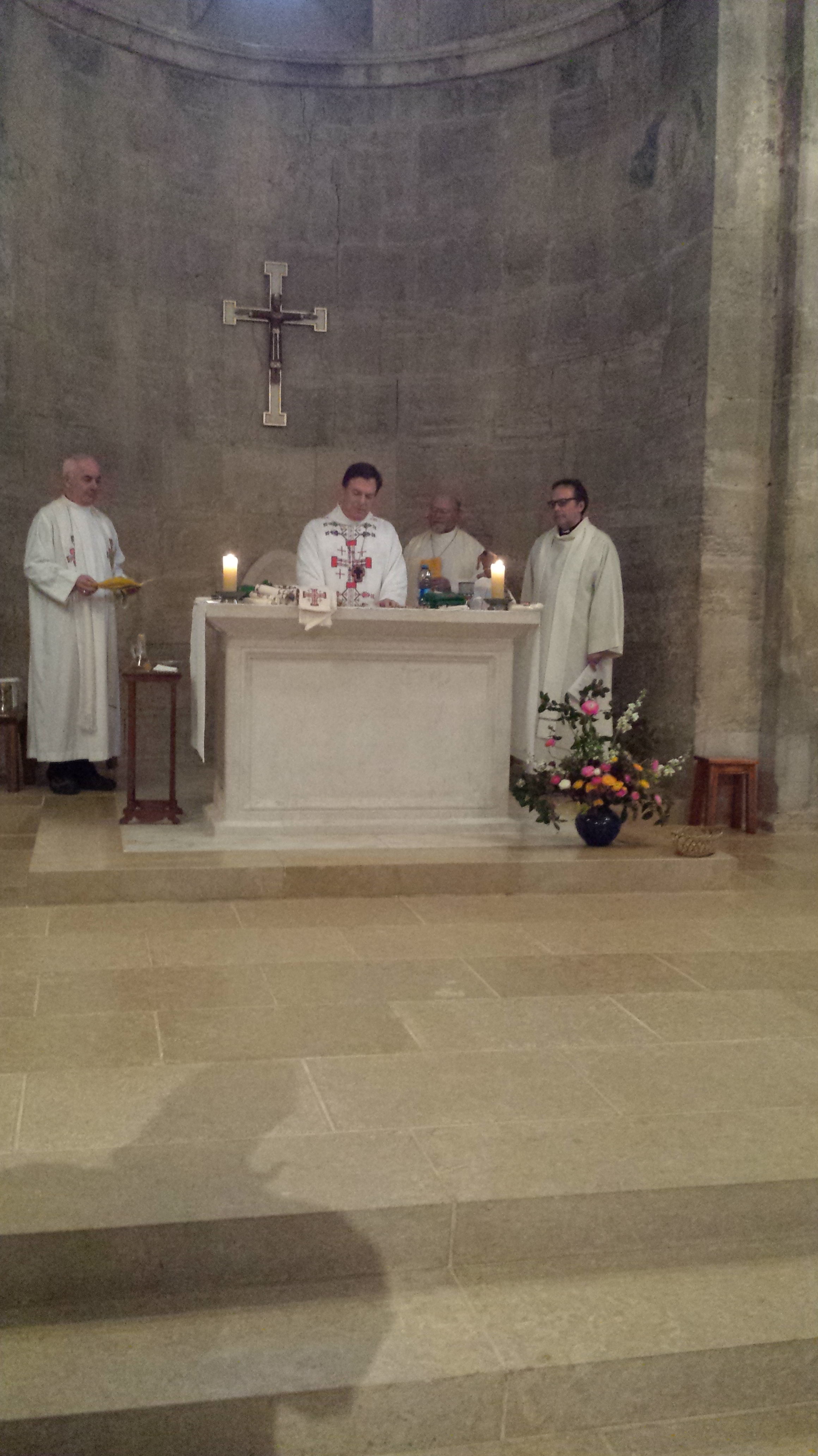
We have had wonderful sermons, hymns and worship throughout our journey in the Holy Land, and this service was especially meaningful. We gathered together items we wanted to have blessed and placed the on the altar.  Bishop Greg presided, with Bishop Barry preaching and Dominic and Paul (our stunning guides from Lightline) assisting. Our local guide from Shepherd Tours, Ghassan, also worshiped with us.

Our Pilgrim items on the altar to be blessed

Our Pilgrim items on the altar to be blessed

Our service at Emmaus

Our service at Emmaus

Immediately following the fine service, the women of our group gathered around the altar, laid hands upon it, and offered prayers on behalf of women – in Israel, Palestine, at home and around the world. Because of the nature of the Christian churches here, even in the Anglican Diocese of Jerusalem, women priests are not permitted to preside at most altars in the Holy Land.  This was especially evidenced by the fact that at no time did a woman clergy person preside or assist at any of our Eucharistic services in any of the places we worshiped. If Rachel takes a group on pilgrimage to the Holy Land, she will need to bring along a token male clergy person in order to gain entrance into many of the altars here – including this one at Abu Ghosh.

Fresco of Mary in the church

Fresco of Mary in the church

After the women’s heartfelt prayers (given with many tears), one of the bishops remarked that we were “lucky” that one of the local priests didn’t walk by to see it. You can perhaps imagine the women’s response to that concern. We felt it was more that the men didn’t want us to jeopardize their future ability to use the space. And here we are being asked by them to stand up for justice for the people and faiths of this country when they are hesitant enough to stand up for justice for the women of their own countries and church. Ah, well, we were glad to be at Abu Ghosh, nonetheless.

Frescoes in the nave arch

Frescoes in the nave arch

20150122_095244

Above the altar

20150122_110947

20150122_111108

Organ

Organ

Chapel under croft

Chapel under croft

Under croft shrine to Mary

Under croft shrine to Mary

It was a wonderful way to formally conclude our Pilgrimage before heading back to Jerusalem for lunch and exploration on our own until departing for dinner and the airport in the evening.

Last visit to the Holy Sepulcher, the Sepulcher itself - a shrine to the tomb of Jesus called the aeticule

Last visit to the Holy Sepulcher, the Sepulcher itself – a shrine to the tomb of Jesus called the Aedicule

The back exterior of the Aedicule being incensed by a Greek Orthodox priest

The back exterior of the Aedicule being incensed by a Greek Orthodox priest

Inside the Aedicule

Inside the Aedicule

Looking out from the interior of the Aedicule

Looking out from the interior of the Aedicule

Front exterior - it is common for Pilgrims to light candles at the Aedicule and then quickly extinguish them to take home for personal devotions

Front exterior – it is common for Pilgrims to light candles at the Aedicule and then quickly extinguish them to take home for personal devotions

Prayer tapers left by Pilgrims line the exterior of the Aedicule, illuminating the shrine

Prayer tapers left by Pilgrims line the exterior of the Aedicule, illuminating the shrine

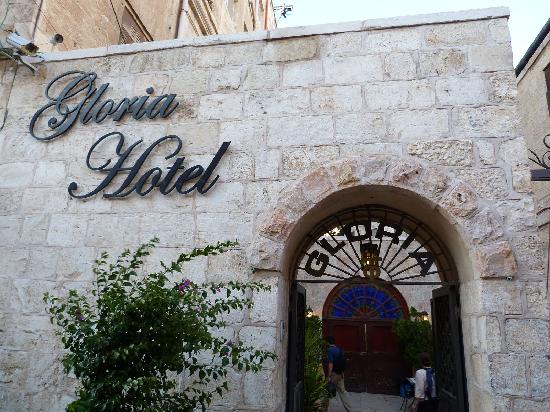
Rachel, Sarah and I had pizza in a shop near the Gloria Hotel and then headed into the suk for last bit of shopping and to go once more to the Church of the Holy Sepulcher. Then we hiked towards the Damascus Gate and had a last drink of freshly squeezed pomegranate juice before going out of the Old City and up Nablus Street to St.George’s College.

Shopping in the suk

Shopping in the suk

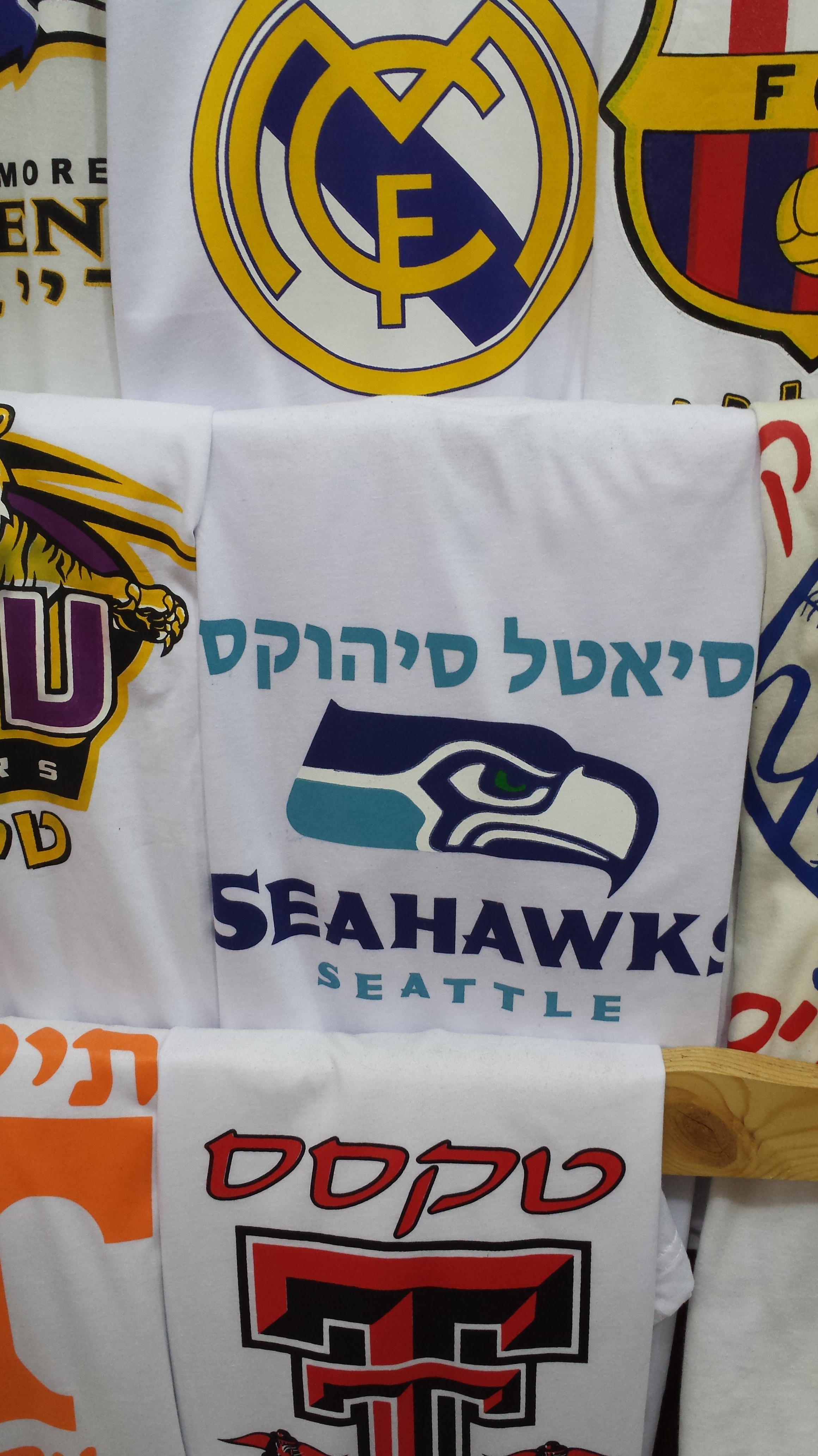
From Jerusalem - Go Hawks!

From Jerusalem – Go Hawks!

One last pomegranate juice in the suk, with Palestinian police in the background

One last pomegranate juice in the suk, with armed Palestinian police in the background

Rachel’s purpose was to visit the shop of Abraham, located just outside the college gateway.  She selected a beautiful pectoral cross there while Sarah went to the cathedral once more.  After that visit, they parted ways so that Rachel could meet up with a friend and possible cousin met through Facebook.

Kate Taber and Rachel Taber-Hamilton

Kate Taber and Rachel Taber-Hamilton

Kate Taber is a Presbyterian missioner representing that denominations efforts in peacemaking and partnerships between Israel and Palestine. Her husband, Nathan Stock, is the Director of the Carter Center in Jerusalem. Rachel and Kate met up at the Notre Dame Hotel for coffee in the cafe there.  They were able to talk for about an hour before Rachel and me had to walk the five minutes up from the New Gate to the Jaffa Gate to meet our bus one last time. I’m glad to know more friends there, and I hope we get to return to visit again.

Church of the Holy Sepulcher

Church of the Holy Sepulcher

Our bus driver, Nihal, took us the two hours to Jaffa, where we had our last dinner together as a Pilgrim group before going to the airport.  The Tel Aviv airport is very security driven – our bus was inspected, and once inside, we had four additional check points that required our passports before even getting to our gates.

Our twelve hour flight to Newark was without incident, and a small group of us from Olympia waited for our common plane to Seattle – Sarah, Michael, Katherine, Cynthia, Rachel and me all boarded on time four our four hour flight to the west coast.

Once home, Rachel’s and my good friends, Becky and Tom Clark, brought Rachel’s car to the airport so that we could drive to Whidbey directly from there – a final ferry ride and we were home to cats, dogs and husband.

Our Pilgrim group at Dominus Flevit - where Jesus wept and prayed for Jerusalem

Our Pilgrim group at Dominus Flevit – where Jesus wept and prayed for Jerusalem

Though we have unpacked our luggage, I think we will be unpacking our hearts and minds from this trip for a very long time (as well as sorting through the many gifts physical, emotional and spiritual that we have brought back with us).

Our pilgrimage was an amazing journey, supported by an amazing team of organizers and guides who made the experience extraordinary in depth of information, breadth of opportunity and in quality of worship. We were blessed a hundred times over by the people we met and who cared for us, guiding us through barriers and obstacles to view the riches of their faith, heritage and country – which is to say, their people.

Ghassan and Nihal

Ghassan (our Guide) and Nihal (our Driver) – both Palestinian Christians and very dear people.

I will treasure it all and will pray for them all for as long as I live. I will be and am grateful.

Peace and Blessings to my beloved squirrels – now and always!

Henry

squirrel blessing to you

Henry Goes to the Holy Land – Day 9

Leave a comment

January 21, 2015

Today was an early start so that our group could get up to the Temple Mount. While the Western Wall (or “Wailing Wall”) is in the jurisdiction of Israel, the Temple Mount is under Palestinian control. This means that pilgrims going up to the mount must walk through an Israeli check point much like an airport security screening. No weapons or Christian (or Jewish) prayer books or bibles are permitted on the Temple Mount. No Christian symbols, such as crosses, should be visible.

Our Pilgrim group in front of the Dome of the Rock, Temple Mount

Our Pilgrim group in front of the Dome of the Rock, Temple Mount

After crossing through the check point, we stopped under a tree for an orientation presentation by Ghustan. The Temple Mount is one of the most important religious sites in Old Jerusalem. It is venerated by Judaism, Islam and Christianity. Jewish cosmology says this is the place from which all the rest of the earth was expanded or made by God – it is, quite literally, the center of their universe. Jewish tradition and Scripture identify it as the place (Mt. Mariah) where Abraham was willing to sacrifice Isaac. Among Muslims, it is considered the third most holy site in Islam and is revered as the Holy Sanctuary where Mohammed mystically journeyed to Jerusalem on a winged horse of lightening before ascending into heaven. Christians know it as the location of the first and second temples, the latter being the temple Jesus knew in his lifetime – where he was presented as a child, where he turned over the tables of money changers just prior to his death.

Looking towards the crusader stable, Temple Mount

Looking towards the ancient archway, Temple Mount

20150121_081824

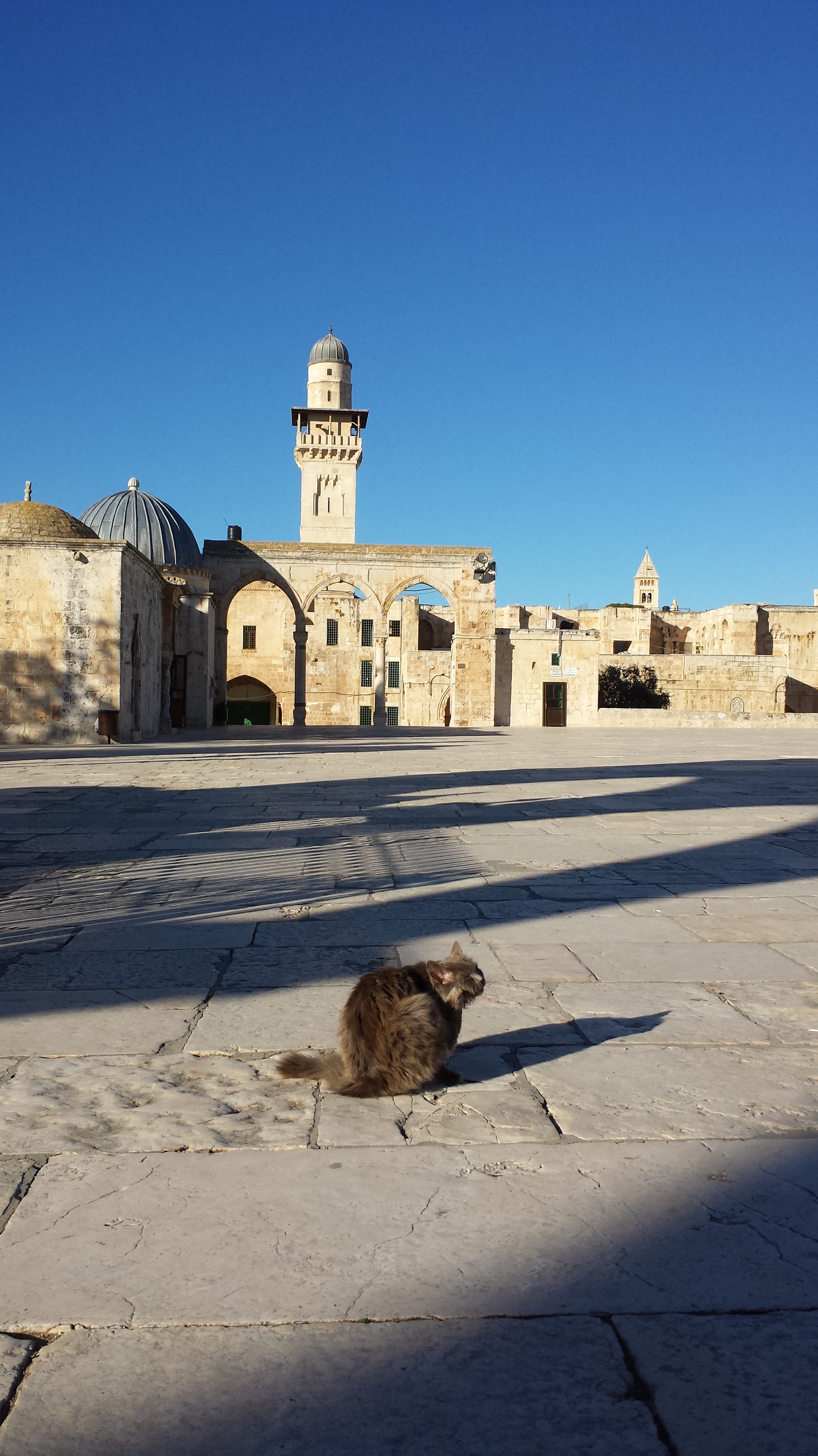
More cats

The First Temple Period is associated with King Solomon, who is said to have built the Temple at this location in 957BC and subsequently destroyed by the Babylonians in 586 BC. The Second Temple was constructed between 538-516 BC, expanded by Herod the Great in 19 BC. The Second Temple was an economic center as well as a religious one. The construction of the al-Aqsa Mosque and Dome of the Rock occurred after the Muslim conquest of Jerusalem in 637 CE. Completed in 693 CE, The Dome is one of the oldest Muslim structures in the world. Its sanctuary covers a large exposed expanse of rock, beneath which is a cave known as the Well of Souls. However, no non-Muslims are currently permitted to enter the mosques here.

Temple precinct

Temple precinct

20150121_081918

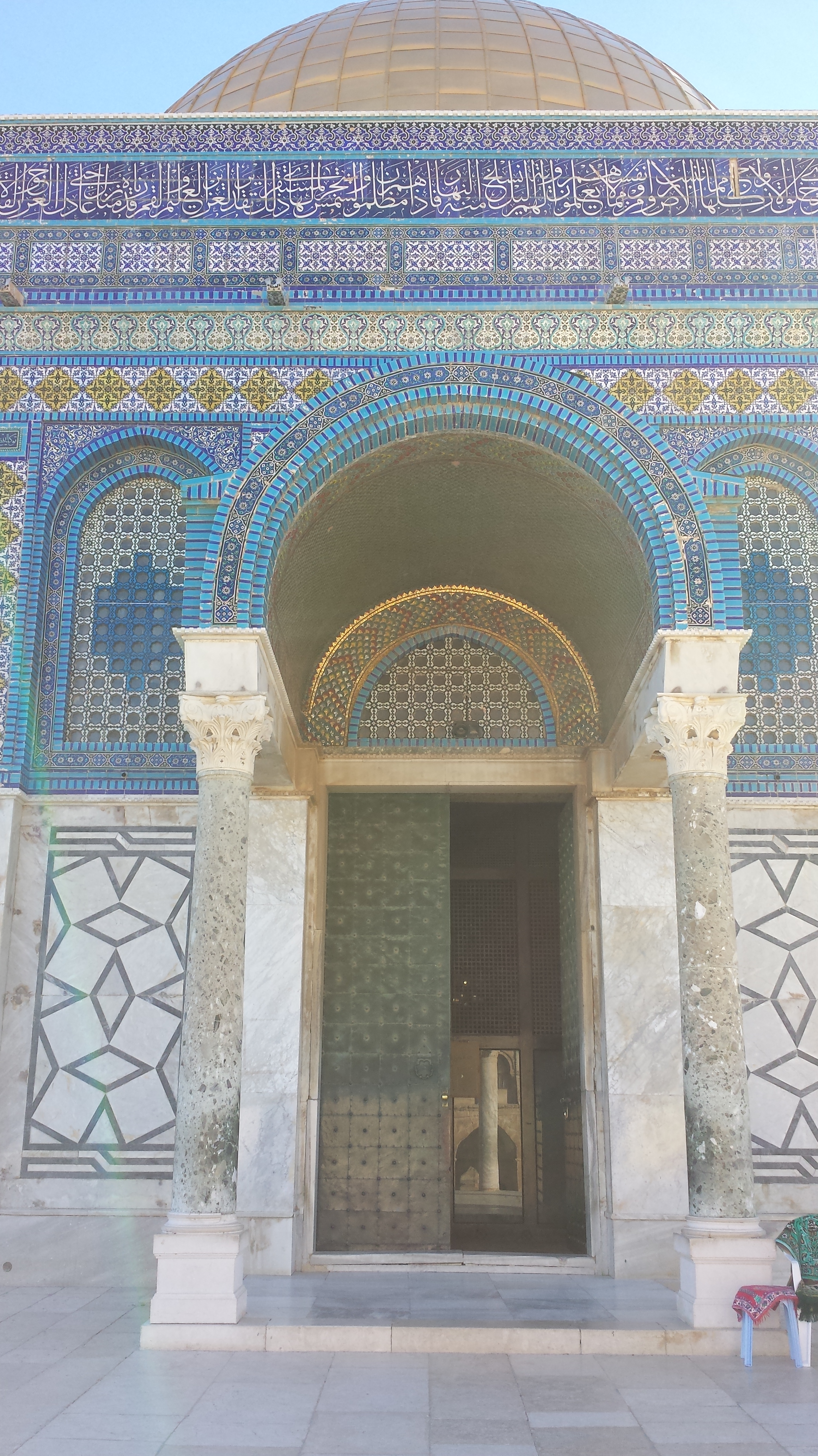
Entrance to the mosque

Entrance to the mosque

The al-Aqsa Mosque is located on the far southern side of the Mount and faces Mecca. The Dome of the Rock is in the center of the 36 acre complex. The Mount also includes a basilica, the Royal Stoa, constructed by Herod to provide a focus for commercial and legal transactions. There is also a small dome known as the Dome of the Chain, a location believed to be where a chain once rose to heaven. There is a ritual fountain for purification, used before entering the sanctuaries. There is also a rectangular building known as King Solomon’s Stables, which was built by Herod but used by the Crusaders during the period when they controlled the Mount.

It's believed that the Holy of Holies may have been located at the spot where the structure on the left currently is.

It’s believed that the Holy of Holies may have been located at the spot where the structure on the left currently is.

20150121_082734

Towards the end of our tour of the Temple Mount, we could hear the sounds of a group of people yelling. Apparently, there was a protest taking place which included some fifty Muslims near the Muslim school located on the Mount who were upset by the presence of Jewish men who had come up to the Mount (this is unusual for Jews to do, since the more conservative sects do not want to risk walking on the location of the Holy of Holies, the exact historical site of which is unknown). The protesters were trying to get the Muslim police who patrol the Mount to come over and intervene. With some concern that the situation could escalate, Ghustan hurried us off the Temple Mount area and into the suk.

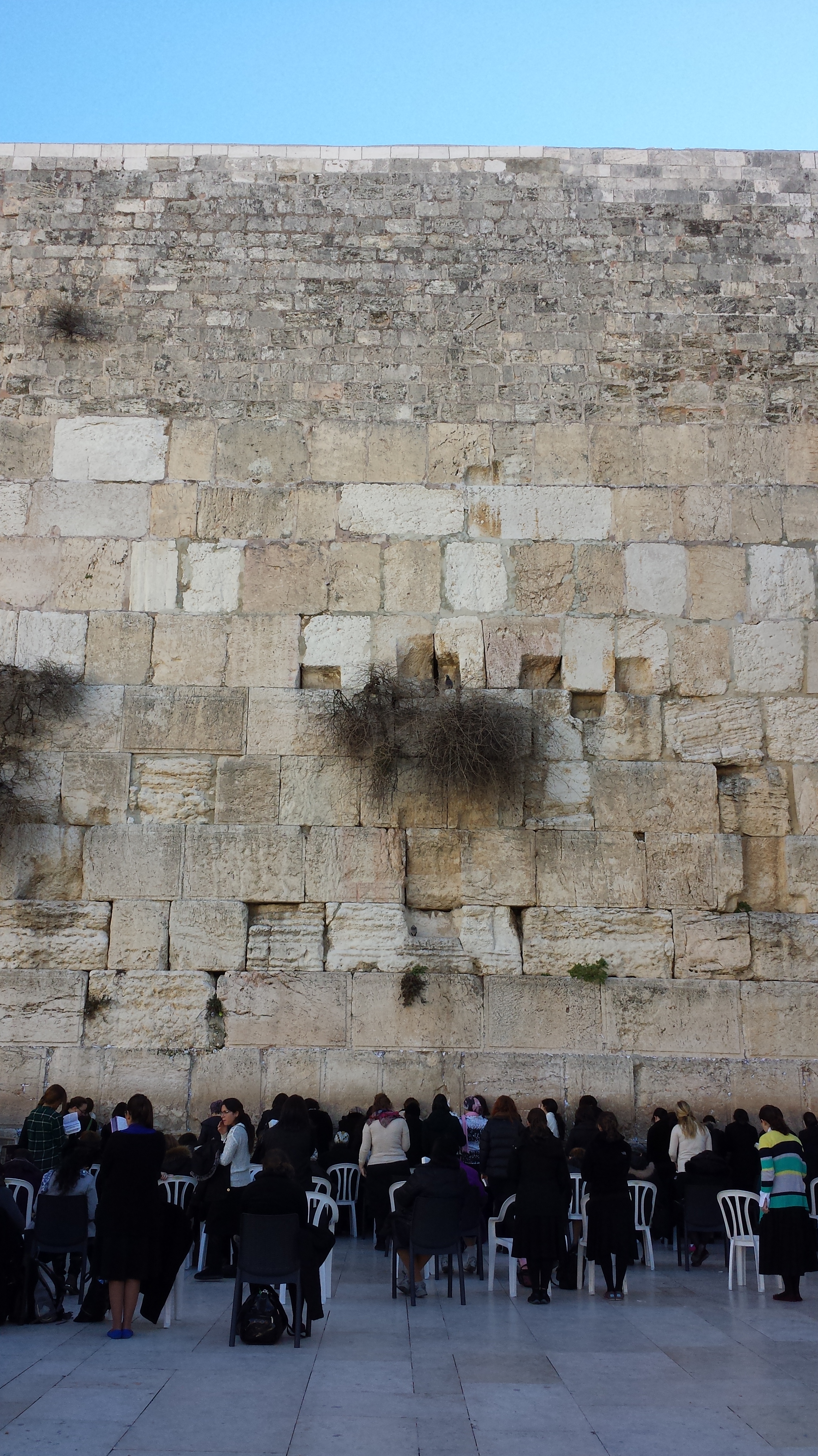
After a few moments of walking, we arrived at the Western Wall. Also known as the Wailing Wall, this section is all that remains of the Jewish temple destroyed by the Romans in 70 CE. The Jewish people believe that third temple will be built here. As you can imagine, there is quite a lot of historic and current tension between the Jews and Muslims about the custody of the Temple Mount.

Graphiti in the suk

Graphiti in the suk

At the Western Wall

At the Western Wall

The women’s section

The women’s section

The Western Wall is a site that is very important to the Jewish people. As a worshipping area, the wall is divided into sections for men and women, with a partition between the two areas. The men’s section takes up the lion’s share of the wall, nearly ¾ of the available wall, and the men have an enclosed heated section as well. The women cram themselves into a smaller section (no heated space). It is popular to hold bar mitzvahs in the men’s section. Mothers who want to view their son’s ceremony must stand on the plastic chairs of the women’s section to peer over the partition at the proceedings. It’s common for the women to throw candy into the event as a symbol of blessing.

20150121_083853

The lowest and biggest stones in the wall are from the second temple period, often referred to as Herodian stones.

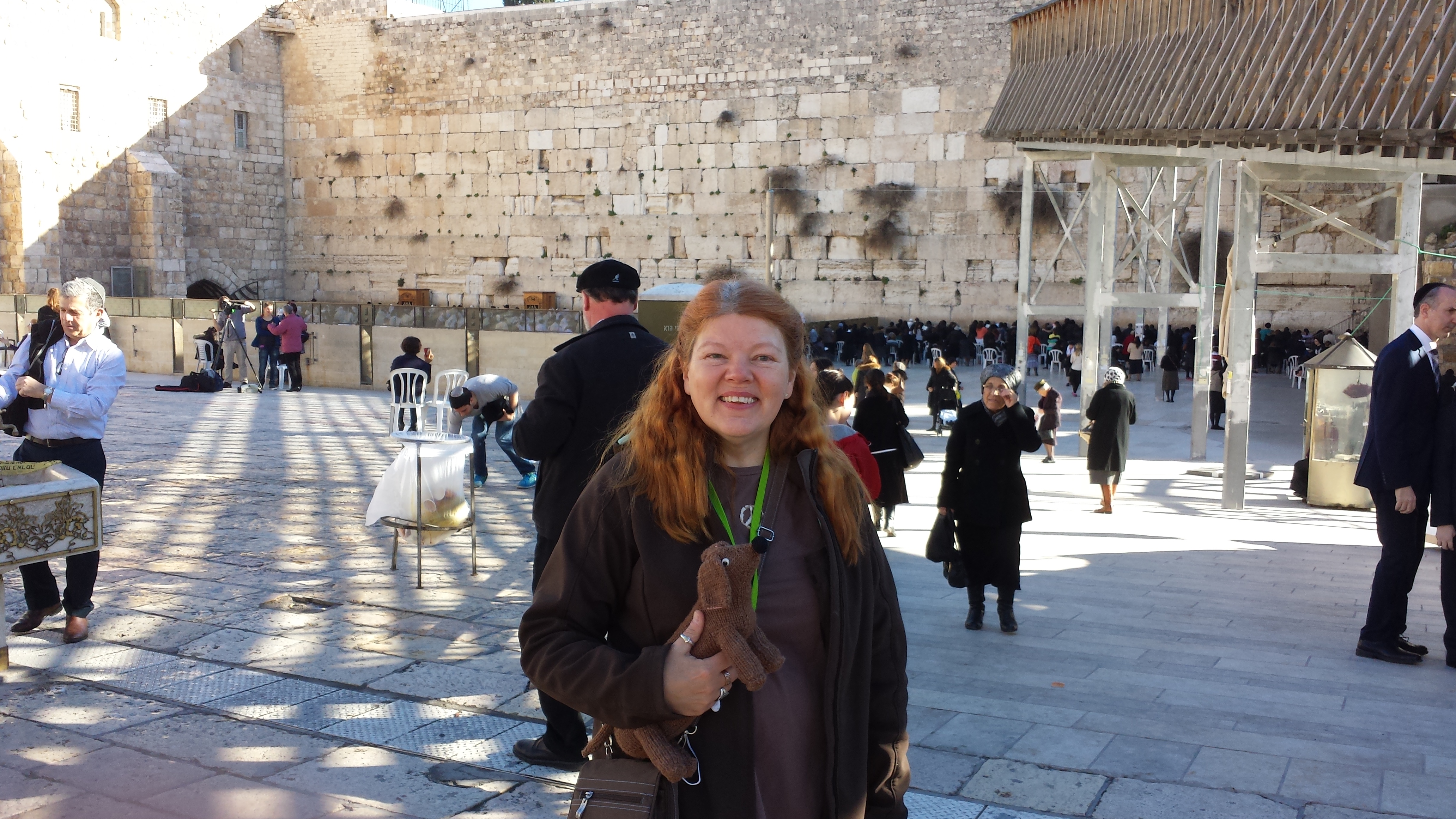
Even though there’s a partition between the men and women, I snuck into the women’s section in Rachel’s interior coat pocket and was able to put my forepaws on the wall as she placed her hands on the wall for prayer. The sounds of women weeping were close all around us in the press of the crowd. After prayers at the wall are complete, it is a practice for many to back up away from the wall so that one does not turn a back to it. When you’re up close to the wall or touching it, you can see small bits of paper on which prayers have been written that visitors have poked into the cracks between the stones.

“Red Signs” warning travellers not to enter the West Bank are posted at every check point.

Ramallah

Ramallah

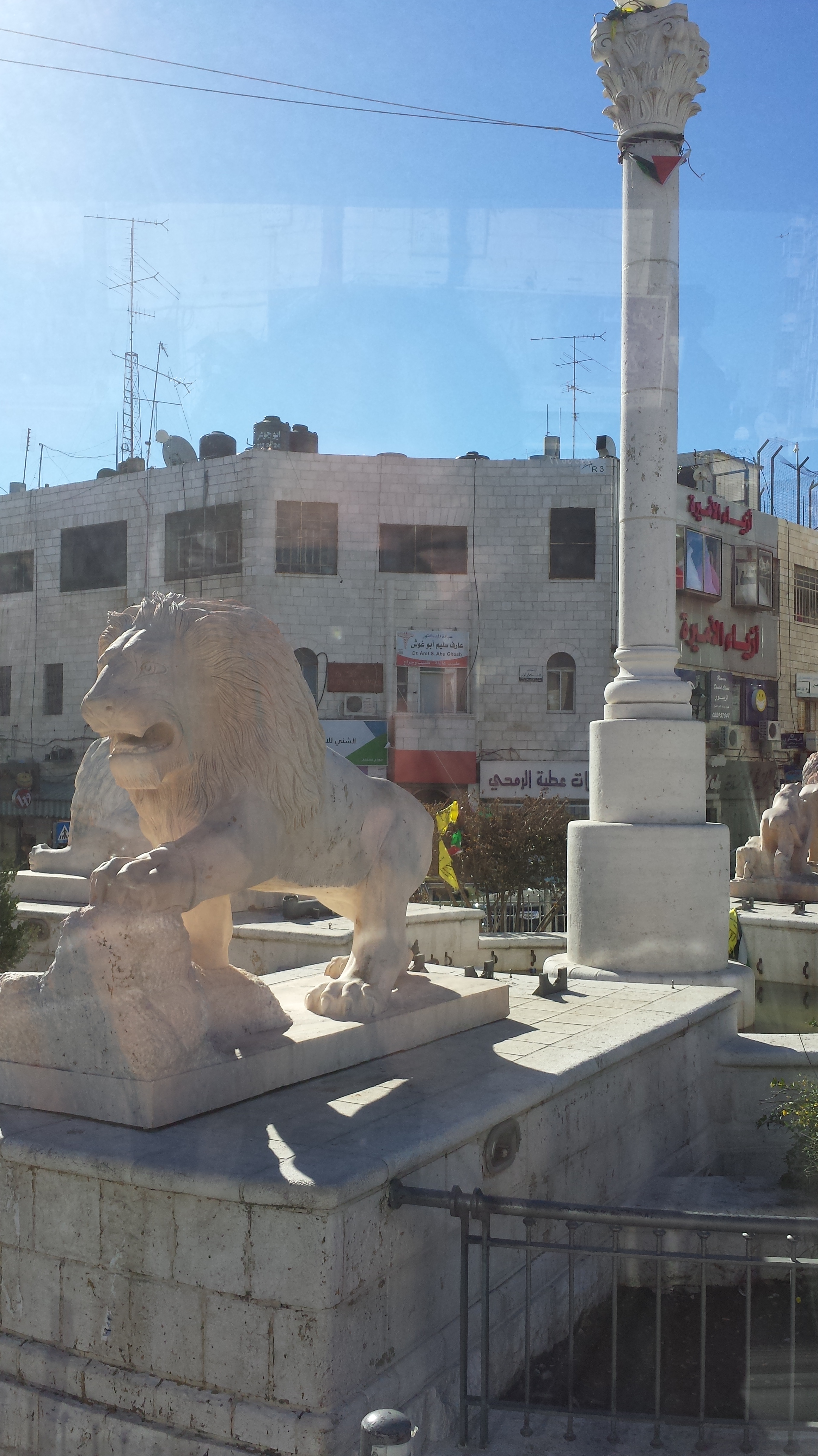
After our time at the Wailing Wall, we boarded our bus once more and headed out to Ramallah, the political center of the State of Palestinian located in the central West Bank approximately six miles north of Jerusalem. Of course, to get there meant crossing through several check points before arriving at the city center. Known as a Christian city, the relationship and cooperation between Christian and Muslim Palestinians is very good. The name Ramallah is Arabic for “Hill of God.”

Lion statues in the center of downtown Ramallah

Lion statues in the center of downtown Ramallah

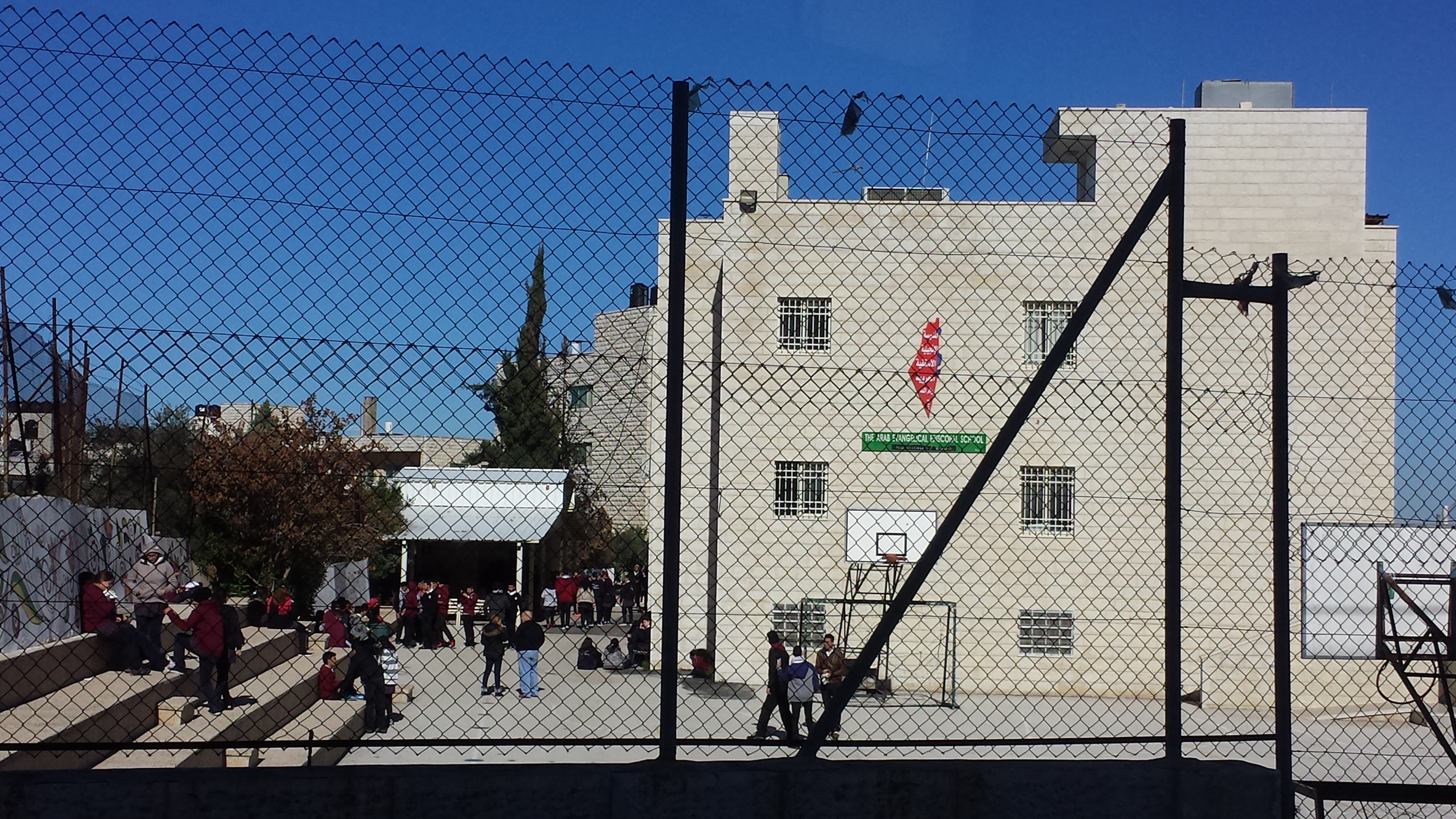
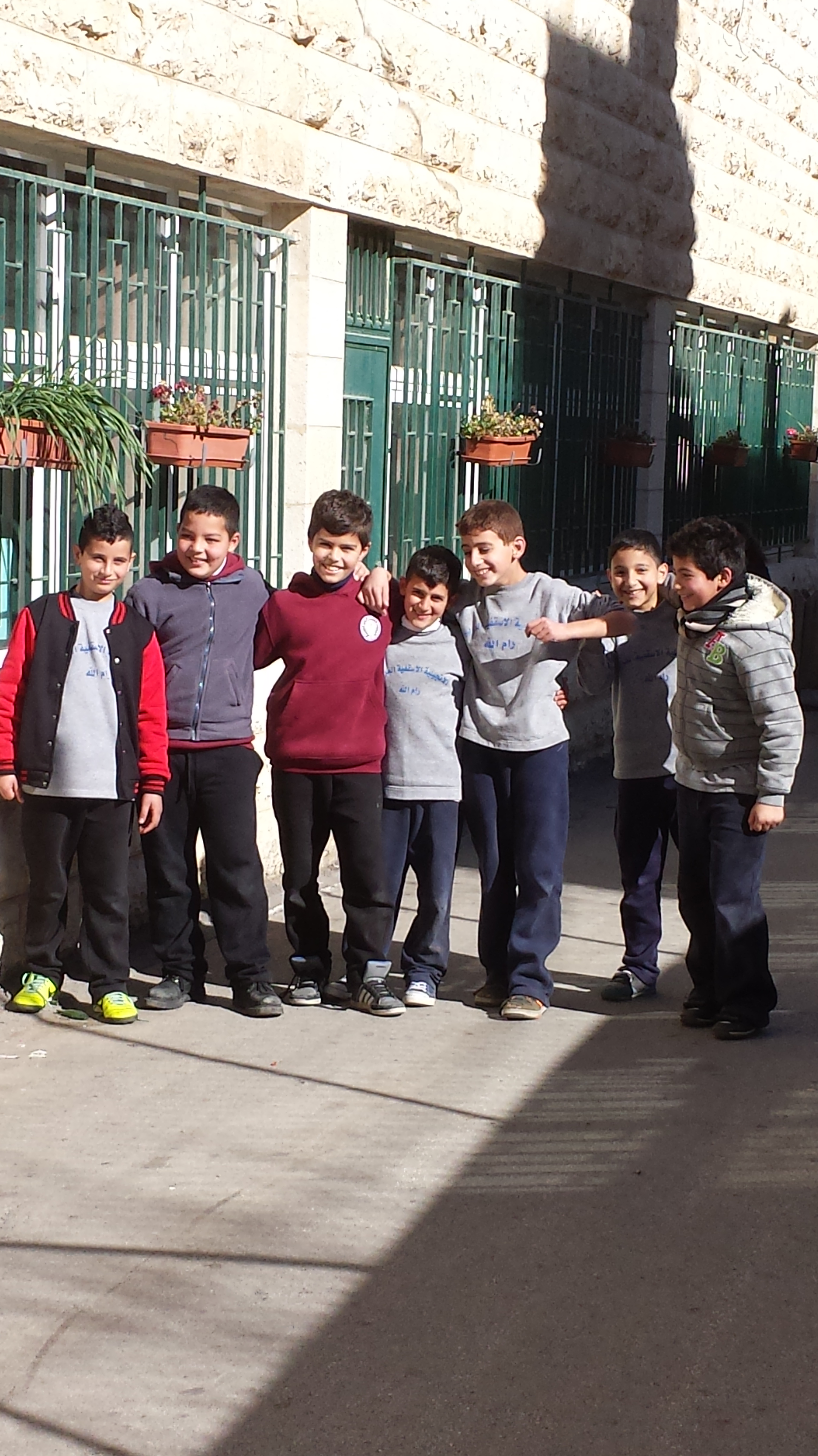
After some time of driving through the busy city center, we arrived at our first destination – a meeting with Iyad Rafidi at the Arab Evangelical Episcopal School in Ramallah. Iyad is the director of the school. As a Christian private school, the school has much to offer to the whole community and is largely considered one of the best schools in the area. The school believes that fulfilling its Christian mission comes through serving the Palestinian community in all its diversity, regardless of religion, race, gender, abilities and socioeconomic status of the person. The school also seeks to educate Palestinian generations to become active citizens who participate in developing a humanistic and democratic society, enhancing religious and national heritage in Palestine, and promoting mutual understanding and tolerance among religions and cultures.

Iyad Rafidi and me

Iyad Rafidi and me

Currently around 150 students study in the new building, in good conditions. However, around 535 students study in two 38 year old buildings, in poor conditions, with leaking windows, old furniture, an inefficient heating system and a worn out electrical system, etc. The school hoped for years to follow up with partial maintenance, yet problems persisted, due to the age of the buildings and its facilities. Engineers recommended undertaking a comprehensive maintenance, which involves changing the whole water and drainage system, electricity and heating networks. The school is currently seeking funds for this major project.

The school

The school

Recess time for the grade school

Recess time for the grade school

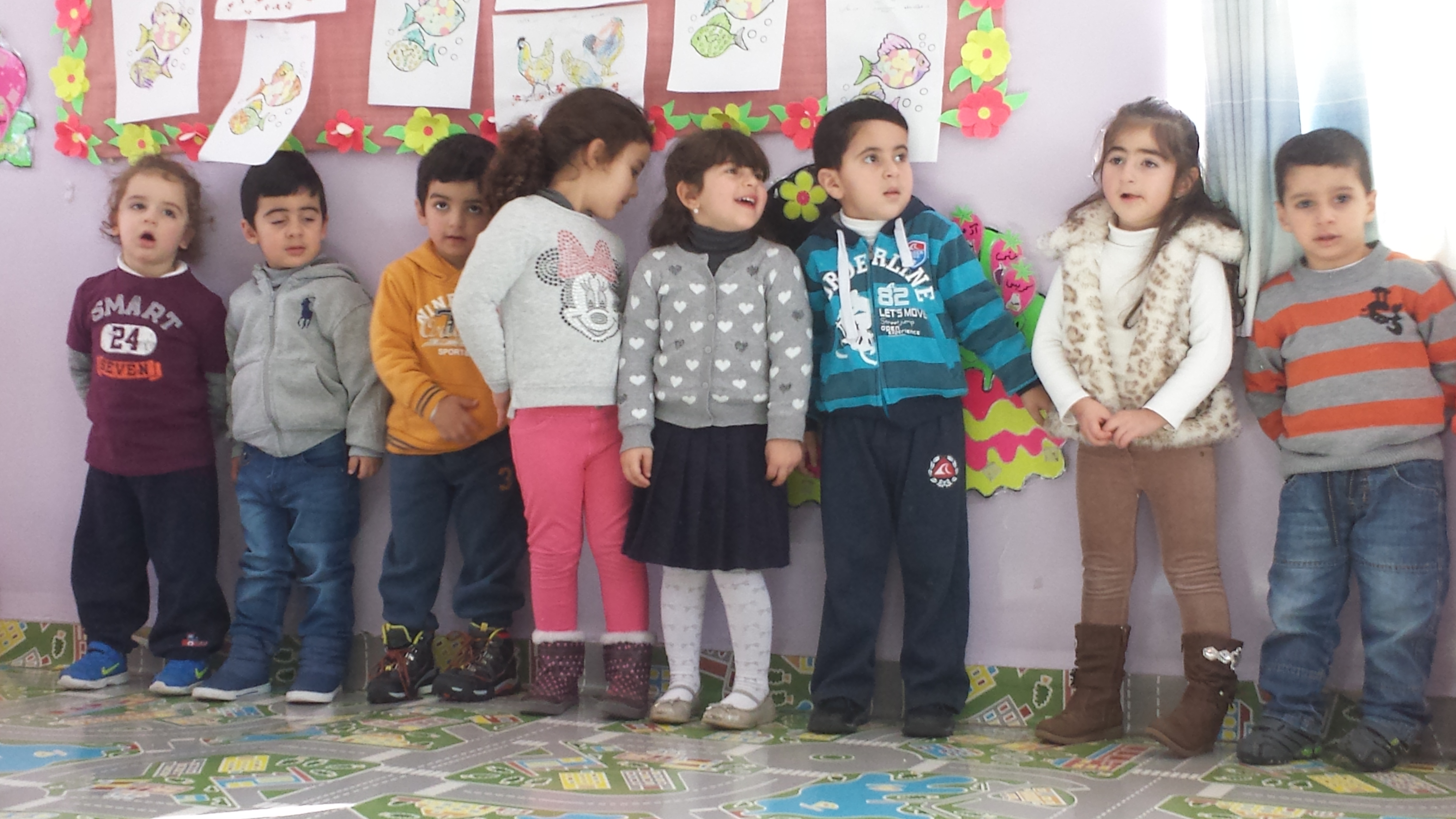
The preschool

The preschool

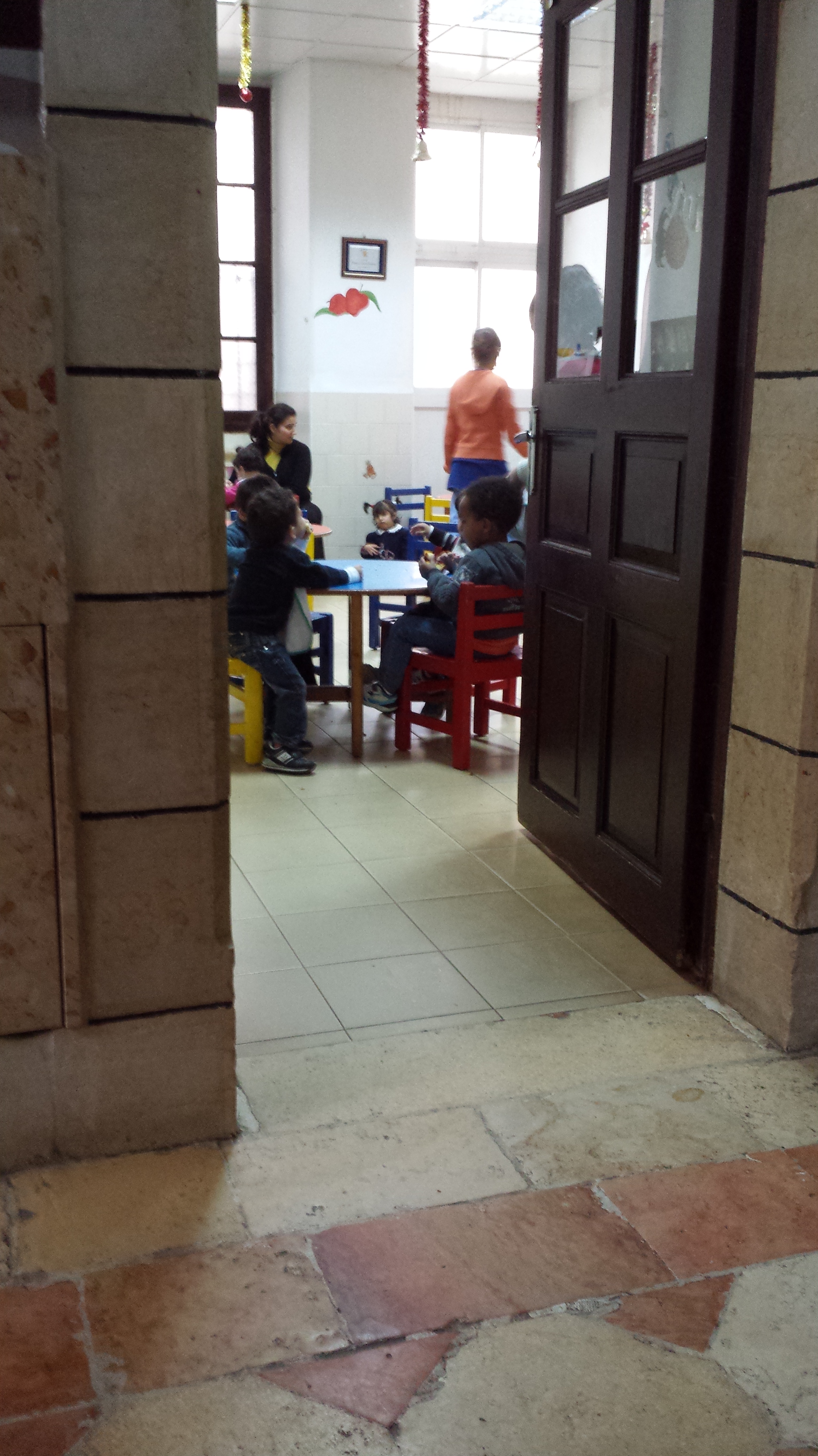
Making friends at the preschool

Making friends at the preschool

The very best coffee and cookie we had were served in hospitality to us during our visit here. The children were friendly, and we were able to see something of the preschool as well as the grade school areas. However, we didn’t have as much time as we would have liked, because we needed to be on time for an important meeting at the offices of the Palestinian National Authority.

20150121_110710

The PNA (or PA) was the interim self-governing body established to govern Areas A and B of the West Bank and Gaza Strip as a consequence of the 1993 Oslo Accords. Following elections in 2006 and the subsequent Gaza conflict between the Fatah and Hamas parties, its authority had extended only as far as the West Bank. Since January 2013, the Fatah-controlled Palestinian Authority began to refer to the areas of it’s jurisdiction as the State of Palestine in official documents, after the United Nations voted to recognize Palestine as a non-member UN observer state.

In the meeting room

In the meeting room

Coffee and snacks before the meeting

Coffee and snacks before the meeting

The politics of the Palestinian Authority take place within the framework of a semi-presidential multi-party republic, with the Palestinian Legislative Council (PLC), an executive President, and a Prime Minister leading a Cabinet. The current structure of the PA is based on three separate branches of power: executive, legislative, and judiciary. The PA was created by, is ultimately accountable to, and has historically been associated with, the Palestine Liberation Organization (PLO), with whom Israel negotiated the Oslo Accords. The PLC is an elected body of 132 representatives, which must confirm the Prime Minister upon nomination by the President, and which must approve all government cabinet positions proposed by the Prime Minister.

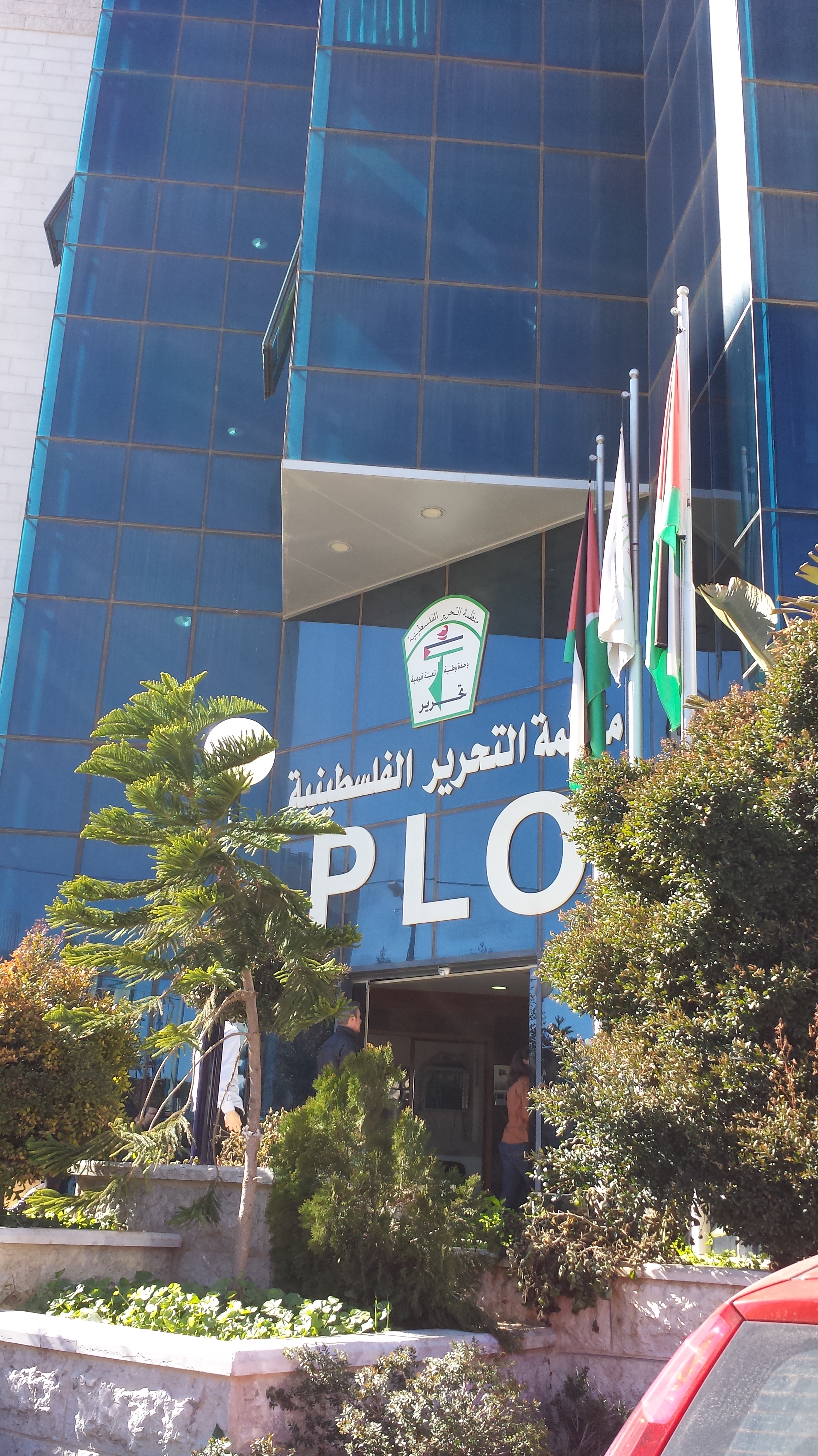
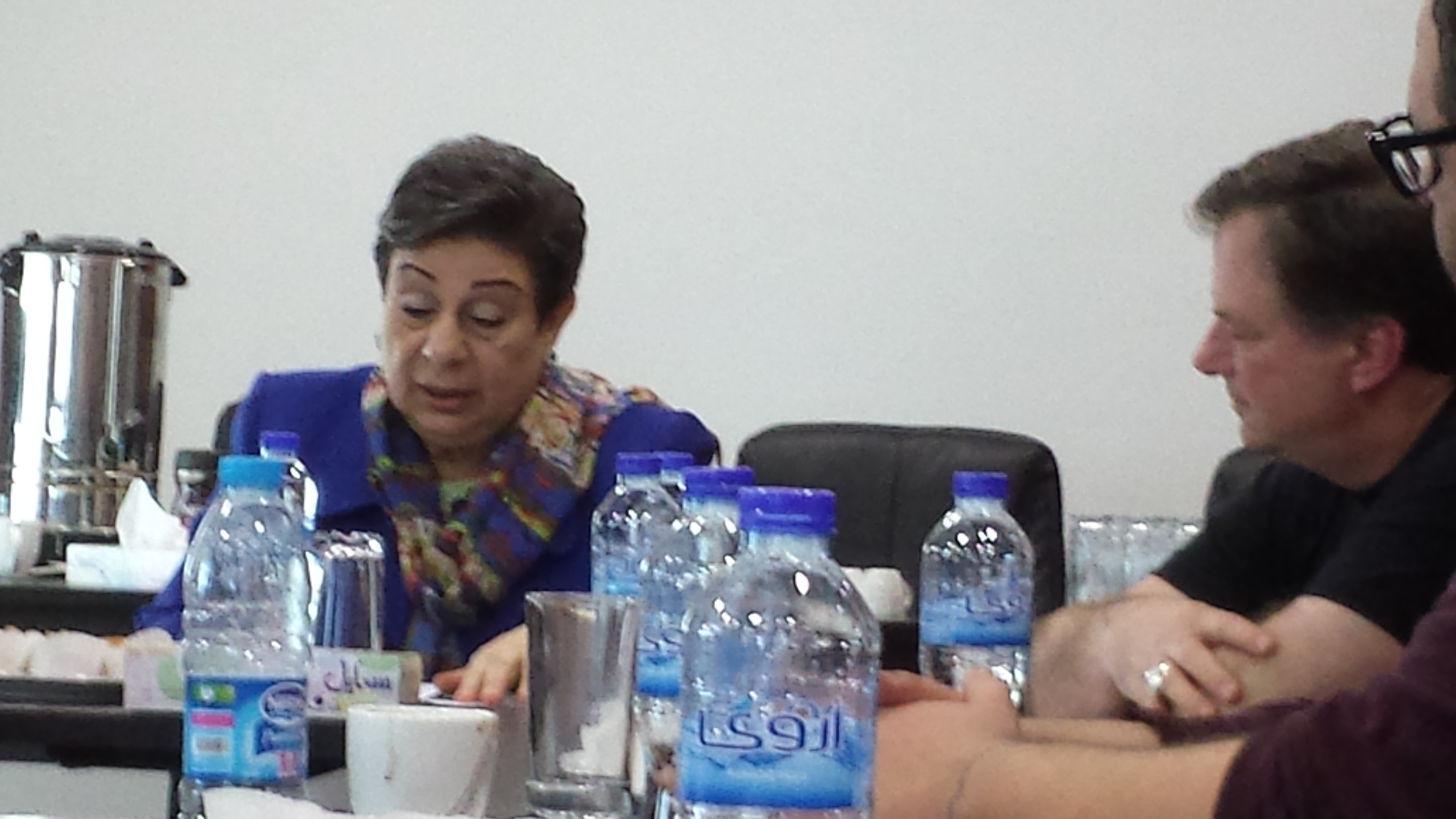
I’m giving you this background so that you understand why, in order to meet with a representative of the PLC, our group was hosted for a meeting at the PLO headquarters in Ramallah. Due to the efforts of Bishop Greg, our group had the privilege of meeting with an amazing woman — Dr. Hanan Ashrawi.

Dr. Hanan Ashrawi and Bishop Greg

Dr. Hanan Ashrawi and Bishop Greg

Dr. Ashrawi is a Palestinian legislator, activist, and scholar. She was an important leader during the First Intifada, serving as the official spokesperson for the Palestinian Delegation to the Middle East peace process, and has been elected numerous times to the Palestinian Legislative Council. Dr. Ashrawi is a member of Palestinian Prime Minister Salam Fayyad’s Third Way party and is the first woman elected to the Palestinian National Council. At this time, she serves on the Advisory Board of several international and local organizations including the World Bank Middle East and North Africa (MENA), United Nations Research Institute for Social Development (UNRISD) and the International Human Rights Council.

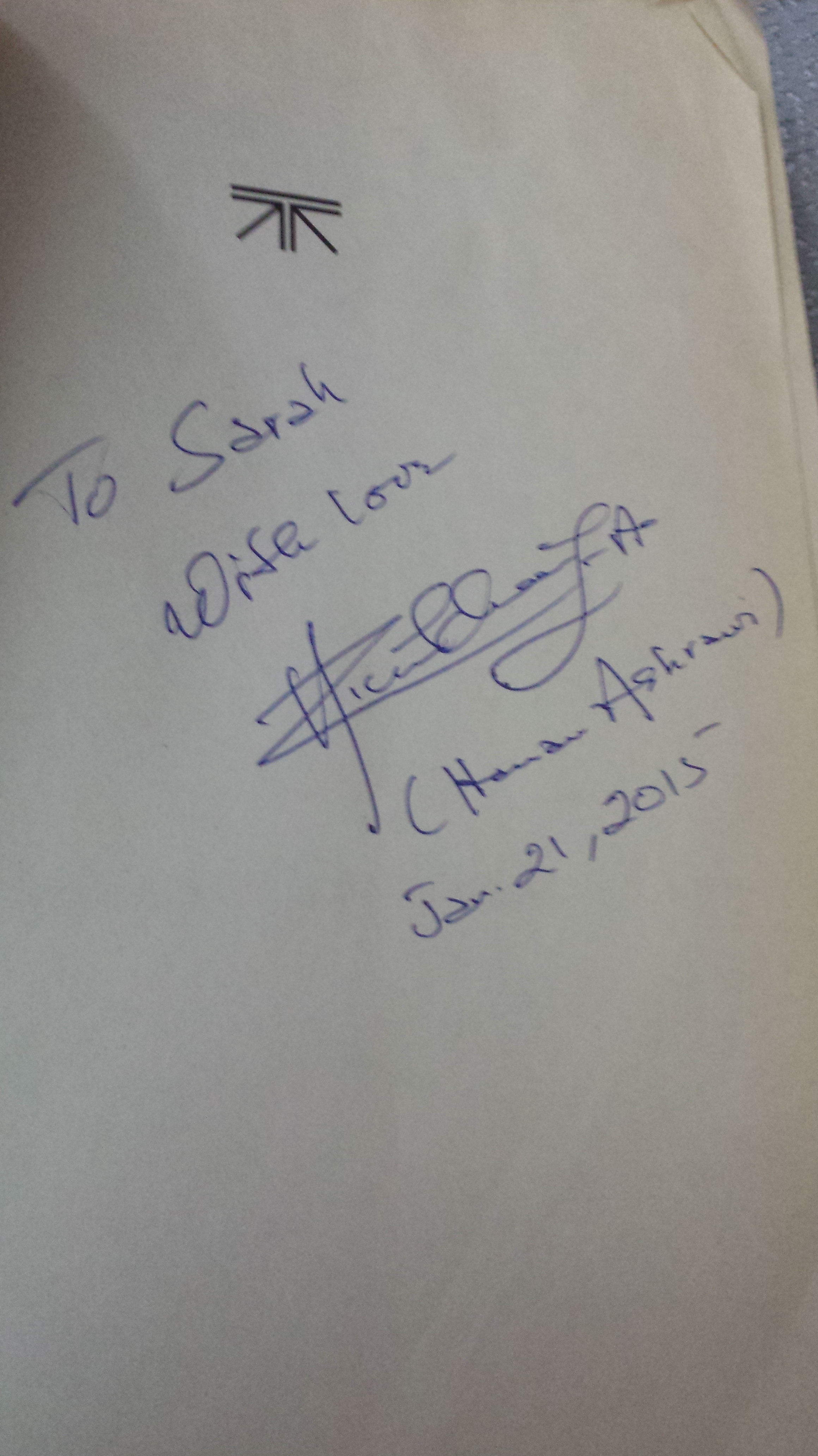
Dr. Ashrawi signed Sarah's book!

Dr. Ashrawi signed Sarah’s book!

Dr. Hanan Ashrawi is also an Anglican Christian, though not actively participating in church per se. However, she is a passionate advocate of many human rights and gender issues and is the recipient of numerous international peace, human rights and democracy awards.

A woman described as

A woman described as “very smart” even by Palestinian men.

In our meeting, she was very articulate about the current situation in Palestine and relationship with Israel, and she took several of our questions. Rachel had the opportunity to ask her what legislative efforts might be in play currently in support of Palestinian autonomy. Dr. Ashrawi was quick to point out that due to restrictions and issues within their domestic governance, their help and hope is in the international community’s support.

After our meeting concluded, Rev. Sarah Monroe had Dr. Ashrawi sign a copy of Ashrawi’s book that Sarah had brought with her. Meanwhile, Rachel asked an aid to Dr. Ashrawi for some business cards to distribute to our group. The aid invited Rachel to follow her up to Dr. Ashrawi’s offices, where Rachel was able to get a stack of business cards to distribute. However, ongoing to the elevator to take it back down to the ground floor (to re-board our group bus), who should happen to step into the elevator but Dr. Ashrawi herself – off to another meeting.

Getting on the elevator with Hanan Ashrawi - OMG!

Getting on the elevator with Hanan Ashrawi – OMG!

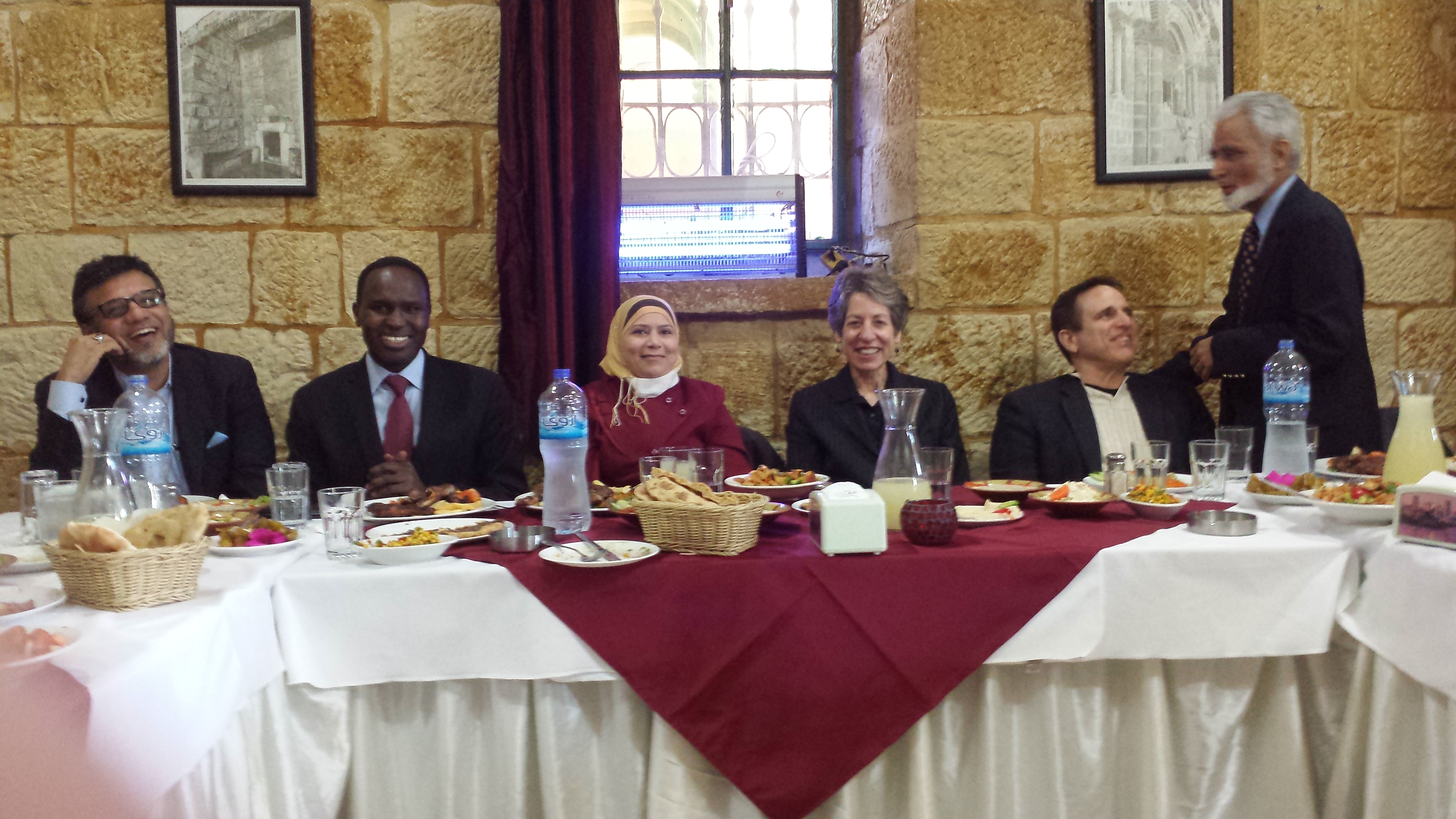
Our next stop was lunch, but oh! What a lunch! After our group settled into our seats, an international interfaith assembly of religious leaders came into our restaurant for their own luncheon. This prestigious group was led by none other than the Rt. Rev. Katharine Jefferts Schori, Presiding Bishop of The Episcopal Church. It’s a good thing that only the salads had arrived at our table, because our meal came to a total stop as we stood to applaud the arriving dignitaries and greet them individually as they made their way into their banquet room (which happened to be near the end of the table where Rachel and I were seated).

Our lunch table in Ramallah

Our lunch table in Ramallah

Look who came to lunch - the Rt. Rev.  Katharine Jefferts Schori

Look who came to lunch – the Rt. Rev. Katharine Jefferts Schori

I'm not sure who these ecumenical representatives are, but they said to Rachel,

I’m not sure who these ecumenical representatives are, but they said to Rachel, “This is what a Jew and Muslim friendship committed to peace looks like!”

The interfaith delegation

The interfaith delegation

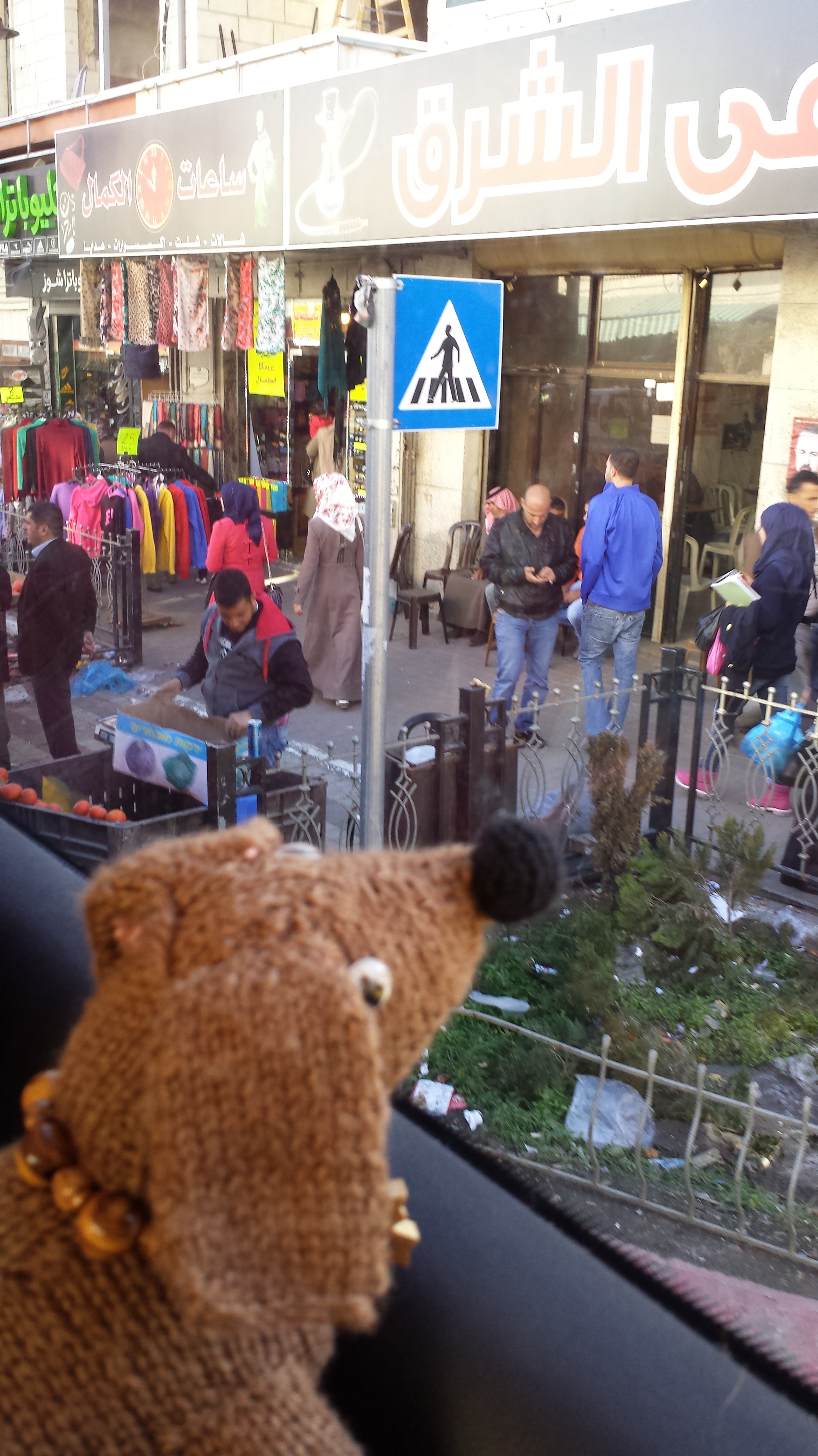
Bus vs. Busy market street in Ramallah

Bus vs. Busy market street in Ramallah

Saying goodbye to a wonderful city!

Saying goodbye to a wonderful city!

On our groups last full day in Jerusalem, the Presiding Bishop and her group were moving into St. George’s College for their stay. So, some of us ran into them all again when we walked back to the college during free time.

Our bus driver, Nihal, did a hero’s job of navigating the bus through the market district of Ramallah as we made our way out of the city, through the check points, and back to Jerusalem.

Refugee camp in Ramallah

Refugee camp in Ramallah

This day was such a joyful contrast to the day before that our group was is high spirits for our afternoon tour of the Israel Museum in Jerusalem. We toured the huge model of the first century city of Jerusalem before viewing the exhibit of the Dead Sea Scrolls (Shrine of the Book) and archaeological and art wings of the museum.

Scroll

Shrine of the Book

There were some things in the archaeological exhibits halls that Rachel had only every studied in books – to see them in person was a remarkable experience, including relics from ancient Levant, Akkadia, Sumer, Assyrian, Persian, Egyptian, Babylonian, NImrodian, Canaanite and Herodian cultures. The collection also included two ossuaries of some import – an ossuary associated with the High Priest Caiaphas and an ossuary engraved with the name “Jesus, son of Joseph,” which caused great public interest and scholarly debate when they were each discovered.

Archaeological and art wings

Archaeological and art wings

Model of second temple

Model of second temple

If any of the museum security had been watching Rachel on their monitor screens, they would have laughed at the way she exclaimed and clapped her hands to her face as she passed from exhibit to exhibit with rising astonishment at the amazing and rare antiquities they have in their collections. The experience made her want to go back into anthropological research, but I reminded her that she’s a priest now and has other obligations to date.

At the end of a superb and astonishing day, Rachel and I boarded the bus one last time for the day and headed back to the hotel for dinner and sleep. It was our last night in Jerusalem, and we felt both full and fulfilled in many ways.

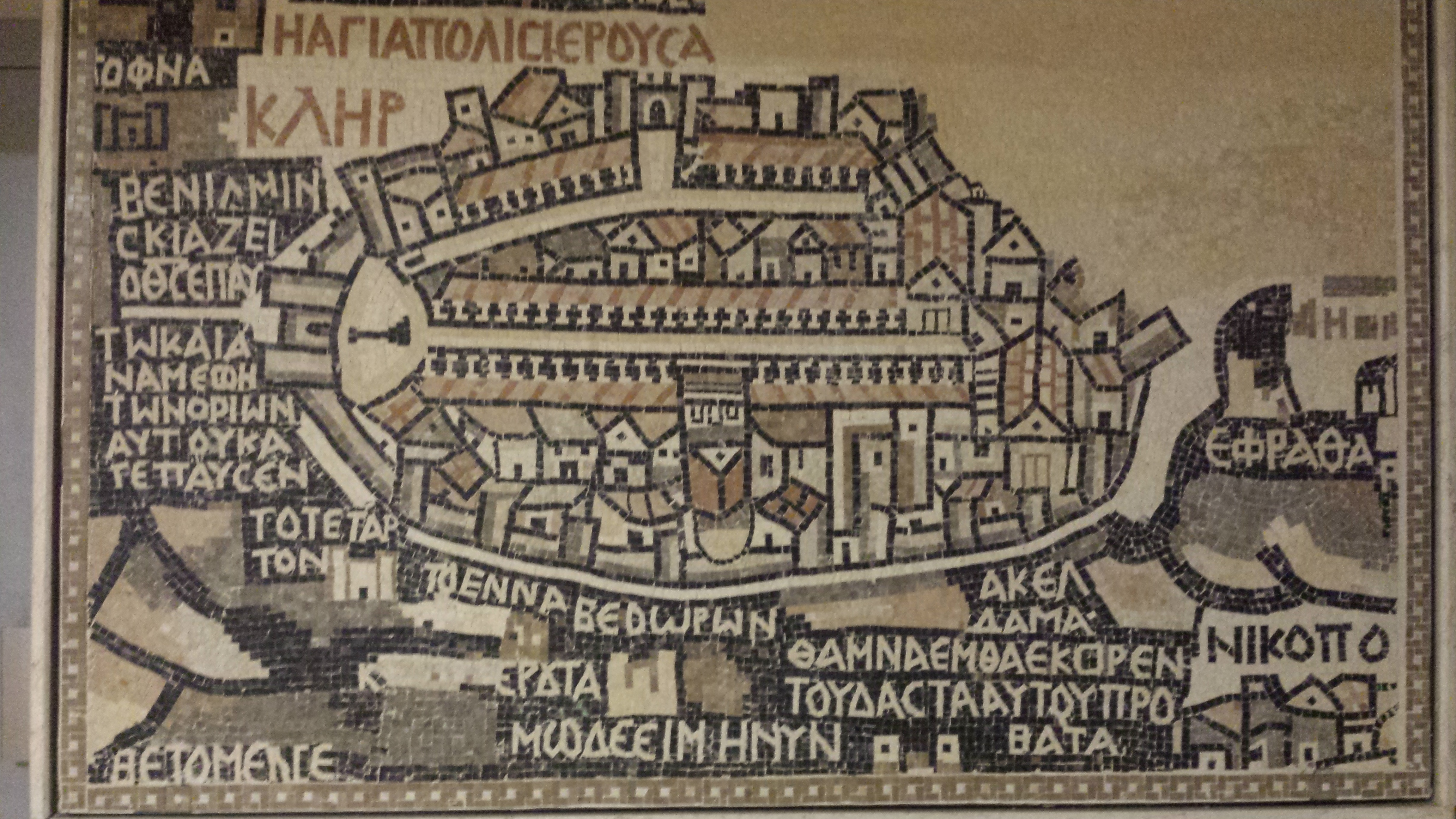
Byzantine mosaic of Jerusalem

Byzantine mosaic of Jerusalem

Here’s to celebrating the history, freedom and creativity of squirrels!

Henry

Henry Goes to the Holy Land – Day 8

Leave a comment

January 20, 2015

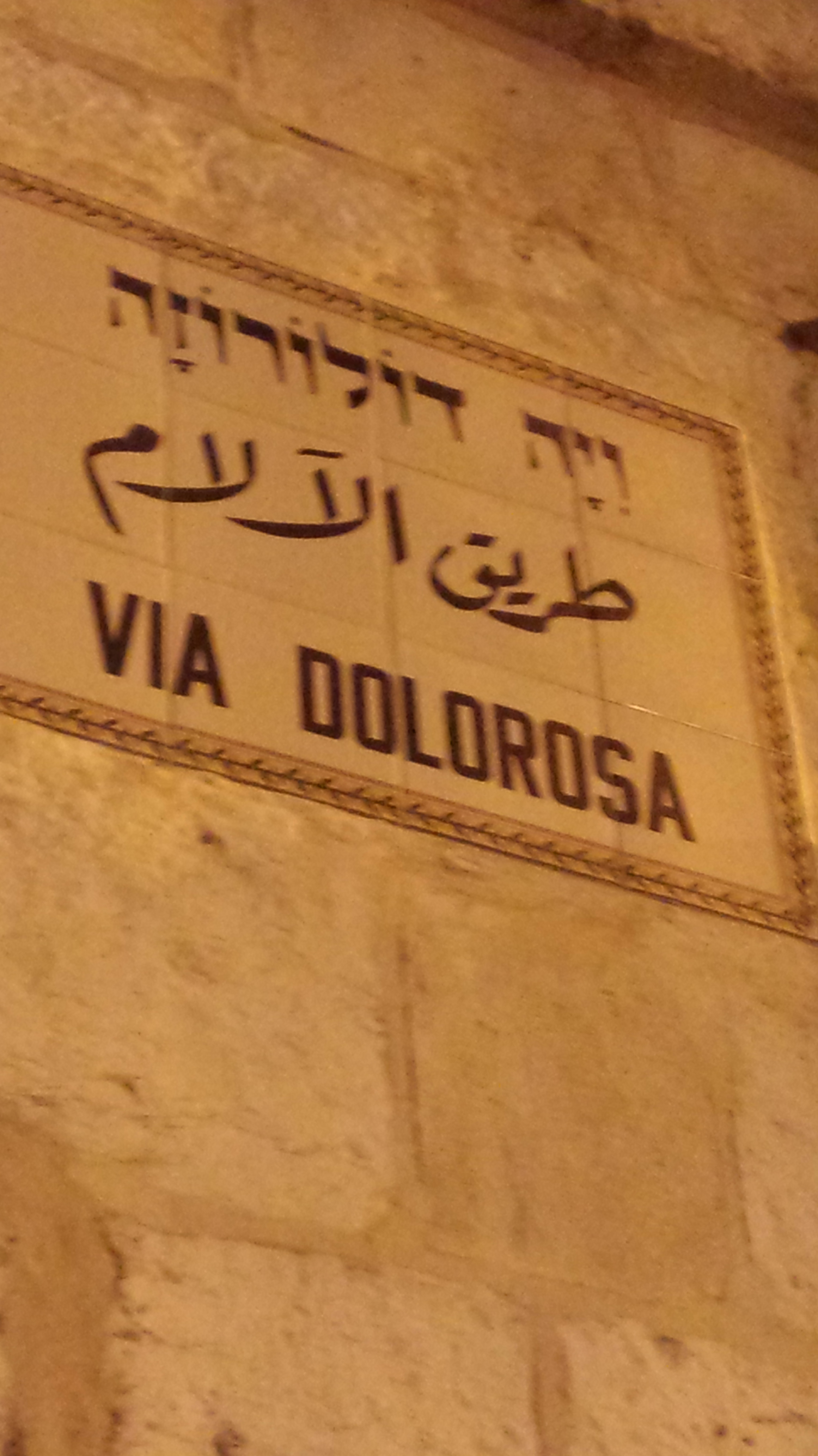
After breakfast at the hotel, we set off in the early morning for a quick bus ride to the Lion’s Gate in order to the Church of St. Anne, located near the start of the Via Dolorosa and in the Muslim quarter of the Old City.

Church of Saint Anne

Church of Saint Anne

The church was built near the remains of a Byzantine basilica, over the site of a cave home believed by the Crusaders to be the birthplace of Mary, mother of Jesus. The church is dedicated to her parents, Anna and Joachim who are said to have lived there. However, another strain of Christian tradition says that Mary was born in Sepphoris, which is very near Nazareth.

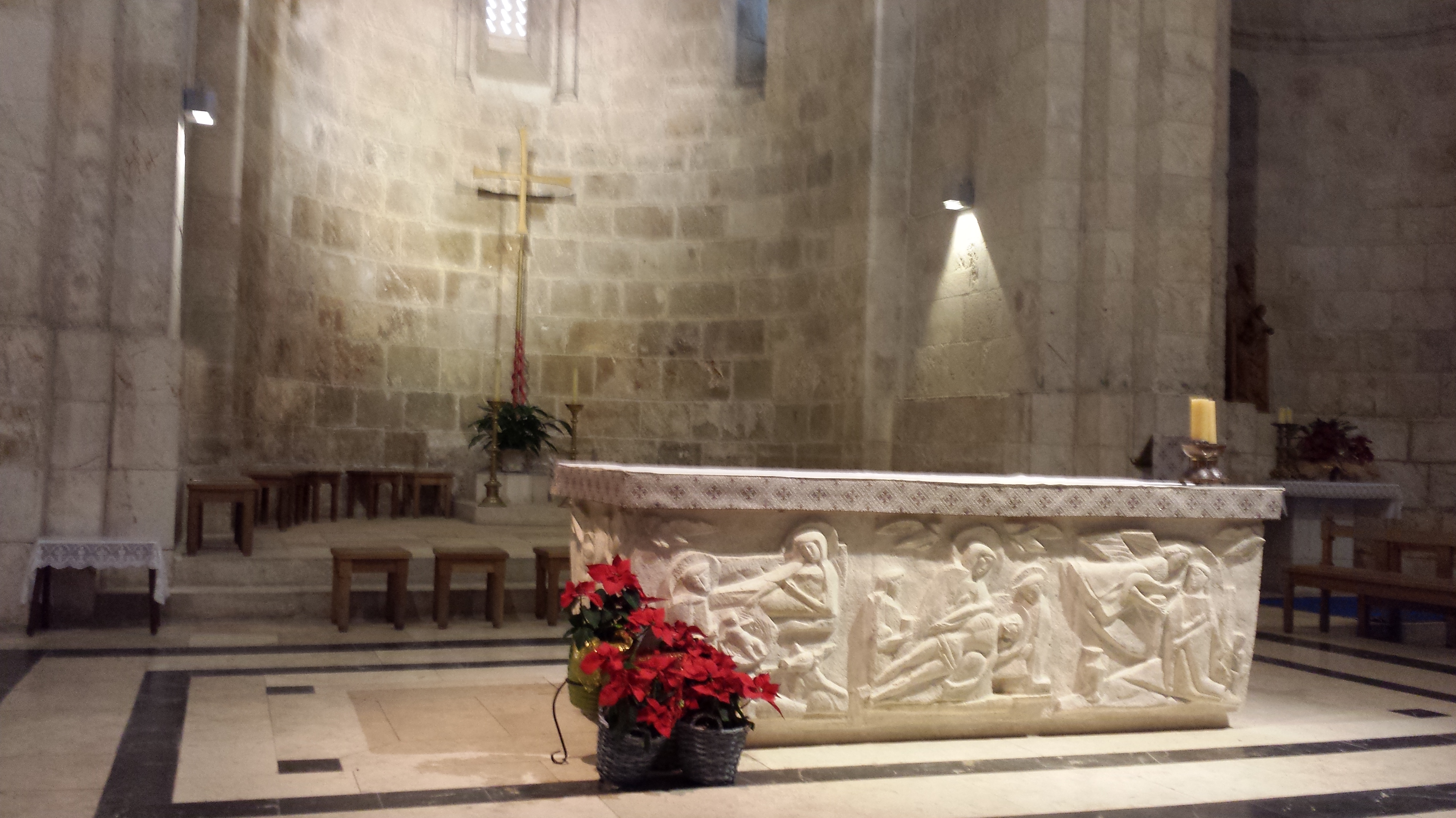
Altar area

Altar area

20150120_084741

Statue of Anne with her daughter, Mary (Mother of Jesus).

Unlike most Christian churches, St. Anne’s was not destroyed after Sala ad-Din’s conquest of Jerusalem in 1187, though it was converted into a Muslim seminary. Technically, for reasons of history, the church belongs to the French government, and it is administered by the White Fathers of the Catholic Church. Due to a high Roman vaulted ceiling, St. Anne’s has amazing acoustics that are perfect for chanting and singing. Our group held a brief prayer service and sang a hymn.

Ruins of the Healing Pools of Bethesda

Ruins of the Healing Pools of Bethesda

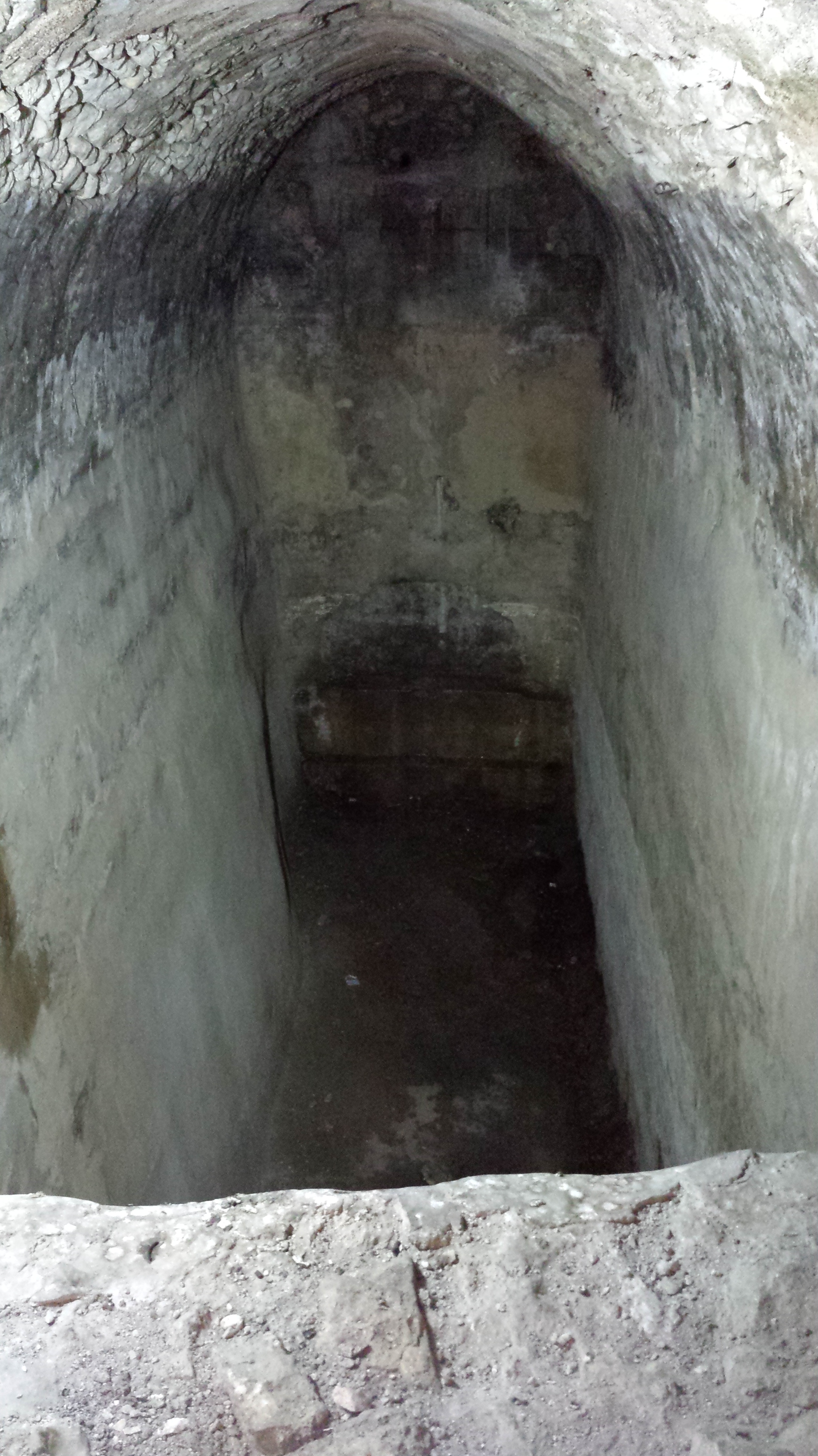
Looking into the remains of a cistern associated with the pools

Looking into the remains of a cistern associated with the pools

A few of us climbed down to get water from the spring fed pool

A few of us climbed down to get water from the spring fed pool

Next to the church are the healing pools of Bethesda. During the Roman period, the pools were a Roman shrine to the Greek God Asclepius, the god of healing. The Gospel of John describes the existence of this pool, noting its five colonnades in the story of Jesus healing a crippled man during the Sabbath (John 5:2-9). A few of us descended down the narrow steps to view a smaller pool that still remains. I even gathered some water from the pool to bring home!
At this ancient place of healing the bishops of our group offered anointing to those of us who wanted to receive it.
20150119_213305

After our time at St. Anne’s and site of Bethesda, we began our pilgrim’s journey on the Via Dolorosa by holding a Eucharistic service in the chapel of the Ecce Homo Convent. Dominic gave an excellent (and musical) sermon, with Bishop Barry presiding. To hear the composition by Gavin Bryars Feat (with Tom Waits) supporting the lyrics sung by an old unknown homeless man and recorded on the streets of London (living rough in the area around Elephant and Castle and Waterloo Station), go to https://www.youtube.com/watch?v=gT0wonCq_MY – the simple words are: “Jesus’ blood never failed me yet, never failed me yet. Jesus’ blood never failed me yet. This one thing I know, for he loves me so…”

20150120_092441

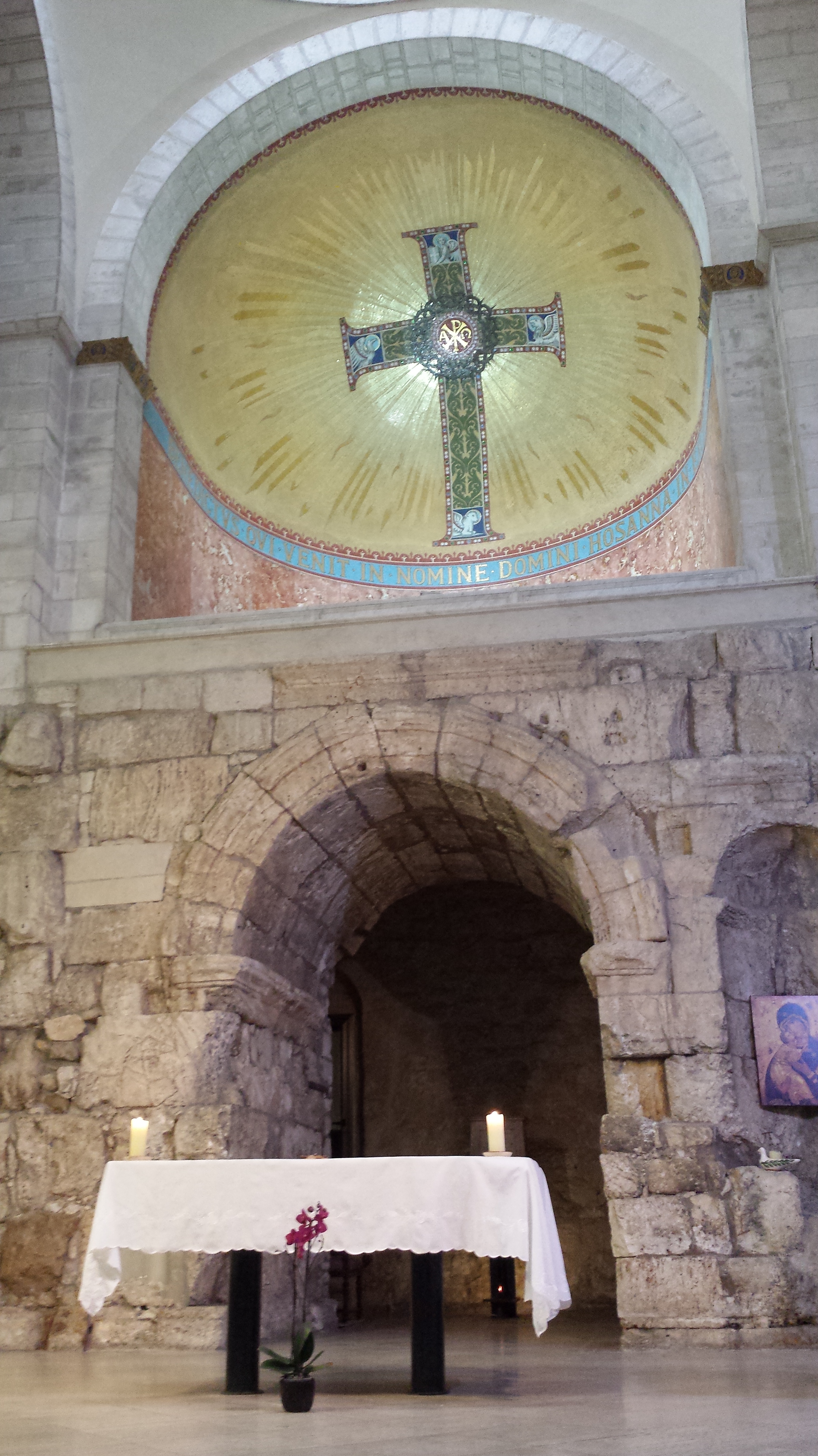
What important about this church is that it is built over the ruins of the first century barracks of the Roman soldiers – it is the location of the archway and courtyard that is the setting for Jesus being mistreated by his guards, dressed like a king and ridiculed, flogged and ultimately given his cross to carry to his execution. The first two Stations of the Cross are located deep underneath the convent, on the occupation level of first century.

Altar area of Ecce Homo Convent Church - you can see the remnants of one of the arches from the Roman era

Altar area of Ecce Homo Convent Church – you can see the remnants of one of the arches from the Roman era

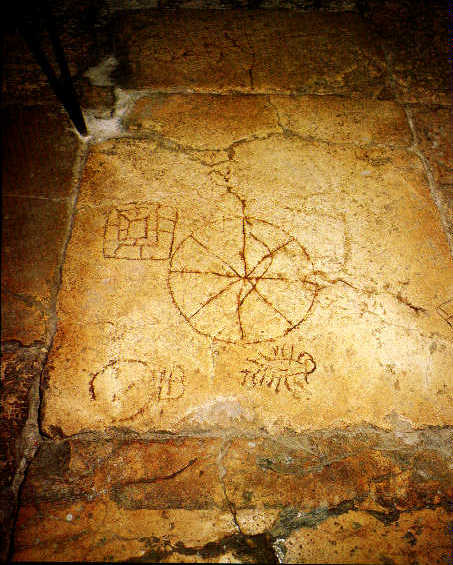
There, carved into one of the stones that would have paved the courtyard, is a game known as “the king’s game” which is likely the gambling game the soldiers were playing – first with Jesus’s life and later for his clothes.

The King's Game carved into a Roman paving stone

The King’s Game carved into a Roman paving stone

Interpreting the King's Game

Interpreting the King’s Game

We made our way along each of the Stations of the Cross, winding through the bustling suk with all manner of activity going on around us until we reached the final stations located within the Church of the Holy Sepulcher.

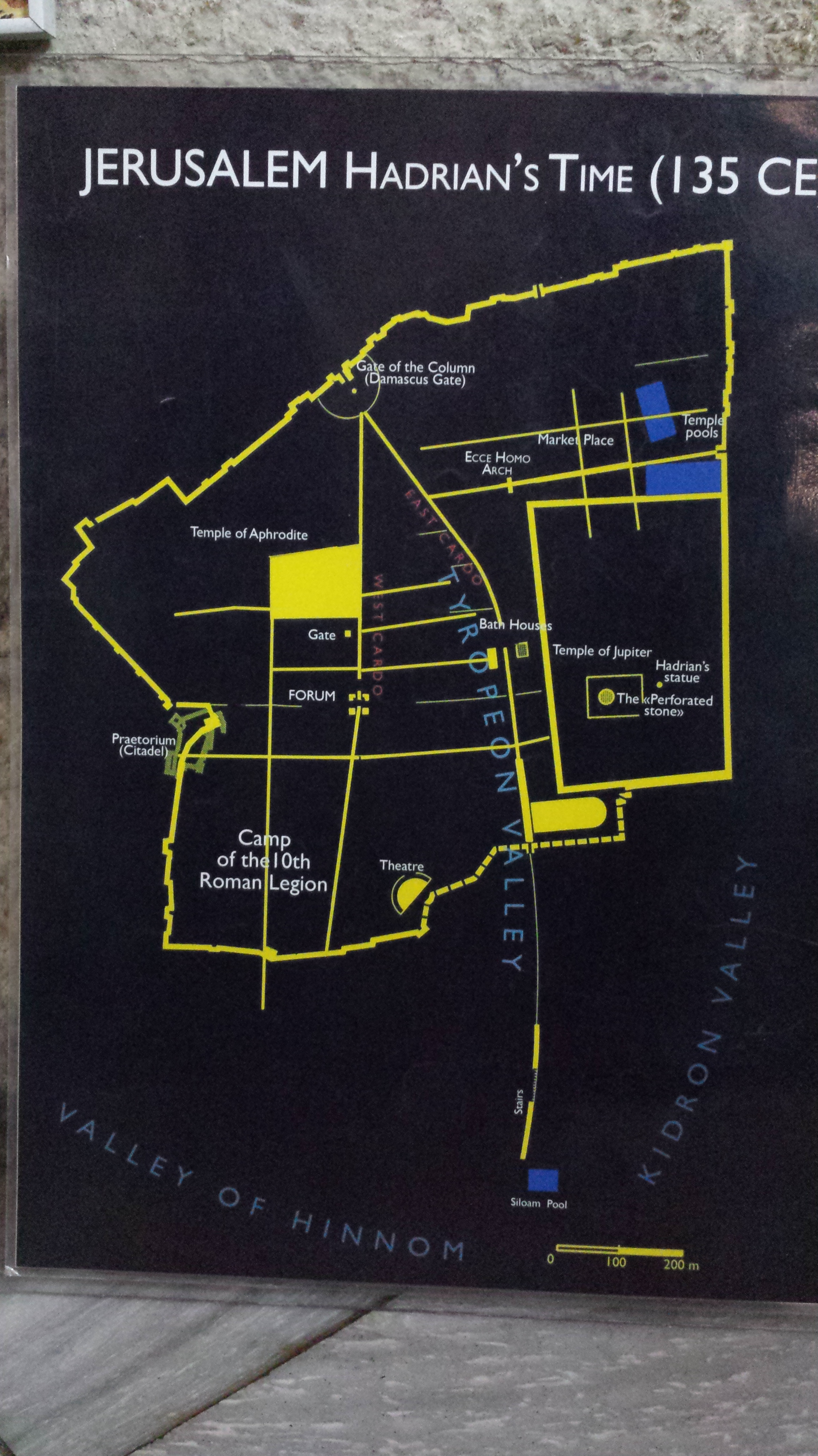
A map showing that at the time of Jesus' crucifixion,  the location was outside the city wall.

A map showing that at the time of Jesus’ crucifixion, the location was outside the city wall.

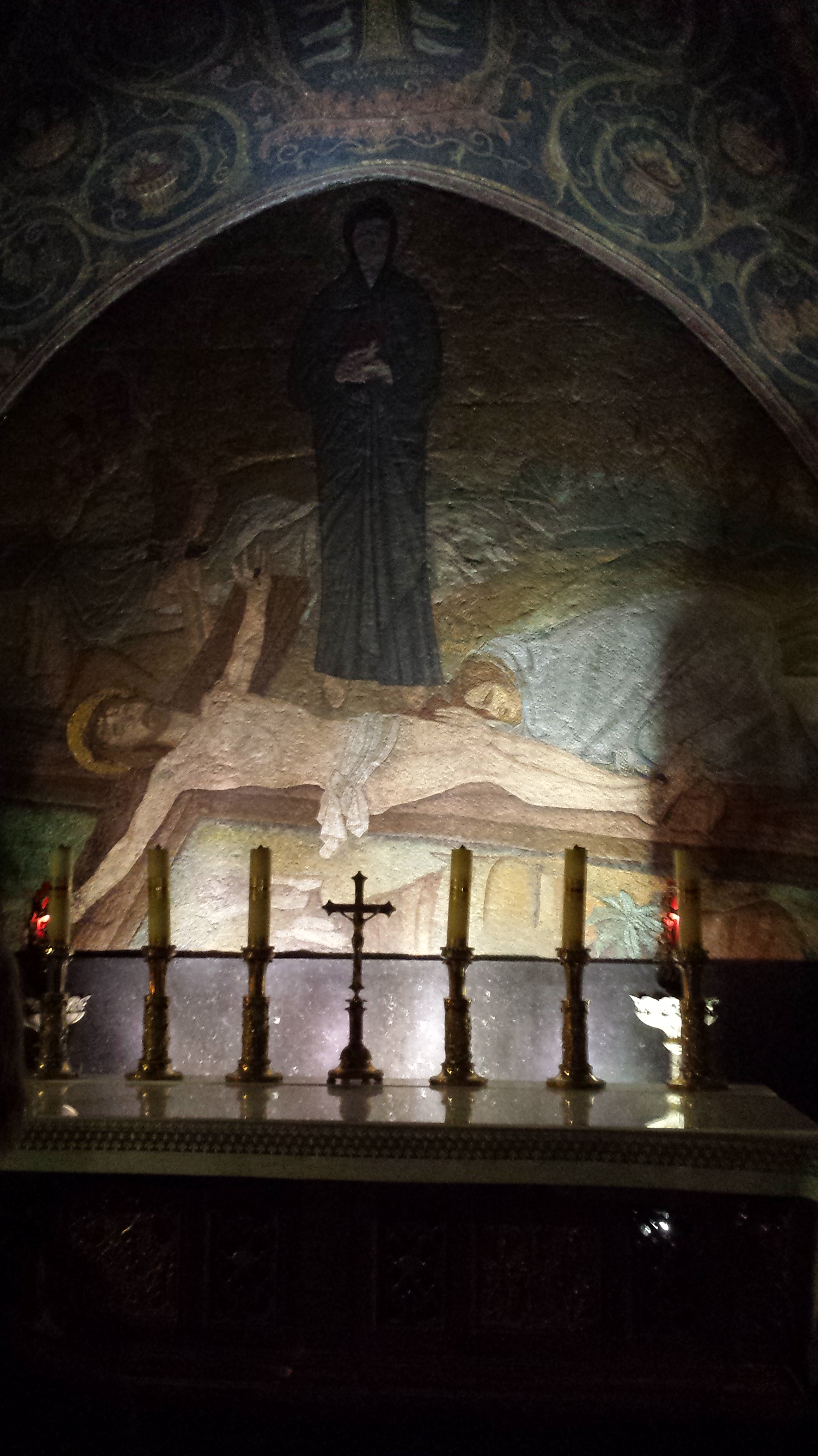
The church contains some of the most authentic sites associated with the location of his crucifixion and initial burial. The church also contains a powerful commemoration of the anointing of his body prior to burial that is a large “anointing stone” inlaid in the floor near the entrance of the church. The stone is overhung with large lamps and has a beautiful mosaic on the wall immediately behind the hanging lamps and stone.

Entrance to the Holy Sepulcher

Entrance to the Holy Sepulcher

Anointing stone inside the entry

Anointing stone inside the entry

The Aedicule where Jesus' tomb is commemorated

The Aedicule where Jesus’ tomb is commemorated

There is also a very ornate and large tomb building called the Aedicule, said to be built over the tomb where Jesus was laid.

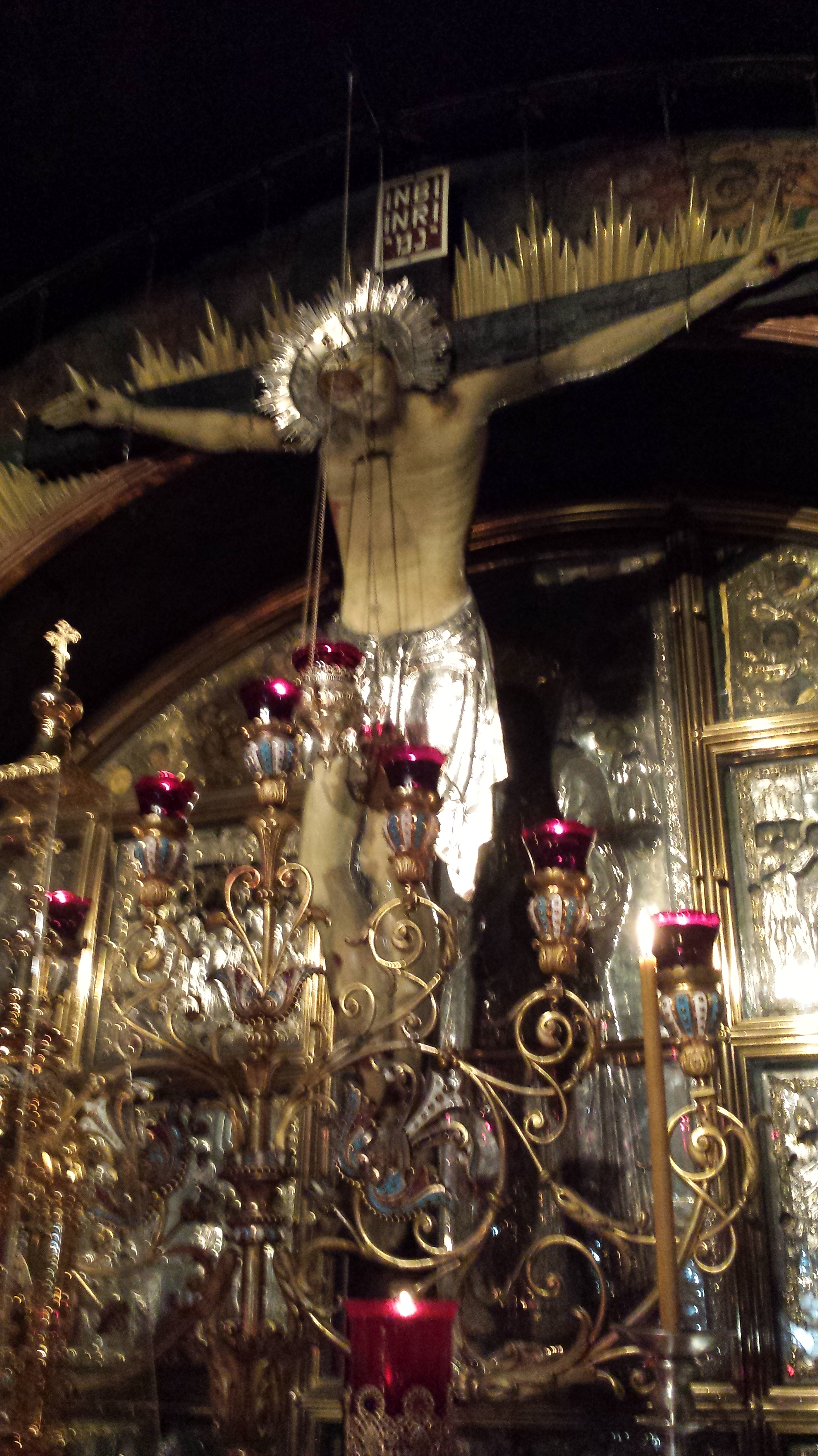
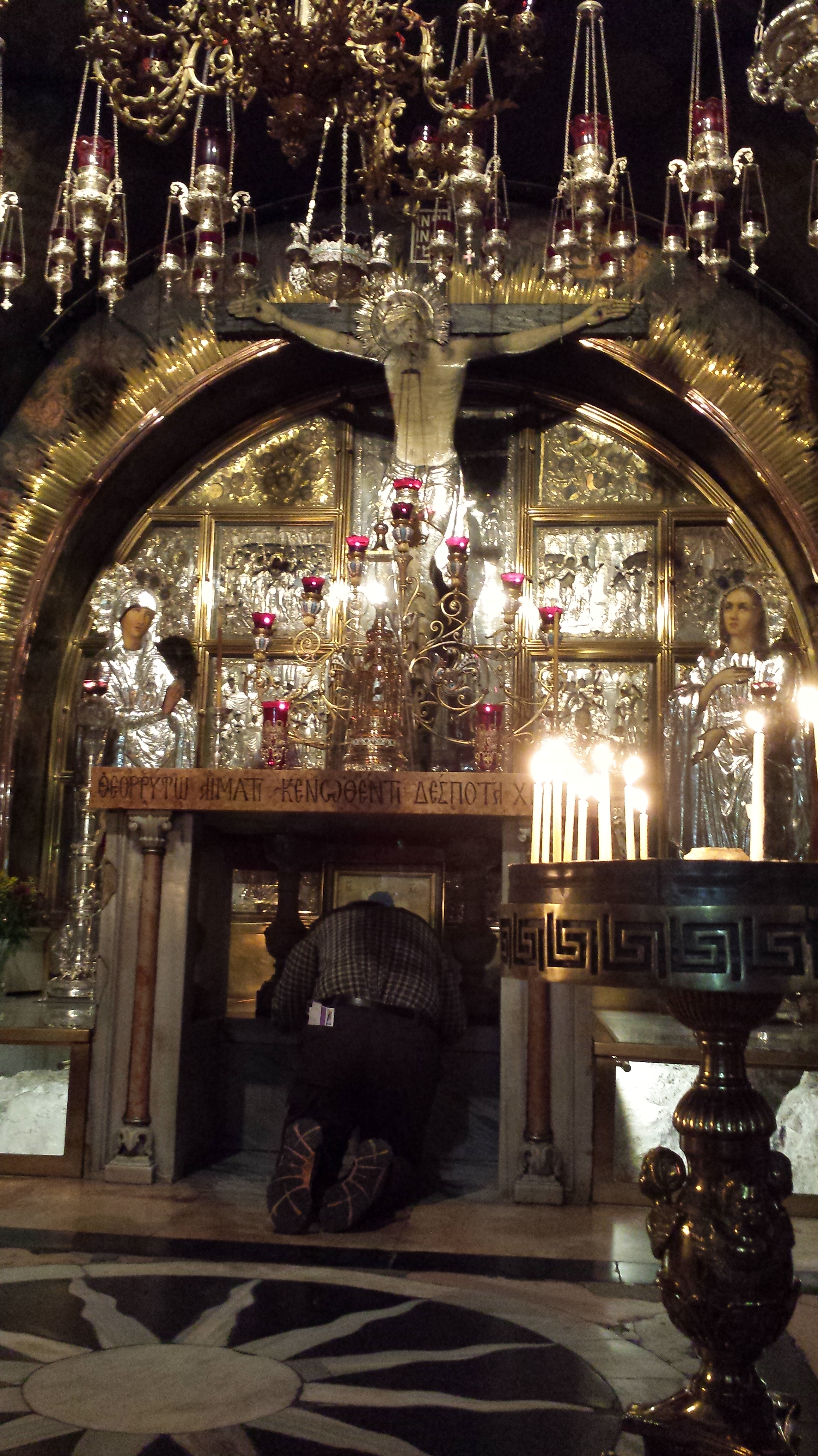
Gogotha shrine

Gogotha shrine

Bishop Greg at the shrine.  Pilgrims can kneel under the altar and reach down through a hole to touch the bed rock.

Bishop Greg at the shrine. Pilgrims can kneel under the altar and reach down through a hole to touch the bed rock.

The primary custodians of the church are the Eastern Orthodox, Armenian Apostolic and Roman Catholic churches, with the Greek Orthodox having the lion’s share. The Coptic Orthodox and Ethiopian Orthodox as well as the Syrian Orthodox have lesser responsibilities. In 1853 an agreement between the churches known as The Status Quo clarified which communities were responsible for which aspects of the large church, with times and places of worship strictly regulated. No part of the church may be rearranged without the consent of all communities. In 1852, a wooden ladder was placed on a window ledge over the church’s entrance at a time when the window ledge was considered common ground. This ladder, known as “the immovable ladder” remains in place to this day.

The immovable ladder above the entry plaza to th Holy Sepulcher

The immovable ladder above the entry plaza to th Holy Sepulcher

After our journey of the Via Dolorosa, we had lunch back at the hotel before a series of experiences related to learning about the perspective of Israeli settlers in Palestine and Israeli Jews in East Jerusalem. We heard an informational presentation before boarding the bus – this time guided by an Israeli settler. We drove into a nearby settlement, where we met with several settlers, many of whom immigrated here from the United States (California, Texas and Colorado). Finally, we drove to the home of a Jewish lawyer, who boarded our bus to give his presentation there.

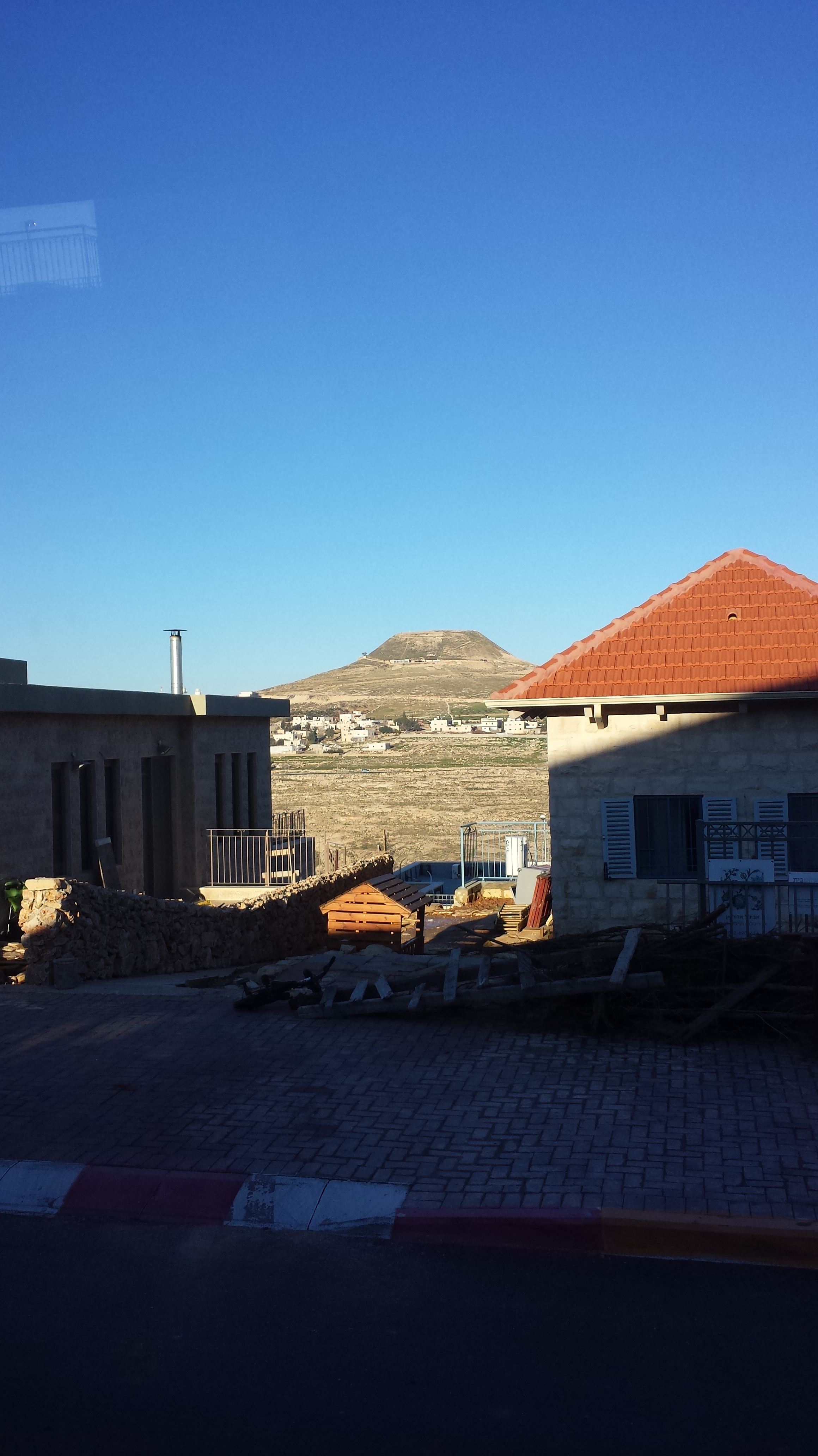
Visiting a Jewish Settlement,  Mount Herodian in the background.

Visiting a Jewish Settlement, Mount Herodian in the background.

This whole experience of the afternoon was actually extremely saddening. In fact, Rachel was so upset by the racist, paternalistic, colonialist and ideological stance that the Jewish settlers shared about Palestinians that after we returned to the hotel, she joined a group going back to the Church of the Holy Sepulcher to pray. However, even after that visit, she still felt depressed and unsettled.

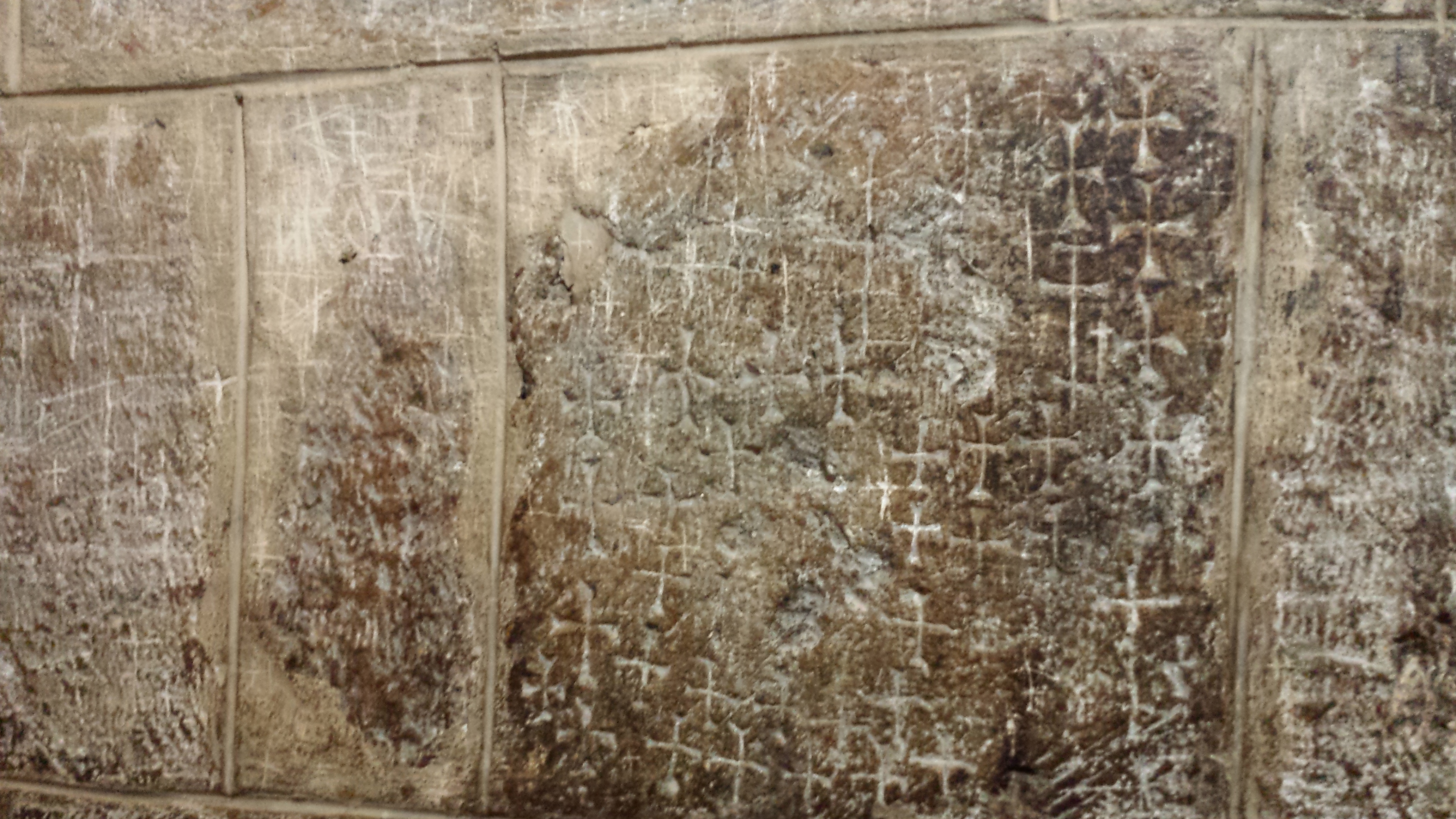
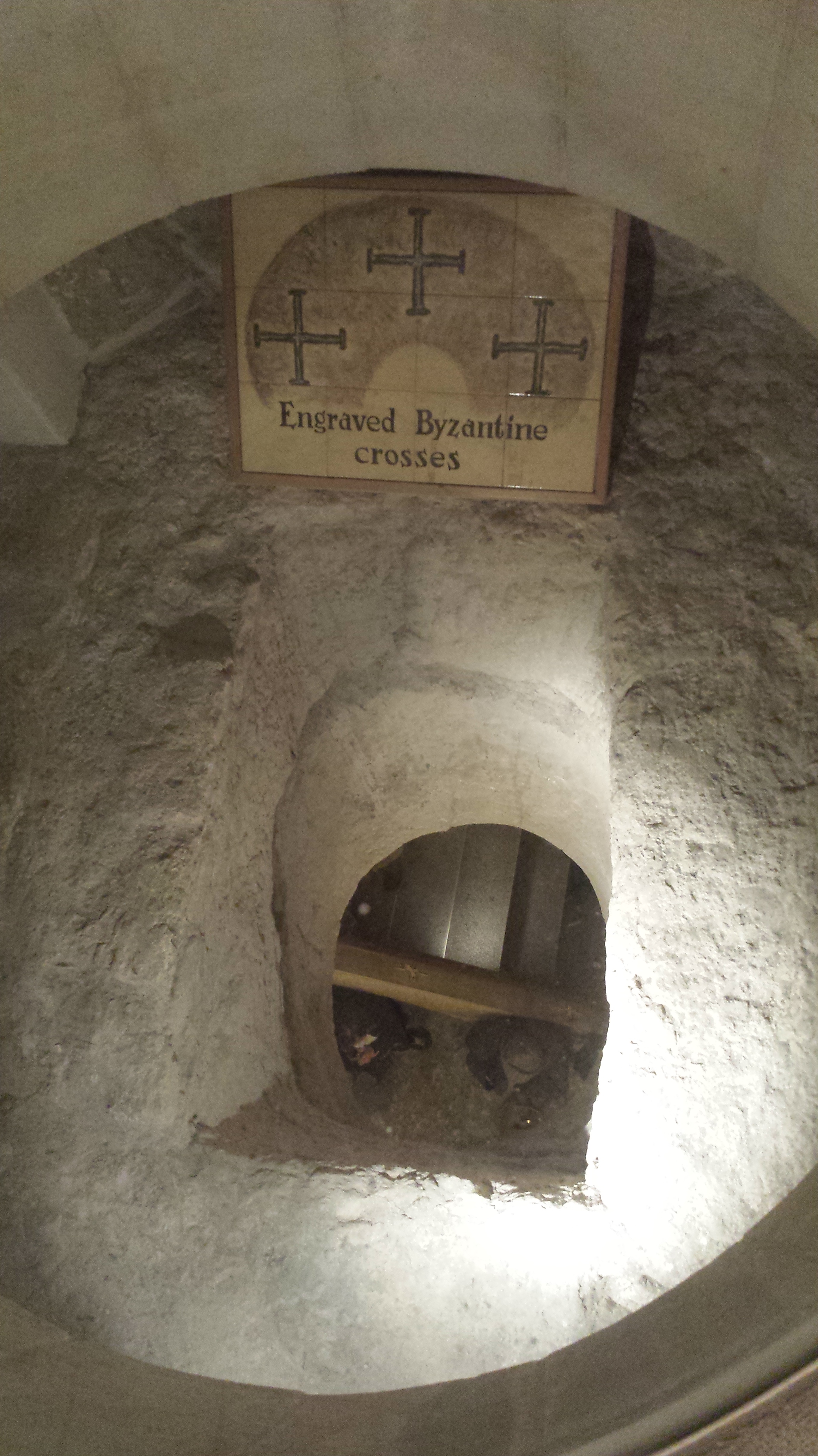
Crusader crosses etched into the walls of the oldest portion of the Holy Sepulcher church

Crusader crosses etched into the walls of the oldest portion of the Holy Sepulcher church

20150120_181226

The base of Gogotha

The base of Gogotha

But, then, on the way back to the hotel – once again walking through the suk – she felt drawn to enter a shop of icons made by the Greek Orthodox monastery in Jerusalem. The shop keep, Anton, patiently set out the icons of various sizes tow which she felt drawn. He served her a mug of tea with mint and honey while she sat for some time in front of several icons – the Annunciation, the Burial of Jesus, and a Madonna and Child. I think you’ll like the one she chose, but I’m going to let her share it with you when she gets back. Anton told her to have the icon blessed while she is here, and she’s definitely going to have that done!

Asp section of the church of the Holy Sepulcher

Asp section of the church of the Holy Sepulcher

What matters is that the exercise, reflection and gentle hospitality of Anton all served to bring her back to calm. She felt healed and rested and finally went to dinner. Our group had a long and important debriefing session after dinner, and now I’m finally caught up on my blog.

Here’s to listening to the needs and concerns of squirrels,

Henry

Henry Goes to the Holy Land – Day 7

Leave a comment

January 19, 2015

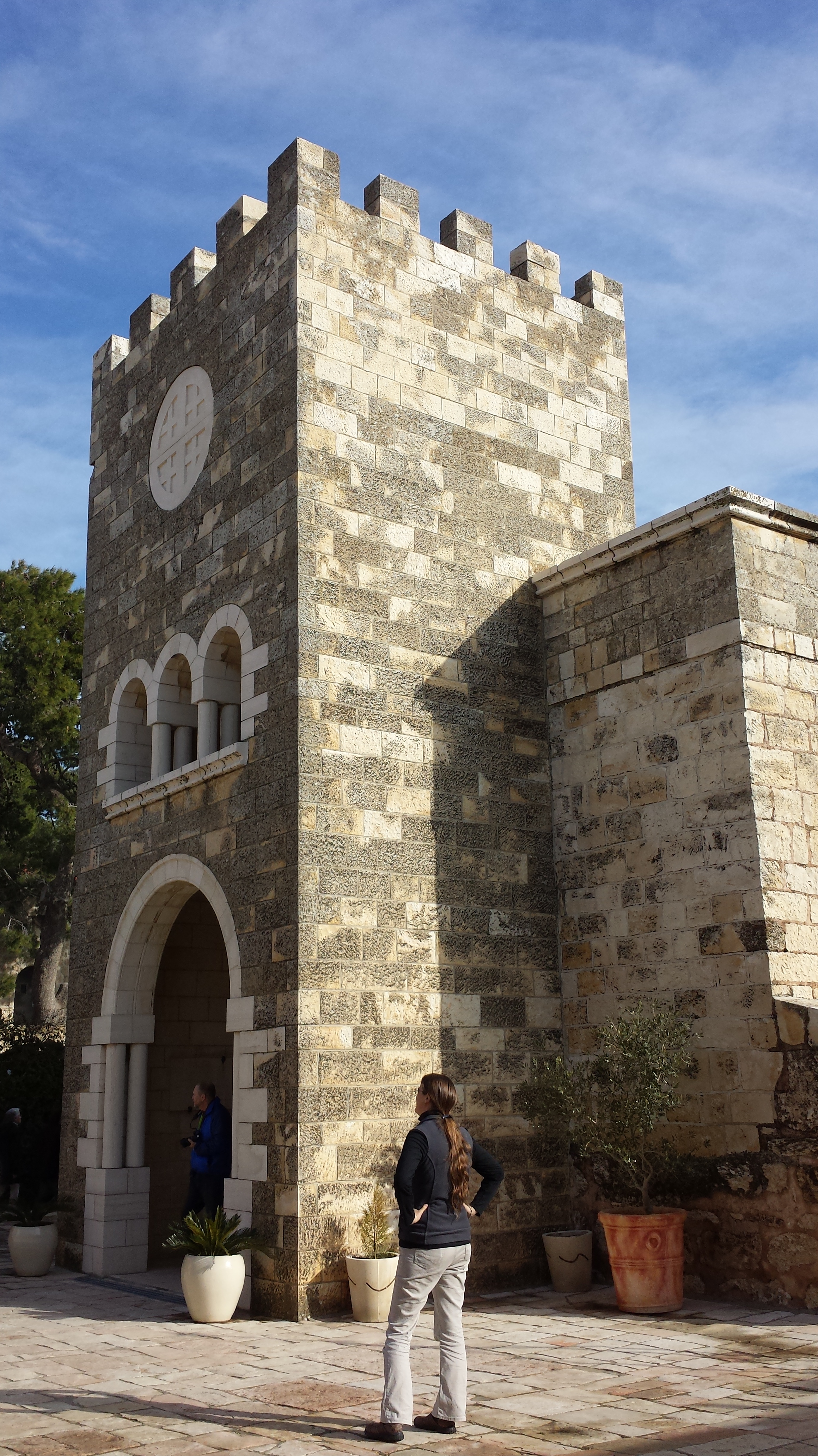
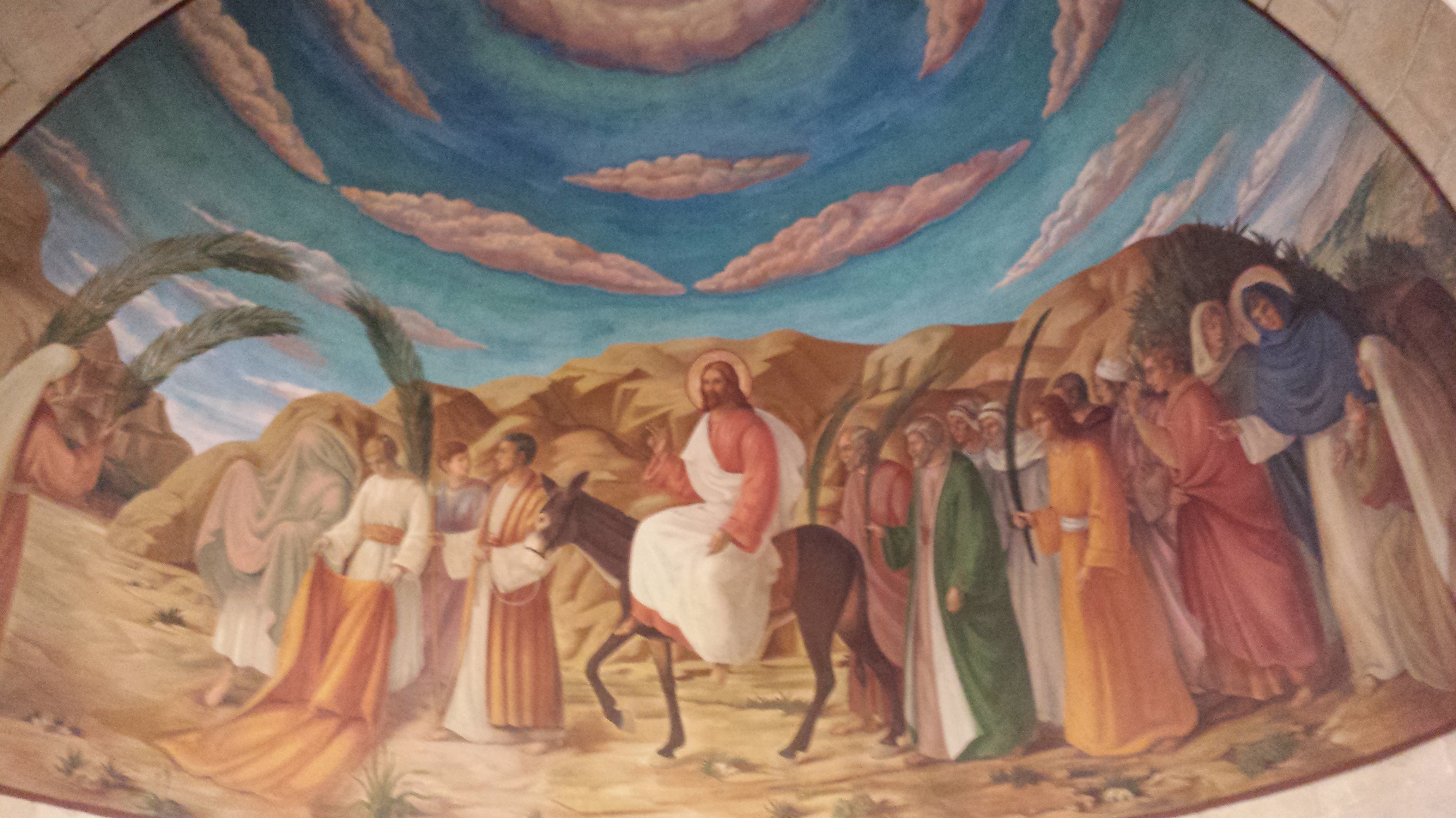
Today was a very full day exploring the vicinity immediately around Jerusalem. We began at a small church in Bethphage, which is located just west of the Separation Wall that cuts off the road to Bethany (where we stopped the other day on our way here from Bethlehem). Bethphage is where Jesus is said to have been seated on a donkey (colt) for his ride into Jerusalem for Passover (Luke19:28-40). The church here is run by the Franciscans. We were allowed to visit the church and held a brief service.

20150119_090229

Church exterior

Church exterior

Interior fresco

Interior fresco of Jesus’s procession into Jerusalem on a donkey acquired at Bethphage.

Fresco on a box shape

Fresco on a box shape

Just across a side street from the church, in among the neighborhood, are the ruins of a Palestinian home recently demolished by the Israeli military. The family owns the land and applied for a building permit for the home, but (as is usual) the permit was delayed, and they built without it. Finally, having lived in the home for fourteen years, they were informed that the permit was refused and that they needed to leave it. There was no deadline on the eviction notice.

Demolished Palestinian home.

Demolished Palestinian home.

The eight families who lived in the home awoke to the sound of bulldozers in the early morning three days later and barely escaped before a bulldozer broke through the wall to gut the interior of the home. This is, unfortunately, a common scenario.

Church of the Our Father

Church of the Pater Noster

Our next stop was the Church of the Pater Noster (Our Father). It stands on the traditional site associated with Jesus teaching The Apostles how to pray the Our Father. The 4th century Byzantine church has been partially reconstructed and includes the remains of a first century cave that is now a Carmelite chapel, where we held a brief service.

Garden

Garden

Cave

Cave

The Lord’s Prayer is represented in over 100languages on tile inscriptions in the garden and church.

Braille version.

Braille version.

Church

Church

20150119_094108

20150119_095623

20150119_110212(0)

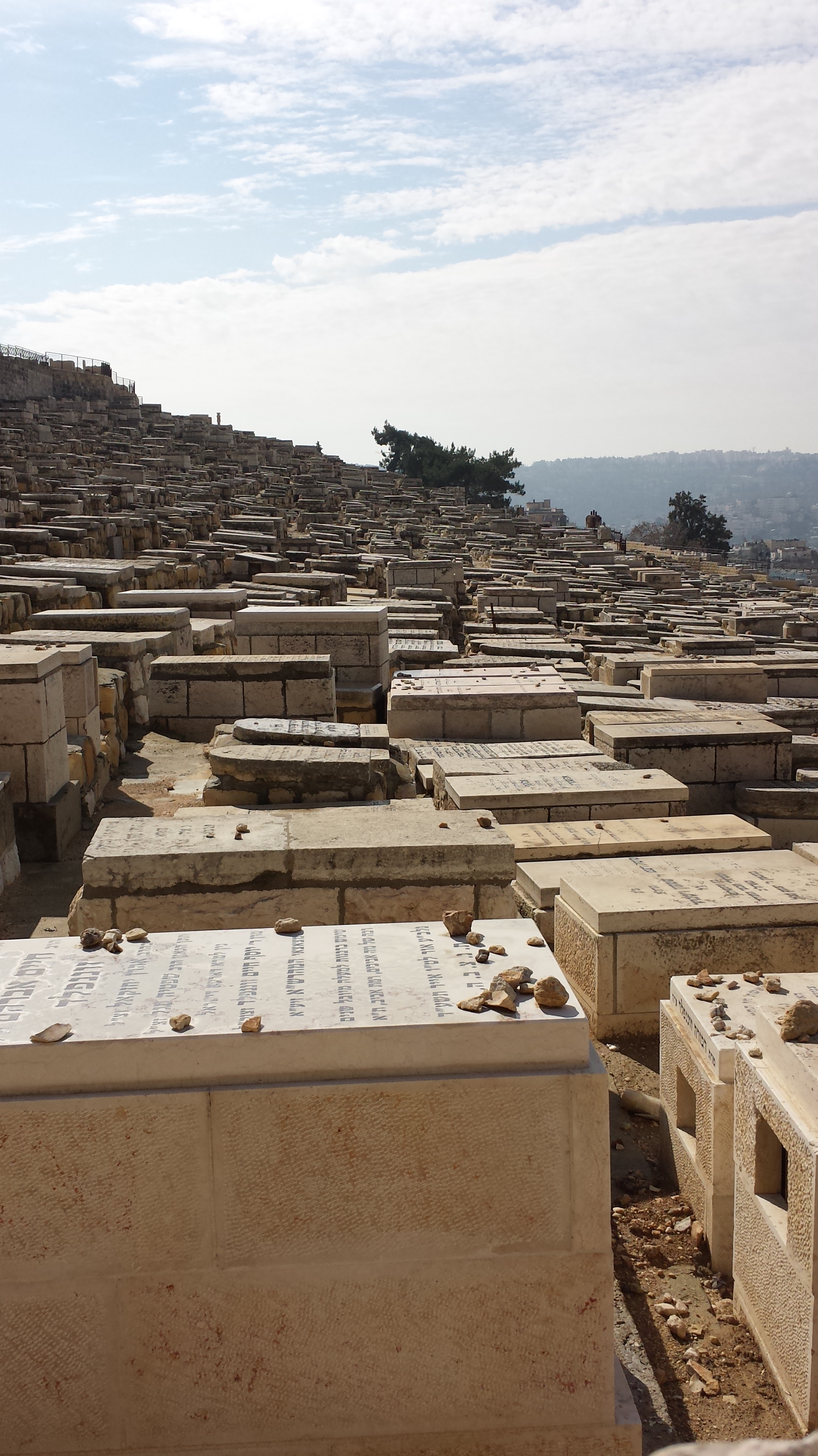
On the walk down from the Mount of Olives,  we stopped in the vast Jewish cemetery on the eastern side of the Kidron Valley that faces west towards Jerusalem.  The cemetery closest to the walls of the city, on the western slope of the valley is Muslim.

Jewish cemetery

Jewish cemetery

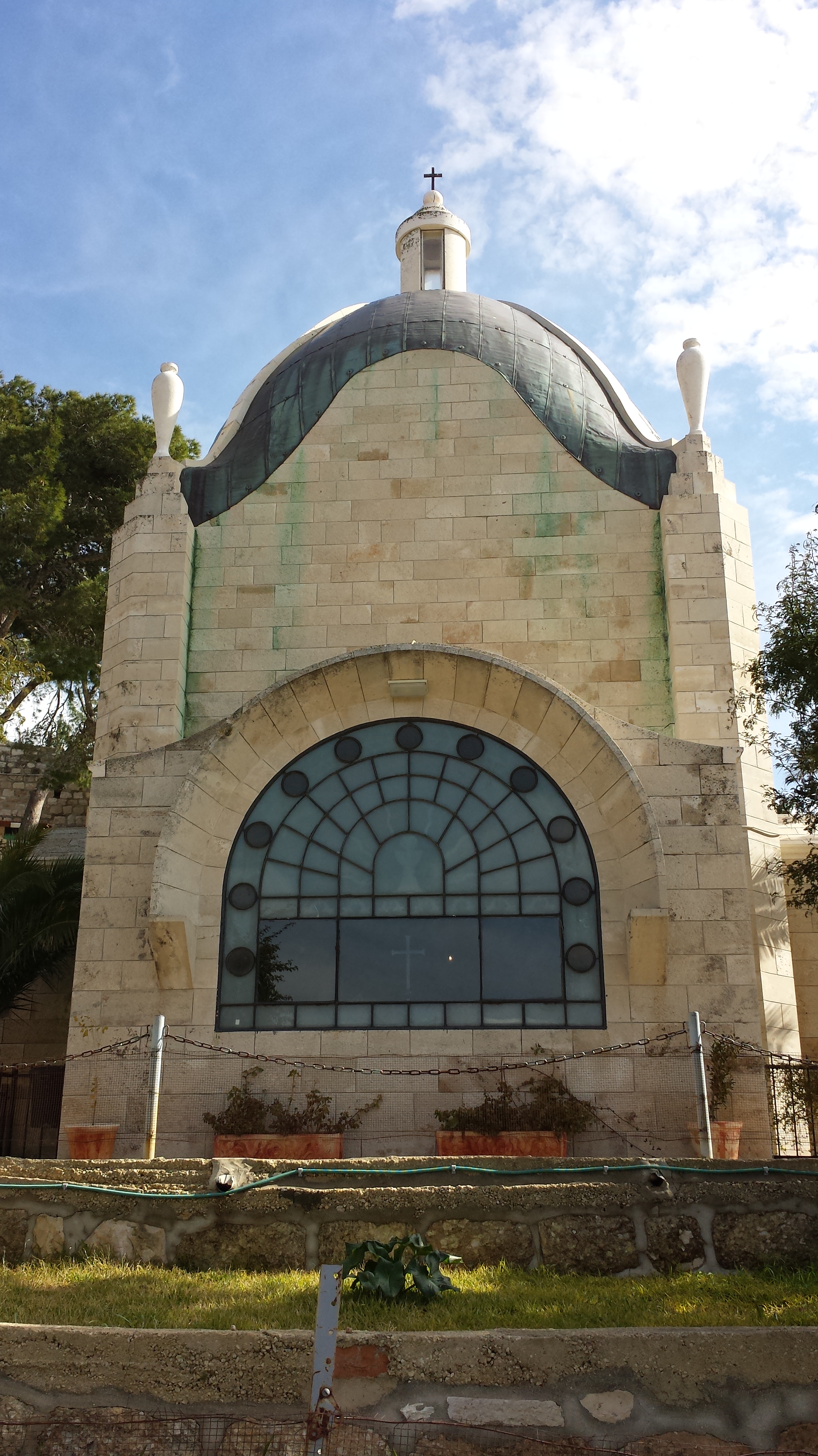
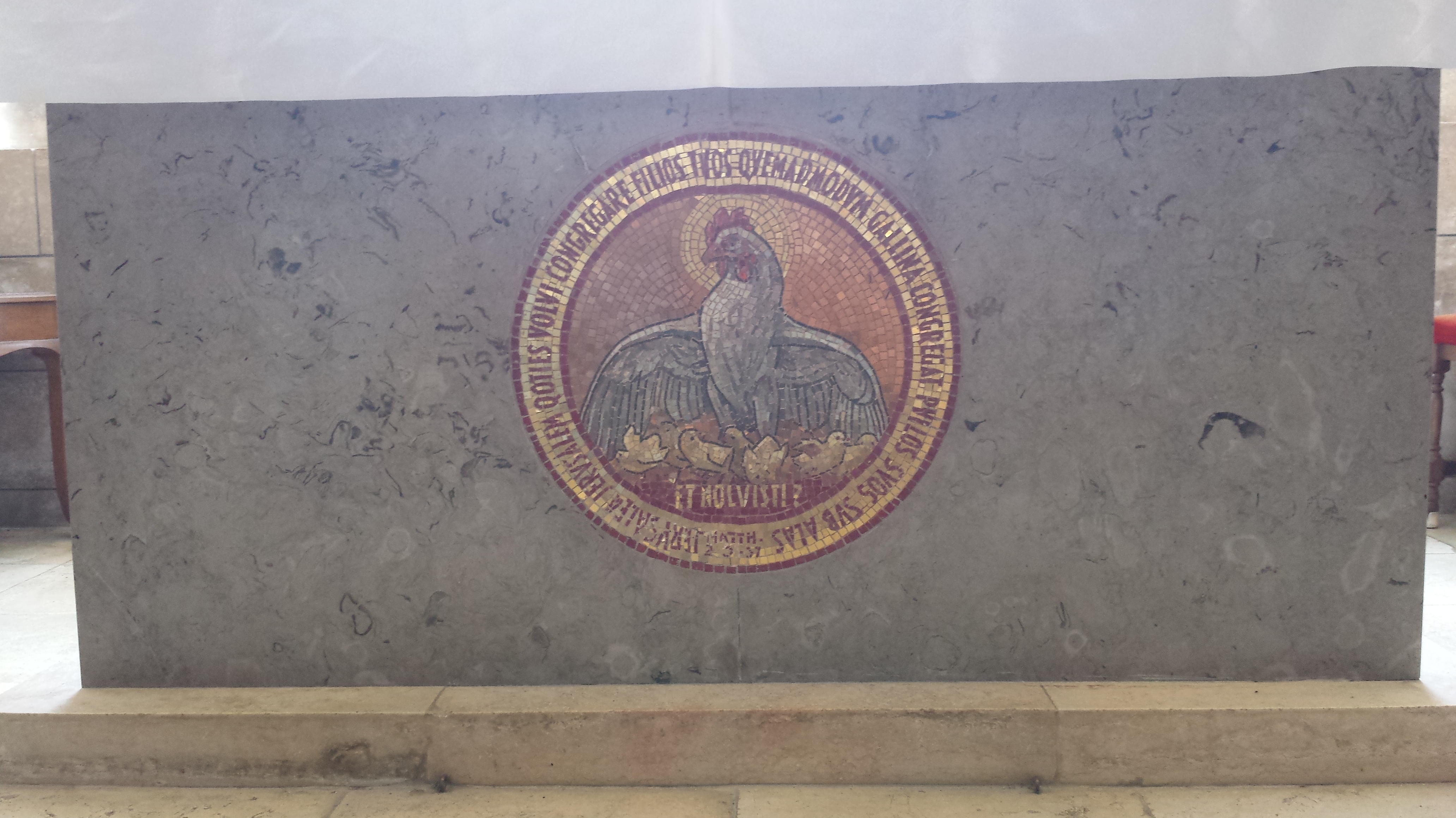
Next we visited the church on the Mount of Olives known as the Dominus Flevit, the place where “the Lord wept” for Jerusalem, longing to gather its people together “like a hen gathers her brood under her wings” (Matthew 23:37-39).

Dominus Flevit church

Dominus Flevit church

Altar at Dominus Flevit

Altar at Dominus Flevit

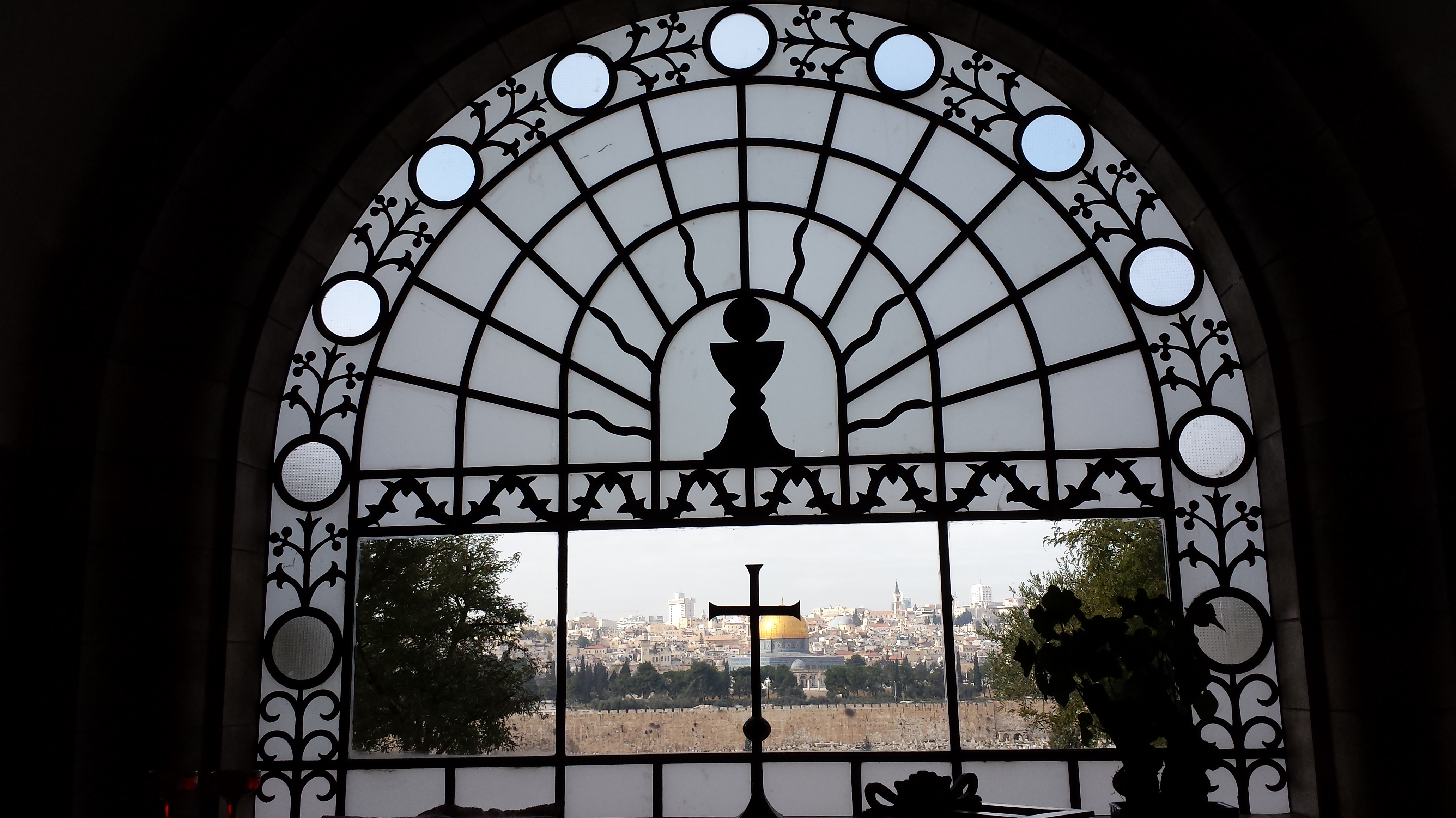
Window above th altar overlooking Jerusalem

Window above th altar overlooking Jerusalem

The clear leaded glass window above the altar is centered on Jerusalem, which means the church faces west, towards the place of Christ’s death (unlike most churches which face east, the direction associated with new life and resurrection). We held another brief prayer service with a hymn in this place before exploring the grounds and garden surrounding it. There is a first century Jewish ossuary cemetery here.

Ossuaries, stone boxes where bones are housed after bodies decompose.

Ossuaries, stone boxes where bones are housed after bodies decompose.

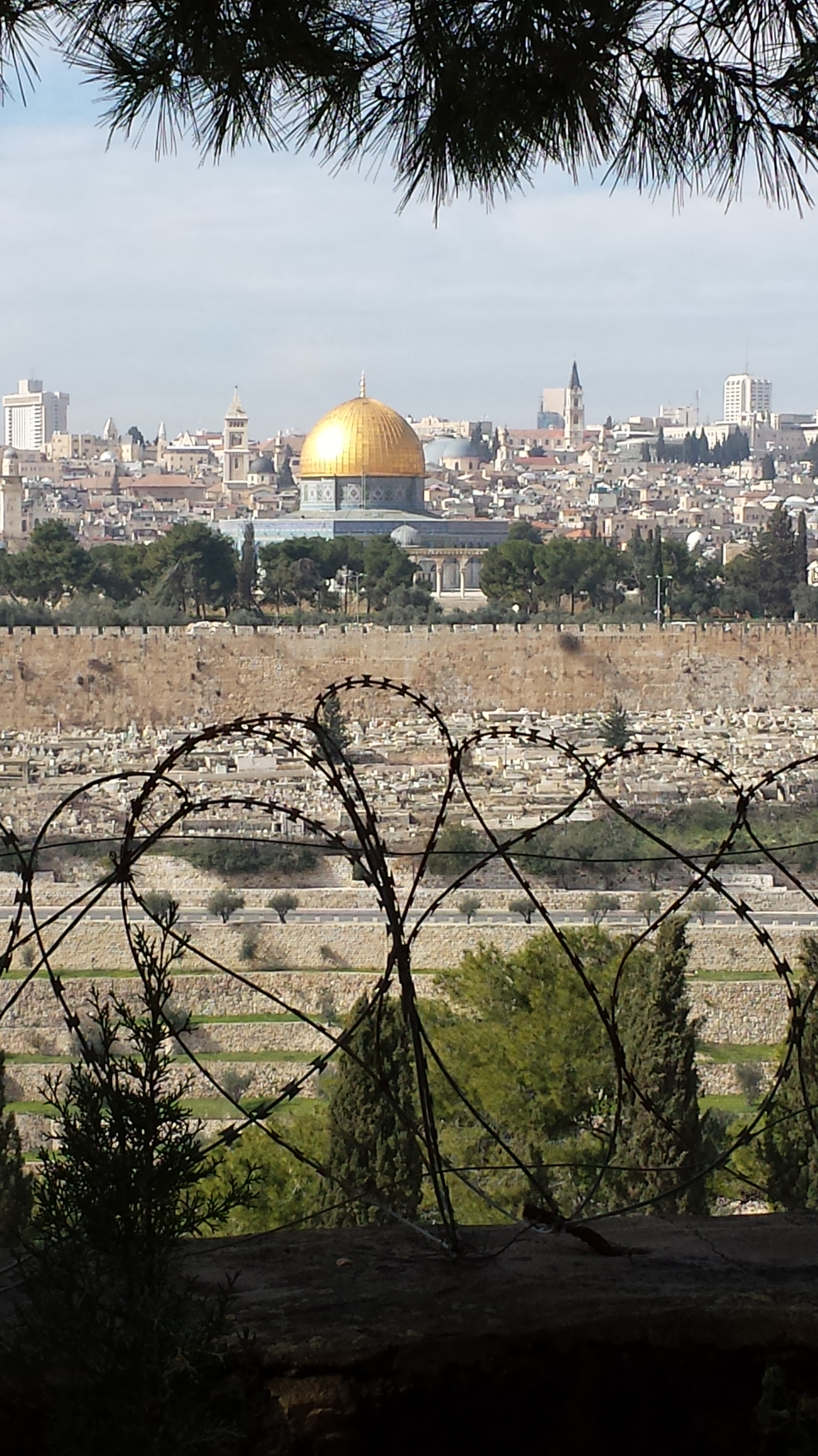
A view of Jerusalem - a city with many barriers to peace

A view of Jerusalem – a city with many barriers to peace

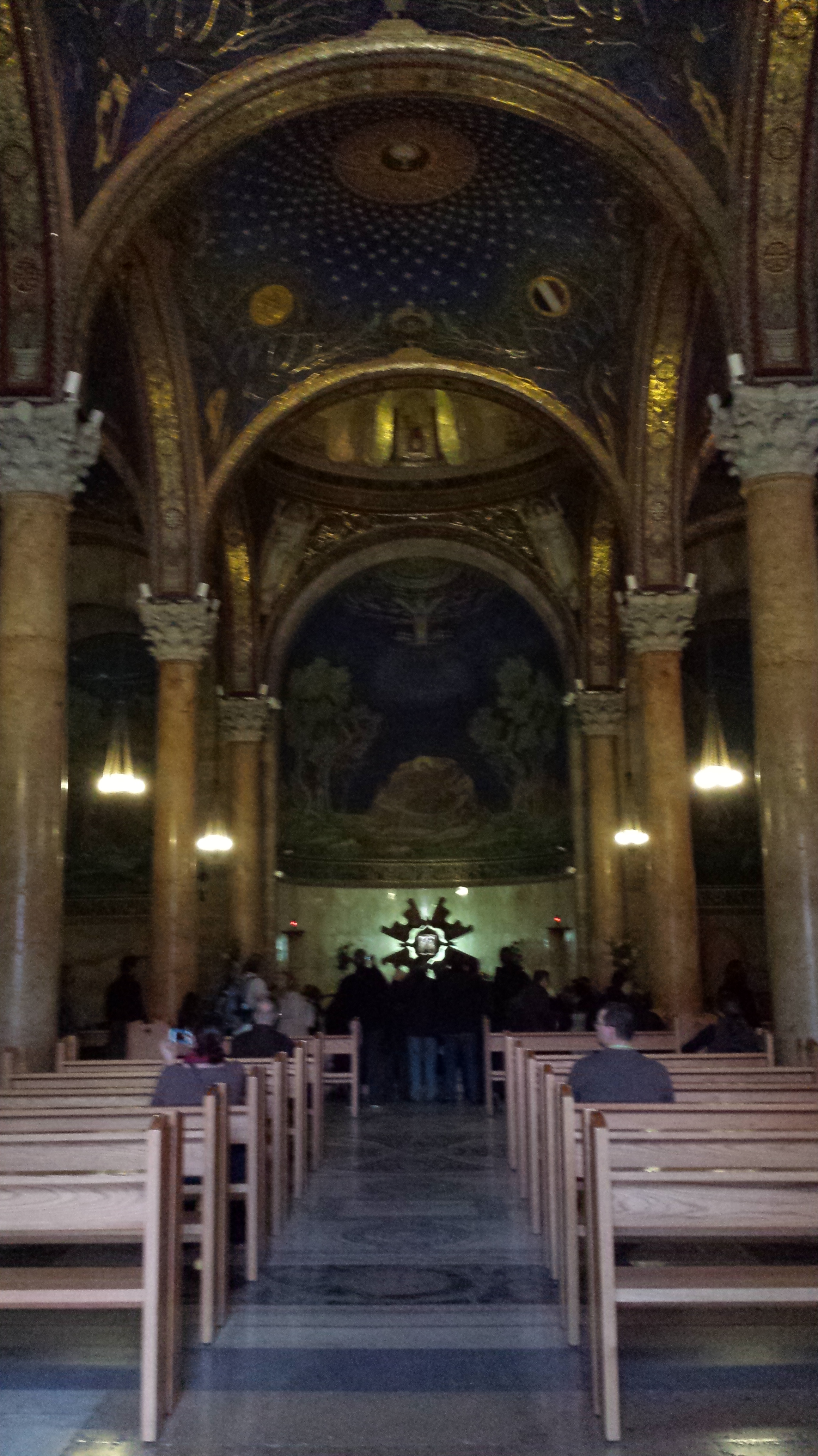
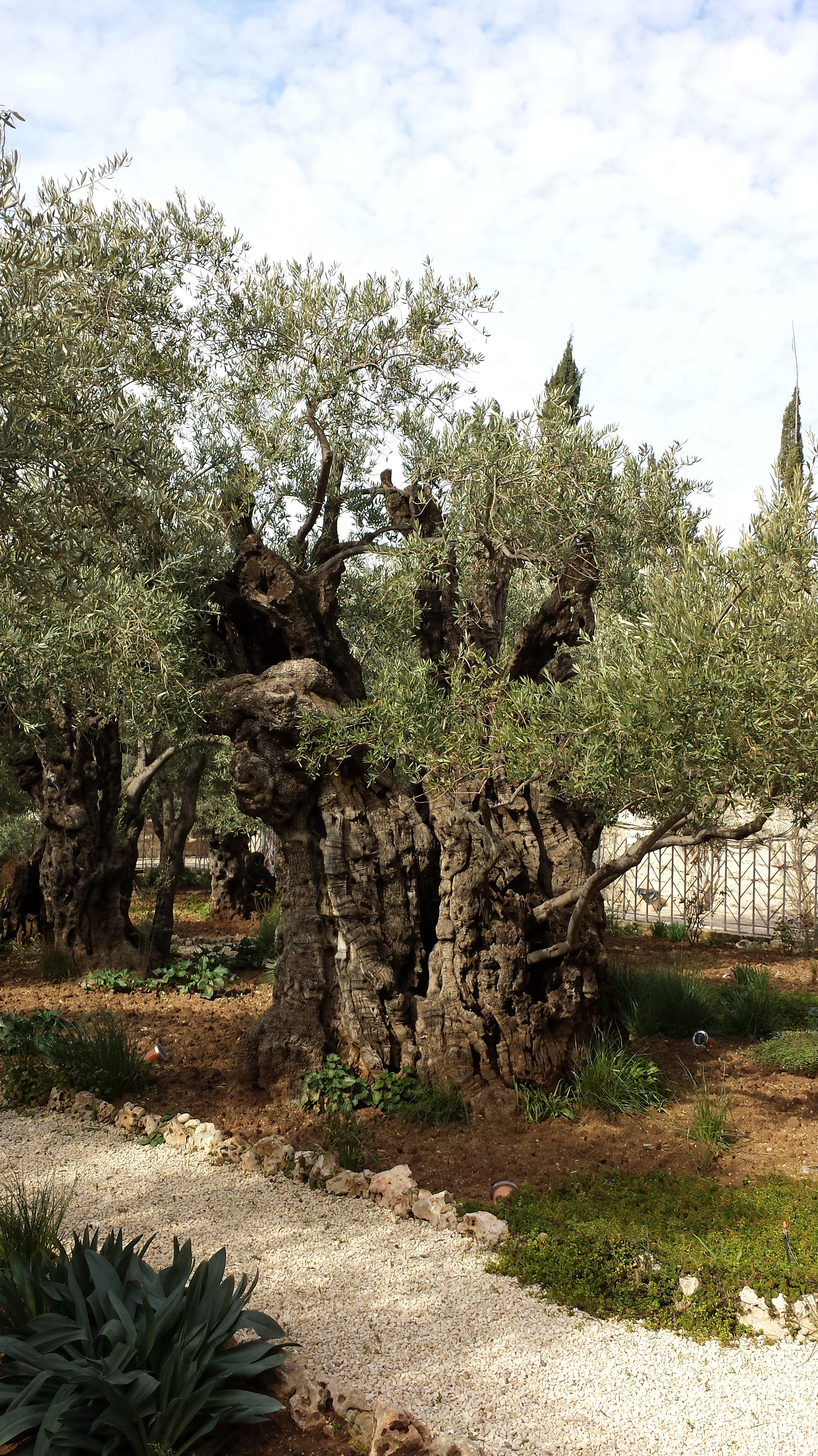
We walked down from the Mount of Olives to The Church of All Nations at the modern location for Gethsemane – the “place of the olive press.”

The Church of All Nations

The Church of All Nations

Interior

Interior

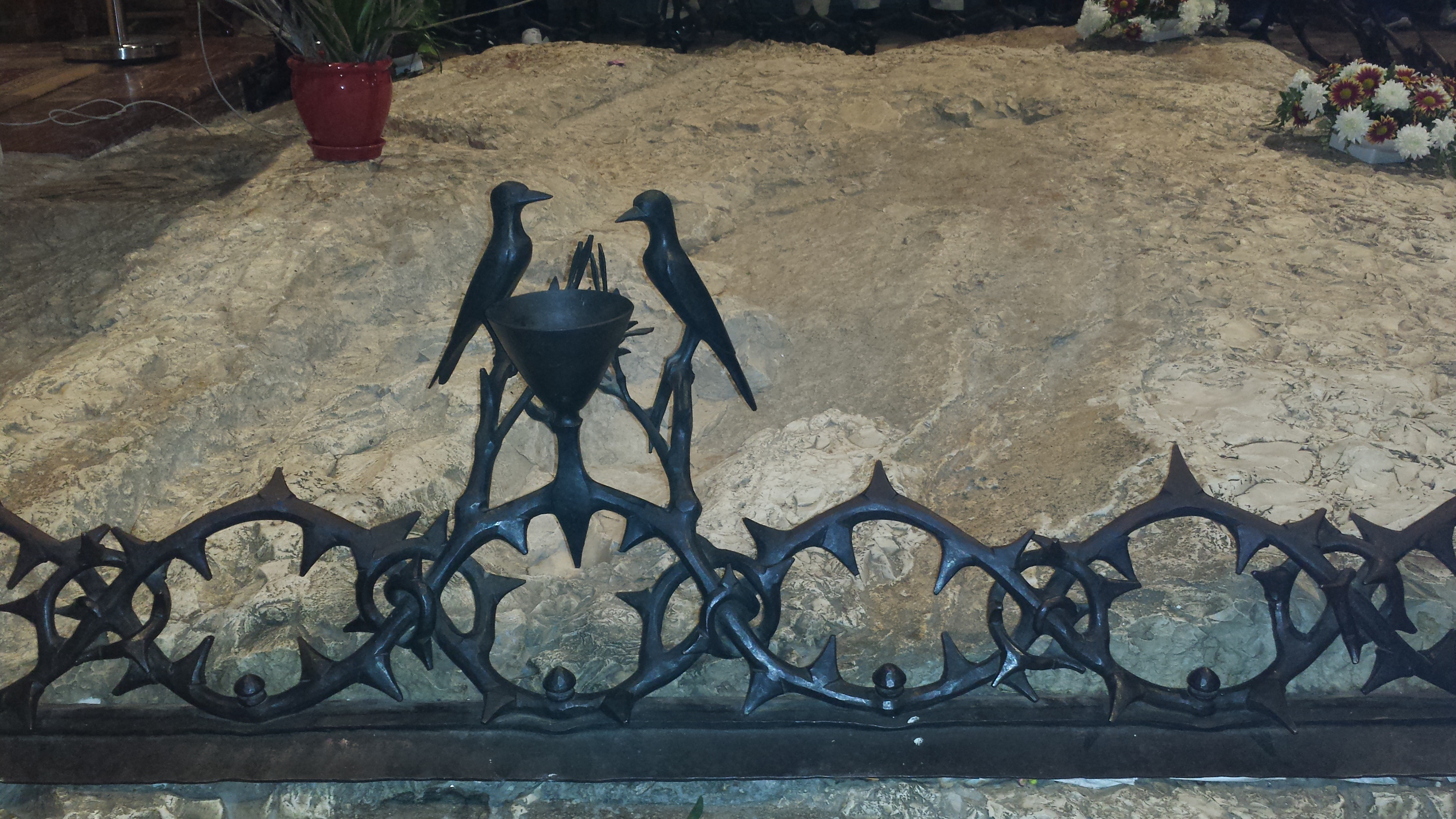
This large church contains within it an exposed area of rock (near the altar) where Jesus is believed to have prayed and wept before his arrest. So, the rock is referred to as “the stone of agony.” As many pilgrim groups do, we were permitted a few minutes to gather around the stone for a brief service and hymn.

Stone of Agony, located near the altar

Stone of Agony, located near the altar

We had some time to explore the church and olive grove outside it. Unfortunately, we did not have the opportunity to see the cave associated with the olive press, where many believe the apostles stayed and slept the night before Jesus’ arrest.

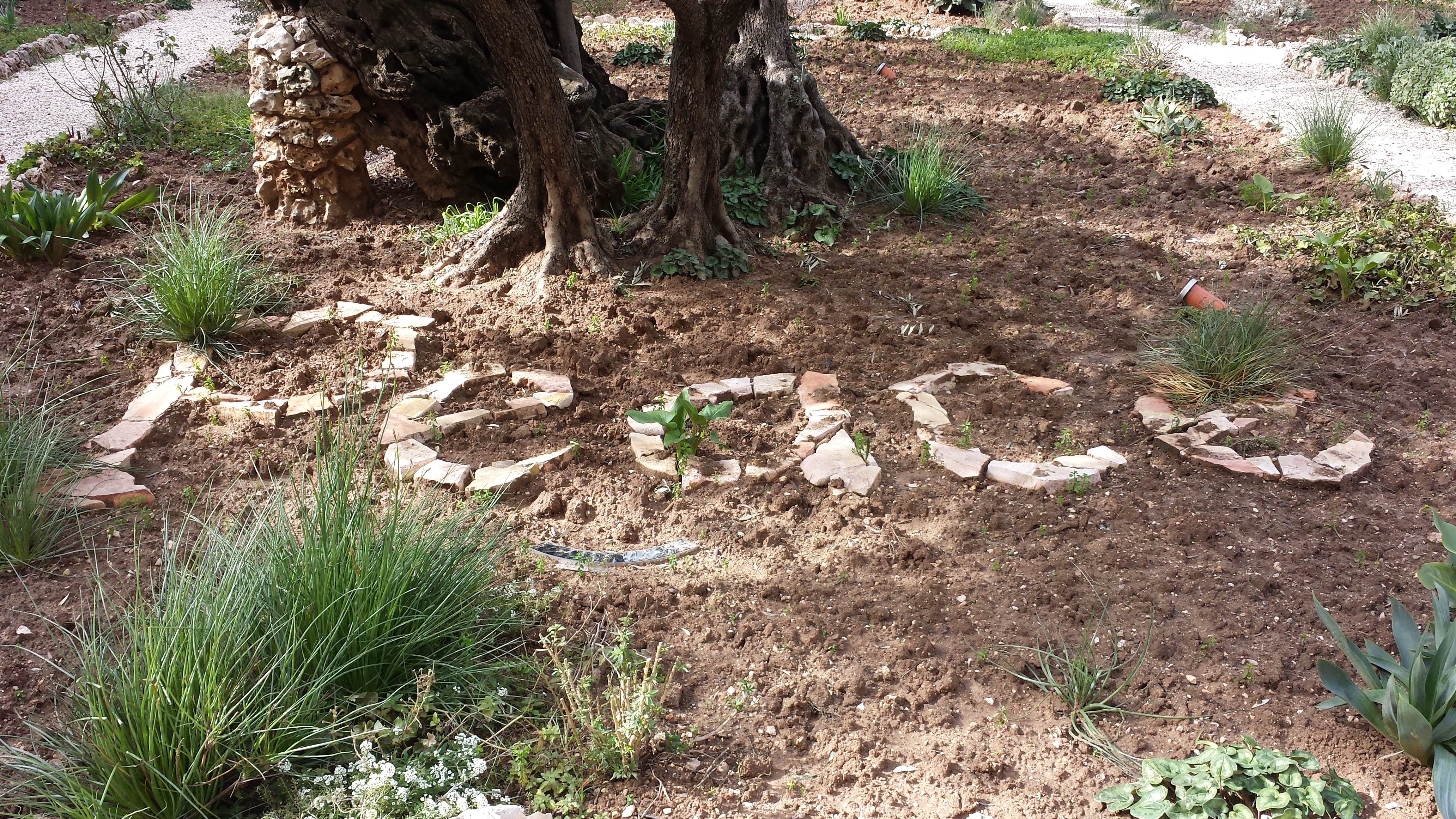
Olive grove beside the church

Olive grove beside the church

20150119_114655

Then we boarded the bus once more for a visit to three sites located on Mount Zion, the area where Jesus and the apostles seem to have headquartered whenever they were in the area nearest to Jerusalem.

Mount Zion area

Mount Zion area

Our first stop was to a crusader era church that was remade into a mosque but which is associated with the story of the Upper Room. The space is known as The Cenacle, and given it’s age is very unlikely to have at all been the location of the upper room.

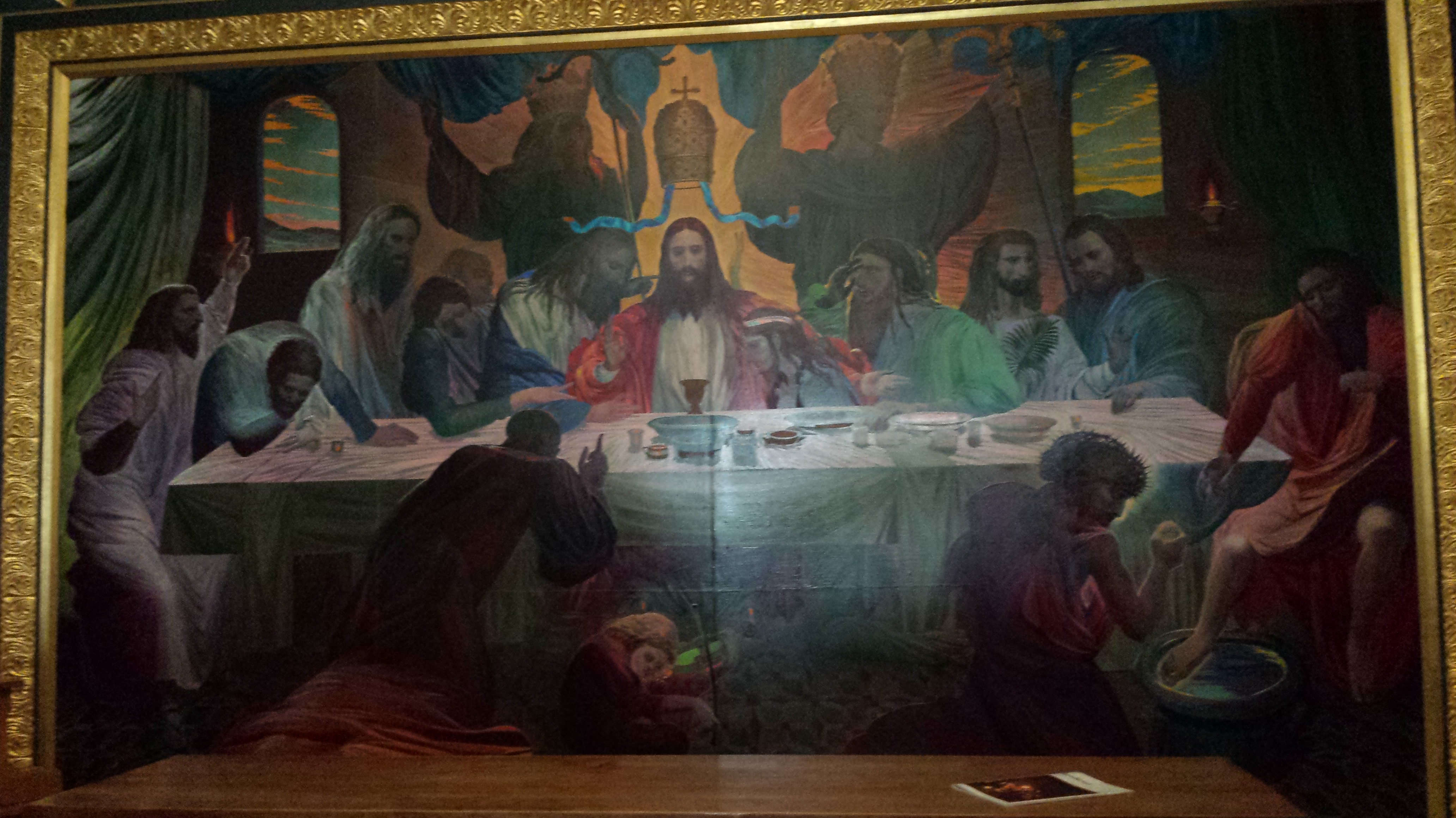
The Cenacle interior

The Cenacle interior

That said, it is possible that Mount Zion was the place where the upper room was located somewhere, and this site does commemorate that space. We said a brief service with a hymn here before moving on.

Dormition Abbey room

Dormition Abbey room

Br. Gregory

Br. Gregory

The next site on Mount Zion was the Dormition Abbey. This church is the domain of a German Benediction community, though it’s very gracious and charming abbot is from Belfast, Ireland. Brother Gregory met with us for about an hour, sharing the history of the Benedictine community there and the role it plays stabilizing relationships between Palestinians and Jews in their immediate area.

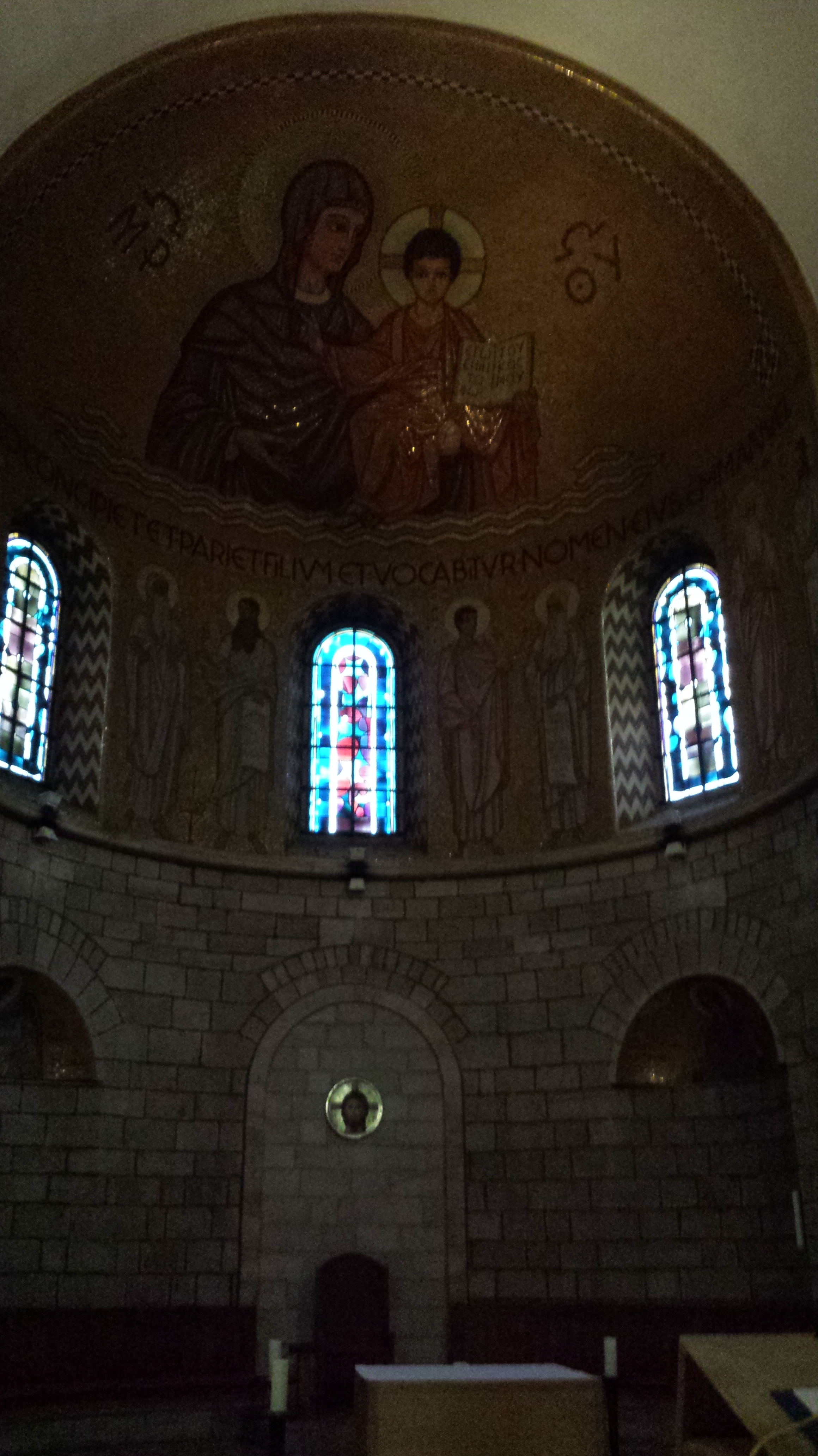
Dormition Abbey upper nave

Dormition Abbey upper nave

Crypt of the Dormition

Crypt of the Dormition

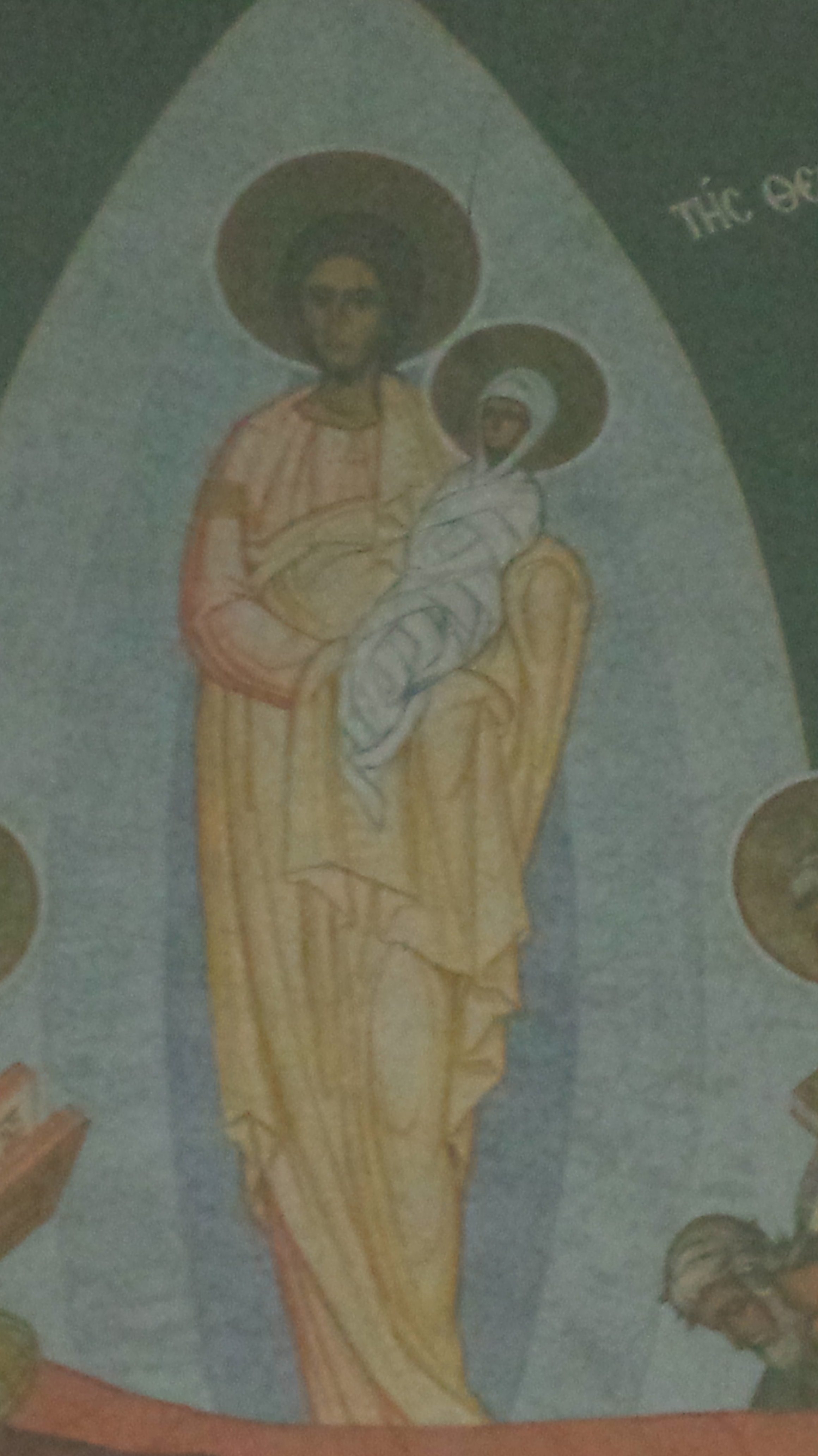
Fresco of Christ holding his Mother Mary - Crypt of the Dormition

Fresco of Christ holding his Mother Mary – Crypt of the Dormition

Fuller view of the same fresco

Fuller view of the same fresco

An exploration of the church buildings includes a crypt dedicated to Mary’s death. Mount Zion is said to be where Mary died, because she lived there after Jesus’ death. There are other strains of Christian tradition that place her death elsewhere, but Mount Zion is very likely.

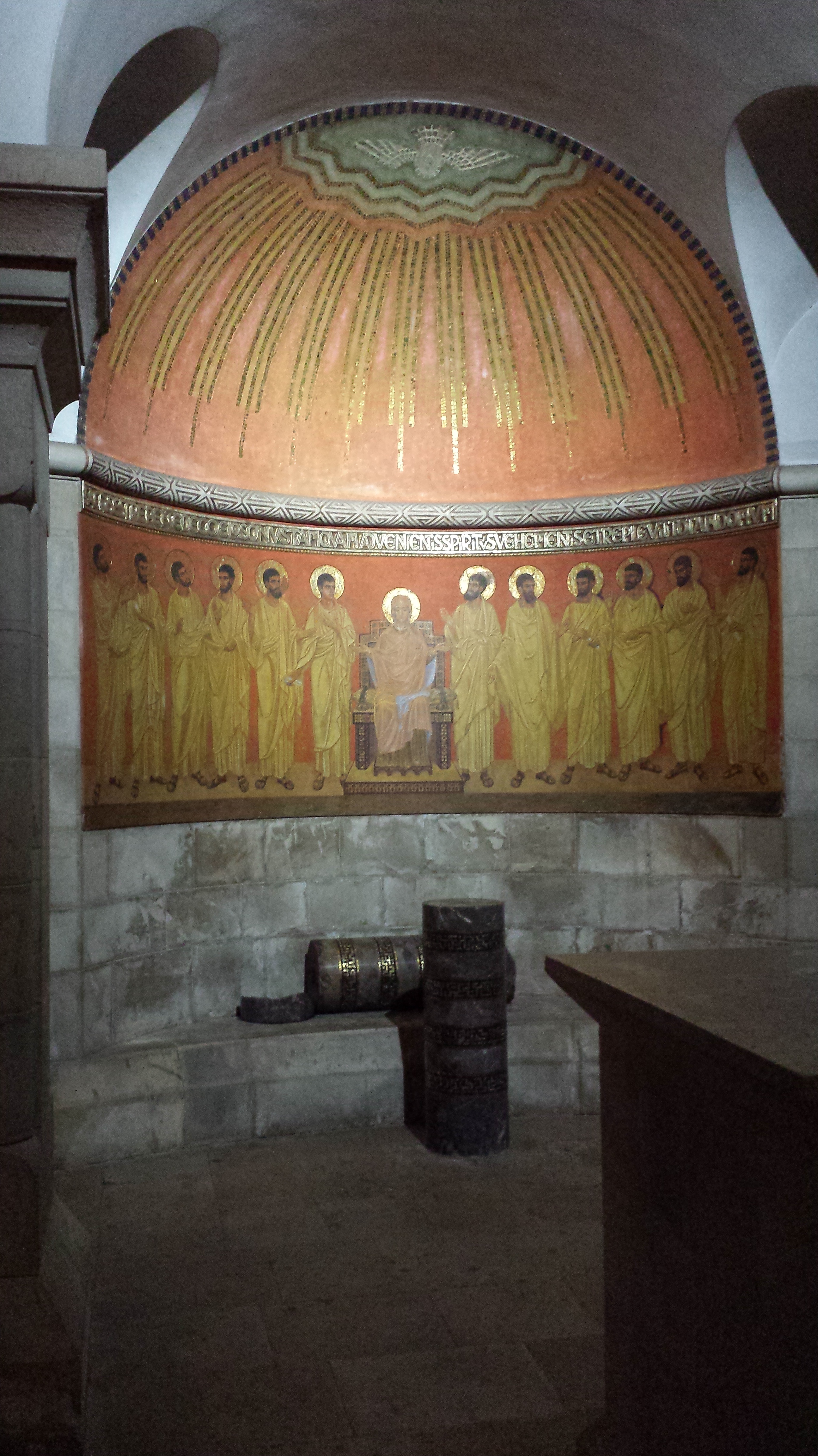
Mosaic of Christ and the Apostles

Mosaic of Christ and the Apostles

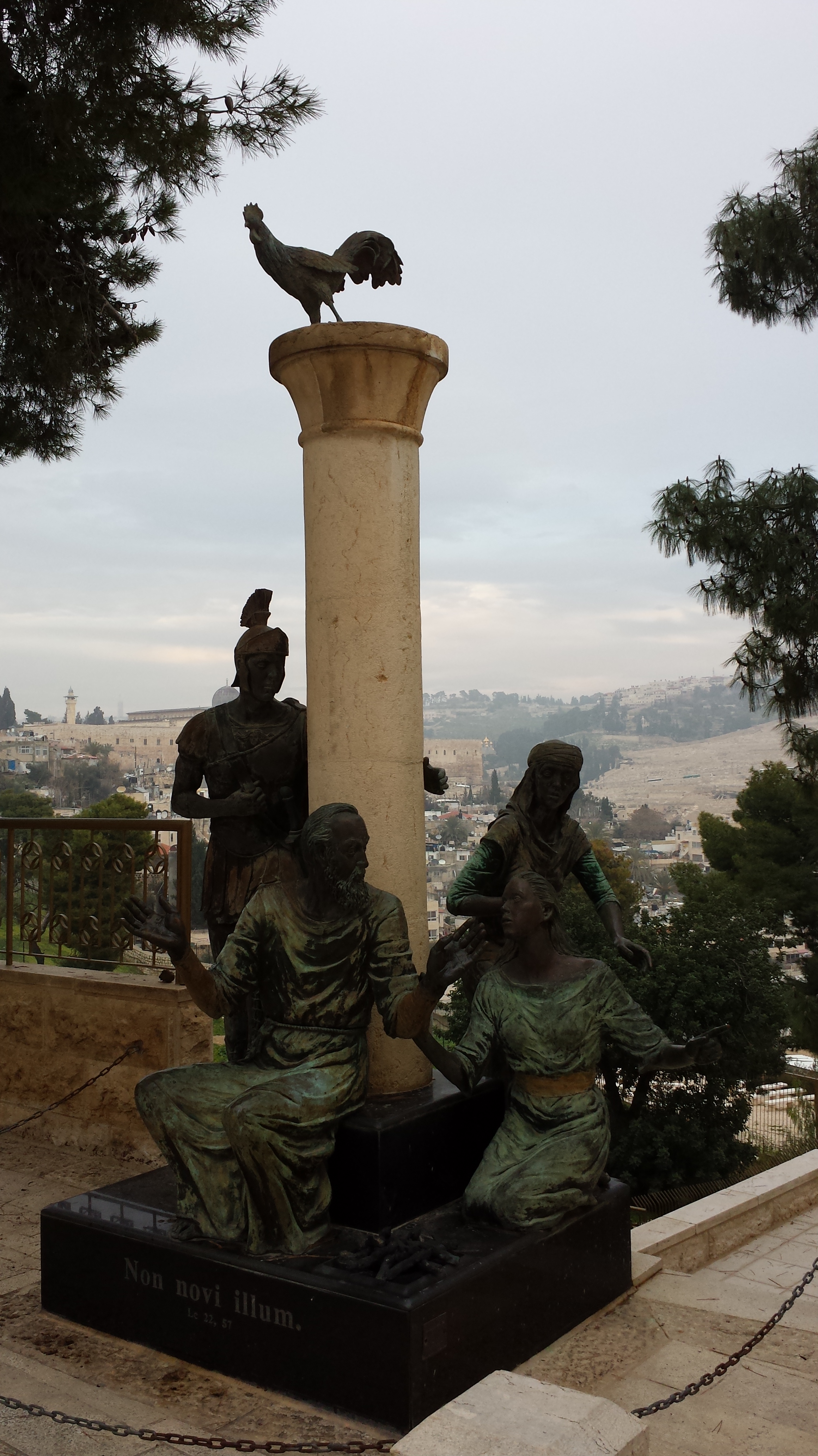
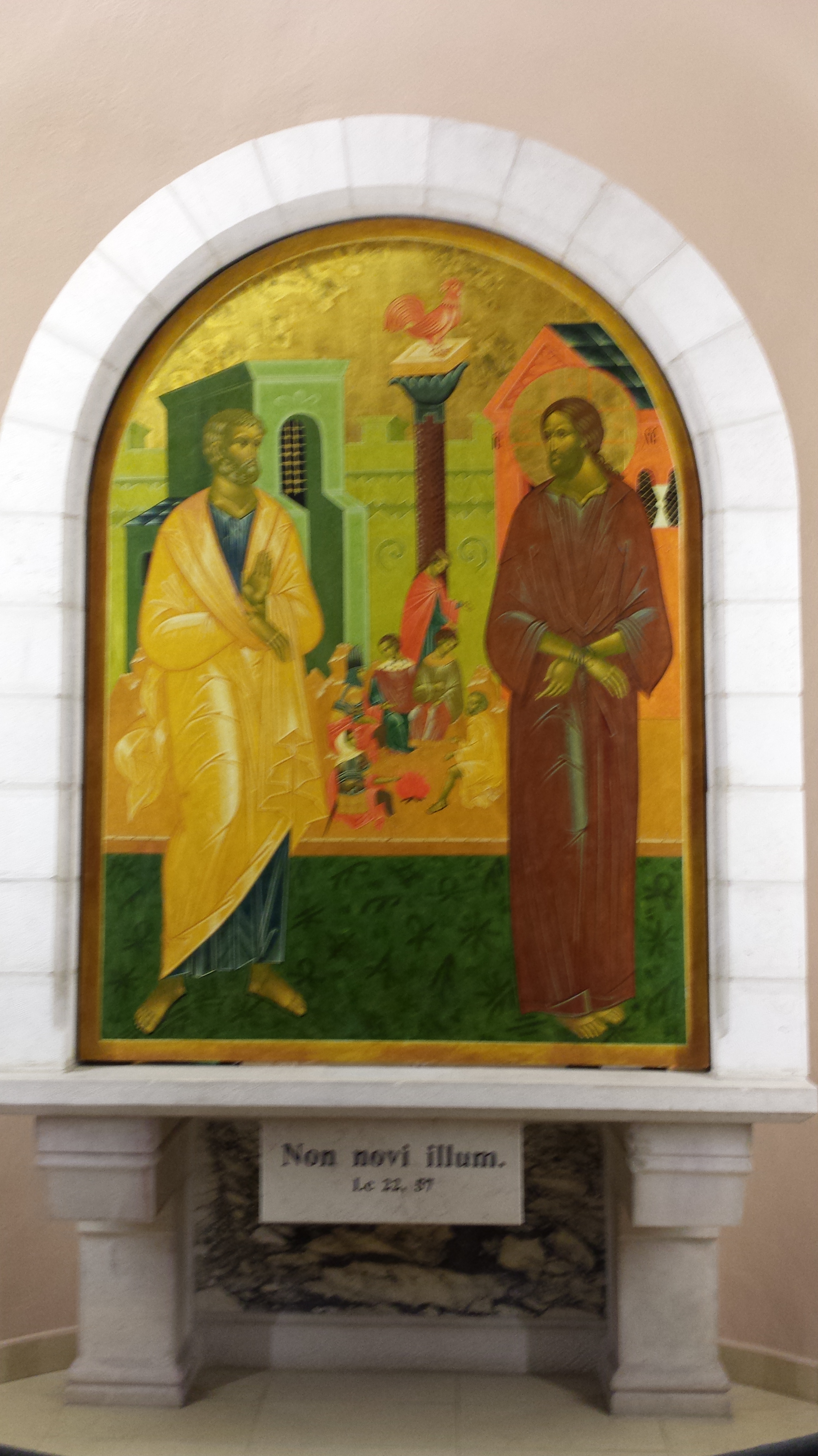
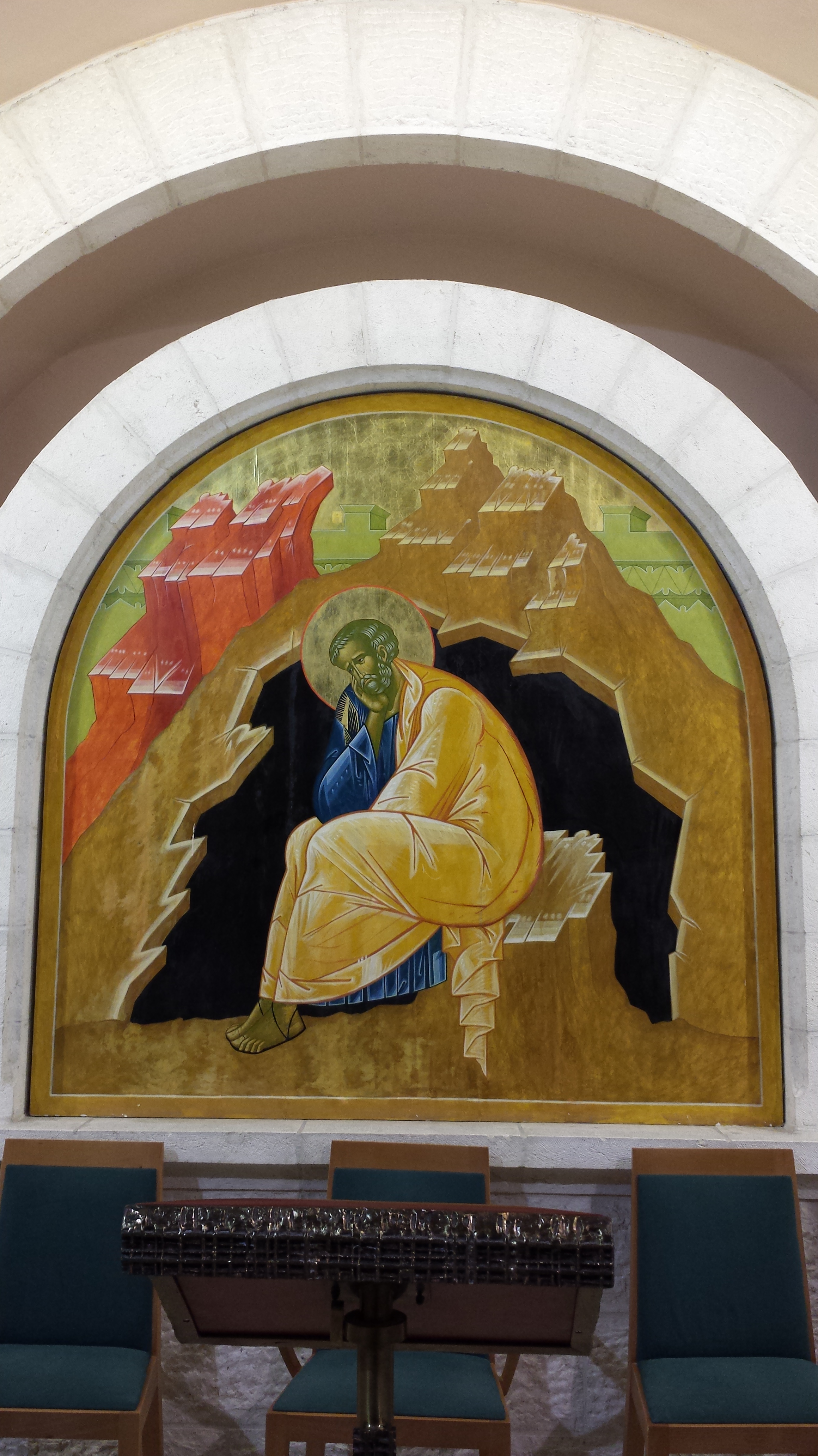
Our last stop for the day was the church associated with Peter’s denial of Christ after Jesus was arrested (Mark 14: 53-4, 66-72). The church is known as St. Peter of Gallicantu, a Roman Catholic church the name of which means “the cock’s crow.” The name is in commemoration of Peter’s triple denial of Jesus before the rooster crowed twice.

Statue outside St. Peter Gallicantu

Statue outside St. Peter Gallicantu

The remains of the Byzantine church built on this sight as well as the old Roman steps up which Jesus would have been brought after his arrest to the high priest Caiaphas’ palace, which this location is believed to have been. Because Jesus and his apostles based themselves out of Mount Zion when they were in the area, they would have used these steps many times to get between lower and upper Jerusalem.

Old Roman road from upper to lower Jerusalem

Old Roman road from upper to lower Jerusalem

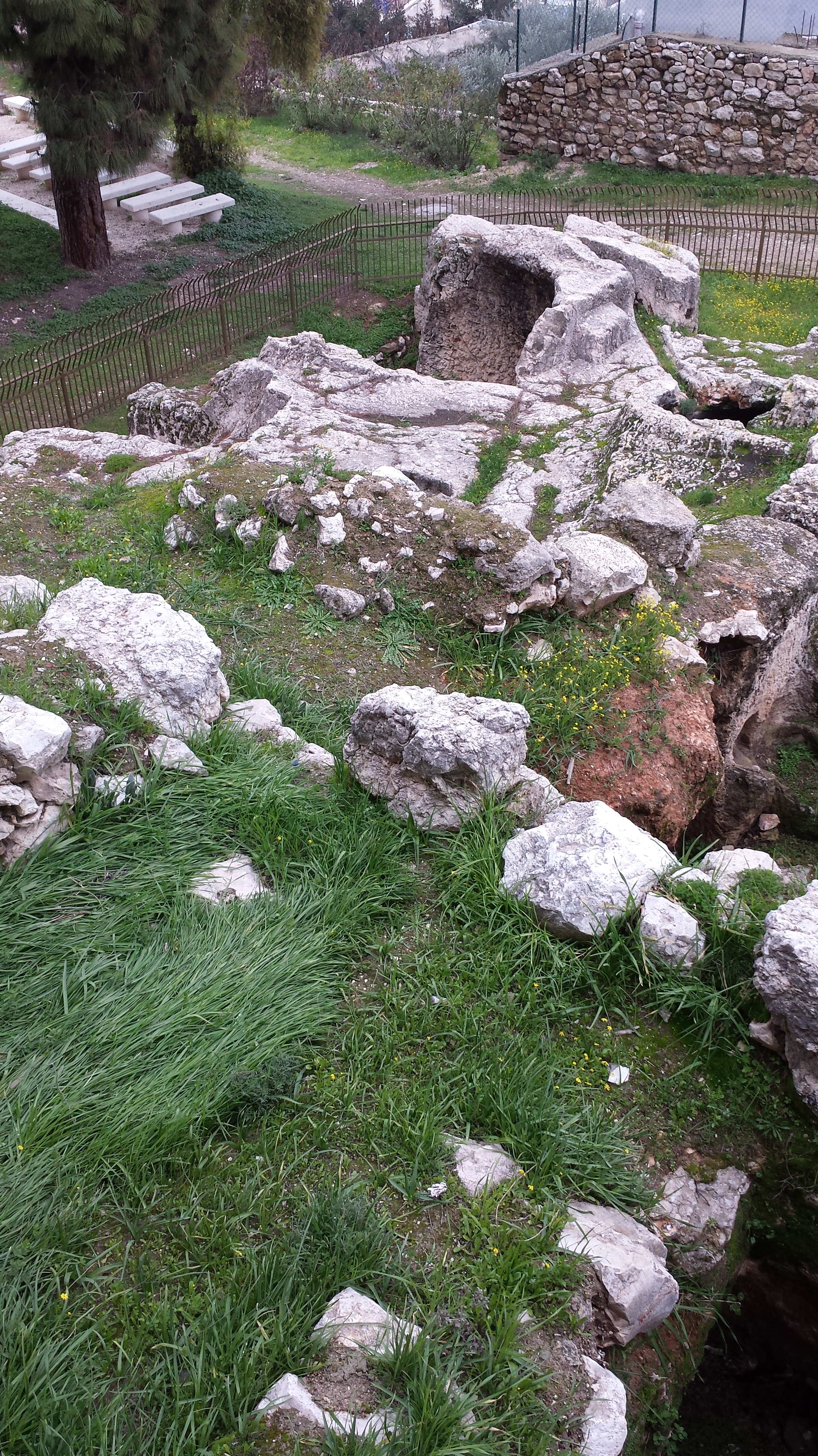
Ruins of the palace of the High Priest Caiaphas,  over which the current church is built.

Ruins of the palace of the High Priest Caiaphas, over which the current church is built.

In the crypt underneath the current church are the remains of first century caves and hole in the floor through known as a thieves’ hole. Prisoners would have been lowered into an isolated cistern, often partially full of water, until they would be brought up again for trial. The early Christian community believed that this is where Jesus was imprisoned before he was taken to Herod.

The thieves hole

The thieves hole

Looking down into the holding area

Looking down into the holding area

Holding area

Holding area

We held our Eucharistic service in the church here today, with an excellent sermon by Paul, the dean of the cathedral in Montreal.

Our service in the church

Our service in the church

Icon of Peter’s Denial

Icon of Peter’s Denial

Icon of Peter’s Guilt

Icon of Peter’s Guilt, located behind the altar

Icon of Christ asking if Peter loves him, with the response of "feed my sheep. "

Icon of Christ asking if Peter loves him – the Primacy of Peter – “Do you love me?  Then feed my sheep. “

After our time there, some us (including me) walked back to our hotel rather than taking our bus back. After dinner at The Gloria, I joined a night walk of the city with bishop Kirk. It was fun to walk through each of the quarters of the city – Armenian, Jewish, Muslim and Christian. We ended up on the roof above the Muslim quarter, for a great view of the city from its center. Our walk included going to the Western Wall (also known as the Wailing Wall), which is the only aspect of the Hebrew temple that was destroyed by the Romans.

Remains of Roman pillars that once lined the cardo that ran through Jerusalem.

Remains of Roman pillars that once lined the cardo that ran through Jerusalem.

The new synagogue in the Jewish Quarter

The new synagogue in the Jewish Quarter

The Wailing Wall

The Wailing Wall

Night view of Western Wall area

Night view of Western Wall area

View from the roof of the suk

View from the roof of the suk

It was a long day, but a good one.

Here’s to peace negotiations with squirrels!

Henry

Henry Goes to the Holy Land – Day 6

Leave a comment

January 18, 2015

Before leaving Manger Square and Bethlehem this morning, we visited the Separation Wall that runs through Bethlehem separating it from Israel.

Saying goodbye to Stars  & Bucks.

Saying goodbye to Stars & Bucks.

The wall was assembled as several narrow sections, each thirty feet high. The surface of the wall facing Palestine is smooth concrete, which makes the perfect surface for spray painting graffiti. Many sections of the wall include intentional displays and commentaries by individuals and groups in Palestine that talk about the experience of being “imprisoned,” of despair, hopelessness, anger, challenges for justice and simple pleas. Some of the graffiti is very beautiful or poignant artwork. Many languages are represented on the wall from locals and from visitors who have journeyed here from around the world. All of it is a letter to Israel.

Bishop Greg and me at the wall

Bishop Greg and me at the wall

The group from the Diocese of Olympia at the wall.

The group from the Diocese of Olympia at the wall.

Rachel finds an important message on the wall.

Rachel finds an important message at the wall.

The wall at the check point going out of Bethlehem.

The wall at the check point going out of Bethlehem.

After our visit to the wall, we crossed the armed check point into Israel and made our way to Jerusalem. Our first stop was St. George’s College, an Episcopal university and the site of the Anglican cathedral in Jerusalem. The local parish here is composed of Israeli Arab Christians, and the Eucharistic service we attended was bilingual, Arabic/English. We sang hymns in each language and heard the sermon twice, Arabic followed by English.

St. George’s Cathedral interior

St. George’s Cathedral interior

The service at the Cathedral at St. George’s.

The service at the Cathedral at St. George’s.

The service was led by Archbishop Sulheil Dawani, the head of the Anglican Episcopal Church in Jerusalem. The four bishops traveling in our group were robed and participated in the service as concelebrants. It was a great service, even though the tiny space heaters in the cathedral were no match for the cold temperatures of the morning. We were freezing, and everyone in the congregation had their coats, gloves and hats on! It was one of those times I was glad to have both a natural fur coat and a sweater.

Here I am checking out the view from the cathedral lectern.

Here I am checking out the view from the cathedral lectern.

After the service, we went out into the courtyard of St. Georges and into another section of the complex for cups of hot coffee spiced with cardamom and other spices – the perfect antidote to a cold morning. Then our group was ushered into a private drawing room to meet with Bishop Sulheil. He shared with us something of the reality of the Christian community in Israel and Palestine. Namely, the percentage of Christians in Jerusalem, for example, has dropped to less than 1% of the population here. There are many reasons for this, but the biggest concern about this decline is that it has been the Christian leaders in Jerusalem that have served as a bridge for peace between Israel and Palestine in the local incidents that occur. Without those who strive for peace, the alternative looks pretty grim. That said, there are many dedicated Muslims and Jews who are also dedicated to peace in Jerusalem.

During our meeting with Bishop Sulheil.

During our meeting with Archbishop Sulheil.

Bishop Greg and Marti with Archbishop Sulheil.

Bishop Greg and Marti with Archbishop Sulheil.

Rachel and I with Archbishop Sulheil.

Rachel and I with Archbishop Sulheil.

After our session with the archbishop,  we went into a lecture hall on campus to hear a presentation by 31 year old Ruth Edmonds. Ruth is the local coordinator in Jerusalem for a group called the Israeli Committee Against House Demolitions (ICAHD), a human rights organization dedicated to ending Israeli occupation over the Palestinians.

Hope Edmonds and me.

Ruth Edmonds and me.

Ruth is a smart and passionate person, whose mother is an Israeli Jew and whose father is a British non-Jew. She shared amazing information with us about the social and governing forces that contribute to the oppression of Palestinians and demolition of Palestinian homes in the West Bank. Homes can be destroyed and home or business building permits denied to the effect of preventing any reasonable life at all for Palestinian families.  The policies of forced relocation have effectively made Palestinian towns into prisons. And yet, Ruth offered a hopeful perspective in the end – that resistance to violent solutions is stronger than ever before all across the world.

St. George’s College

St. George’s College

After eating lunch at St. George’s, we went to Yad Vashem , the Holocaust Memorial. Located on the western slope of Mt. Herzl on the Mount of Remembrance, the memorial consists of a series of indoor exhibits as well as outdoor memorials and a research center. The exhibit halls follow the historical events and circumstances leading up to the events of the holocaust, including quite an indictment of the role of European Christianity in casting Jews as the theological villains of Christ’s death. This perspective of the time contributed to social conditions that helped to enable racism and persecution.

Yad Vashem museum

Yad Vashem museum

While our group toured the memorial, it did seem ironic to many of us that a company of young Israeli soldiers were also touring the memorial. Somehow, it seems that rather than instilling a sense of empathy out of their historical experience, there is a fueled victimhood that wants revenge for grievous wrongs that serves to perpetuate violence and victimization of others – namely, the Palestinians.

Young Israeli soldiers contemplating a collection of shoes from victims sent to the furnaces.

Young Israeli soldiers contemplating a collection of shoes from victims sent to the furnaces.

After our tour at the memorial, we visited Ein Karem, which means “spring of the vineyard.” According to early Christian tradition, John the Baptist was born in Ein Karem. It contains a site called Mary’s Spring. Tradition has it that Mary visited Elizabeth here and where the Magnifcat was sung by her for the first time. There is a spring that is said to be where Mary met Elizabeth.

Church of the Visitation

Church of the Visitation

Mosaic of the Visitation on exterior of the church

Mosaic of the Visitation on exterior of the church

Fresco of the Visitation inside the church

Fresco of the Visitation inside the church

Altar

Altar

One of the many floor mosaics.

One of the many floor mosaics.

Statue of the Visitation in the court yard. The Magnifcat is displayed in several different languages on tiles around the walls.

Statue of the Visitation in the court yard. The Magnifcat is displayed in several different languages on tiles around the walls.

The Church of John the Baptist in Ein Karem is built on the remnants of Byzantine and Crusader churches, a good indication of being an authentic site. Inside the church are the remnants of Byzantine mosaics and the cave home in which John was born. The church has been in the care of the Franciscans since the 1600’s, and we met one of the monks who live there now.

Monk and me!

Monk and me!

After Ein Karem, we went to our hotel, The Gloria, located in the Christian Quarter of the Old City, near the Jaffa Gate. The first two floors of the hotel were built in the 1850’s, and Rachel and I are on the second floor (which is really the first floor, since the entry level is called floor “zero.” The hotel has a great atmosphere, with vaulted arched ceilings and cushions on every possible surface one can sit on.

exterior

Lobby

Lobby

Areas to talk

Areas to talk

We walked to dinner at another hotel called the Notre Dame, so that after dinner we could hear a presentation by two very special men who are members of an organization called The Parent’s Circle. The group is composed of both Israeli and Palestinians whose children have been killed in conflicts. The group transcends issues of politics and religion to focus on the common cause of the cessation of violence and the building of peace. They actively promote reconciliation between individuals and nations.

The Notre Dame Hotel

The Notre Dame Hotel

Rachel with Rami and Khaled

Rachel with Rami and Bassam

Rami Elhanan is a seventh generation Jerusalemite Israeli Jew. His daughter, Smadar, was fourteen years old when she was out shopping for books for the new school year and was killed (along with two of her friends and two others) by two Palestinian suicide bombers. Bassam is a Palestinian Muslim who became involved in the Palestinian struggle as a boy growing up in the ancient city of Hebron. At 17, he was caught planning an attack on Israeli troops, and spent seven years in prison. However, In 2005, he co-founded Combatants for Peace, an organisation of former Israeli and Palestinian combatants leading a non-violent struggle against the occupation. Since then, Bassam has not once picked up a weapon – not even when, two years later, his ten-year-old daughter, Abir, was shot in the back and killed by an Israeli sniper at a checkpoint.

Rami and Bassam shared powerfully of their personal stories and struggles and how they now lecture together for peace. At the end of the presentation, Rami said, “You in America must all strive for peace with us. In the holocaust horrible things were happening and no one said anything. Horrible things are happening now. You cannot be silent. It is not anti-Semitic to work for peace.”  To read more about these two extraordinary men and their friendship, go to http://www.theguardian.com/lifeandstyle/2013/aug/03/men-kill-children-middle-east-israel-palestine

I think I may need to stop barking at squirrels…

Henry

My room at The Gloria

My room at The Gloria

Henry Goes to the Holy Land – Day 5

1 Comment

January 17, 2015

Waking up on Manger Square in Bethlehem is such a surreal experience. Three different Christmases are celebrated here – the date for Western Christianity, the date for Orthodox Christianity and the date for the Armenian Church (which is actually on January 19th.

Today was all about Bethlehem and visiting the important work and ministries of the Christian communities here.

Bishops Greg and Barry in front of the college.

Bishops Greg and Barry in front of the college.

First, we traveled to Dar al Kalima, a college dedicated to fine arts and bringing this reality and creativity and identity to Palestine. We met with Dr Nuha Khoury,  She shared with us how the college is part of the wider work of Diyar – which is based in the International Center of Bethlehem. The programs here focus on cultivating the artistic growth and promotion of Palestinian arts and culture. Young adults can get undergraduate degrees in Dramatic Arts and Graphic Arts. They also have programs in the culinary arts, music and tour guiding.  They are planning the development of more programs, such as dance and restaurant management. All of this was the vision of Lutheran Pastor Mitri Raheb, whose books about Palestine are very powerful and recommended reading for those who want a better understanding of everything that is happening today in Palestine.

Dr. Khoury

Dr. Khoury

In the context of Israeli occupation and removal of Palestinians from their traditional homelands, Dr Khoury said at one point, “Art is the way for people to have identity without land. It is very important to have.”

A student painting

A student painting

After a wonderful time hearing from and speaking with Dr.Khoury, we toured the college and had the chance for a break in the student lounge.

10941145_10152656408198333_7114061221621252109_n

Next, we traveled a short distance to the Sisters of Charity Orphanage within the grounds of the Holy Family Hospital (often referred to here as the St Vincent Creche).  The sisters are contacted by Muslim women from all over the West Bank.  In most cases, the babies raised at the orphanage are birthed by young Muslim women who are often raped, sometimes by their own family members.  Young Muslim women can face death if found to be pregnant out of wedlock, and most of the births are induced six months into the pregnancy before the mother’s pregnancy begins to show.  So, most births are by intention premature. The sisters work closely with hospitals that can initially care for the preemies before they can come to the orphanage nursery.

Entrance to the orphanage

Entrance to the orphanage

The sister who spoke with us (in French, translated by Fr. Paul Kennington from Montreal who is helping to guide our group) and gave us a tour of the orphanage has been working there for 19 years. She is sincerely devoted to the children and spoke of how difficult it is that the children must leave the orphanage at the age of six years old.  The Muslim tradition does not believe in adoption, nor are the children (by law) allowed to be raised in the Christian faith while living at the orphanage. As a result, the children are not raised in any faith tradition, and they live in different facilities of care until they must go out on their own and try to make a life for themselves.

Sister and Paul

Sister and Paul

Sister told us a story of how she was trying to answer a child’s question, “What is Christmas?,” without using any religious language. She made it into a story about a young woman and her husband who couldn’t find a place for her to give birth because there was no room. One of the children to whom she was telling the story interrupted, “Why didn’t they come here to the orphanage?  We have plenty of room!” Sister continued her story to the children, explaining that the couple having their child were very poor.  Another child interrupted again, saying, “That baby’s not poor, Sister; the baby’s got two parents, and we haven’t got any.”

A classroom at the orphanage

A classroom at the orphanage

Needless to say, between the Sister’s sharing with us and the tour itself, all of our group were in tears at one point or another.

The nursary. This baby is three days old.

The nursary. This baby is three days old.

The main hallway of classrooms.

The main hallway of classrooms.

After our tour of the orphange school and nursery, we returned to the chapel for Eucharist.  Bishop Kirk Smith of Arizona presided, with Bishop Barry Beisner of Northern California preaching.  As part of our service, we sang several Christmas carols all heralding and celebrating the birth of the infant Christ. Sung in this setting, these all took on especial significance. The fact that all of Bethlehem and the orphanage are still decorated for their Christmas season was like celebrating Christmas all over again, and Rachel and me were very moved by the whole experience.

This little boy is blind and was found abandoned in a card board box. None of the children are permitted to have Christian names.

This little boy is blind and was found abandoned in a card board box. None of the children are permitted to have Christian names.

As with each of our special stops like this one, the bishops gifted Sister and the orphanage with funds from each of the diocese sponsoring this trip. We were able to give the orphanage about a thousand dollars, but they need year-round donors to maintain the important work they do.

We had a Eucharistic service in the orphanage chapel, led by Bishop Kirk Smth.

We had a Eucharistic service in the orphanage chapel, led by Bishop Kirk Smth.

At our lunch time that followed, our table groups continued to talk about our experiences at the orphanage as we ate in a traditional Palestinian setting. After dessert, it just so happened that our table was the one gifted with the opportunity to partake of a hookah, a traditional extension of hospitality to visitors.  The tobacco in this particular hookah was “watermelon mint,” which while it may sound dubious was deemed quite good by those who partook of it (it’s considered rude towards the hosts to not do so).

Sarah Monroe partakes of the local hospitality. :)

Sarah Monroe partakes of the local hospitality. 🙂

So that we would have a better understanding of how life was in first century Palestine, when Jesus was born in Bethlehem, we visited a small church set within a first century cave home called The Shepherds’ Field.  Ghassan explained how people lived in these types of homes, with sections of the cave divided into separate living areas and rooms by hanging hides. The part of the cave closest to the entrance was usually a common area like a living room and food preparation area, while the sleeping areas were towards the middle and back of the cave.  Stored goods and animals were housed at the farthest back of the cave, and this is the area of a such a home where Mary gave birth to her child – the most private part of the cave home, which is why traditional lore about the Nativity story places animals and a feeding bin (manger) in the scene of Jesus’ birth.

Altar in the Shepherd's Field cave home church.

Altar in the Shepherd’s Field cave home church.

20150117_142843

The back section of the Shepherd’s Field cave has a Nativity in it for the Christmas season.

A Byzantine mosaic in the floor of the church - the star seen by the shepherds.

A Byzantine mosaic in the floor of the cave church – the star seen by the shepherds.

Church above ground at Shepherds Field

Church above ground at Shepherds Field

Church of Shepherds Field - above ground sanctuary

Church of Shepherds Field – above ground sanctuary

This was very good preparation before our visit to the Church of the Nativity, the entrance for which is just steps away from our current pilgrim hotel, the Casa Nova.

Entrance to the Church of the Nativity.

Entrance to the Church of the Nativity.

Church of the Nativity

Church of the Nativity

A couple years ago, the Church of the Nativity experienced a fire, so much of the large Byzantine and Crusader sections of the church are being restored.  Scafolding is everywhere and much of the historic art is covered over.  In spite of this, we entered just when the Greek Orthodox priests were holding their prayer service.  The expectation of the monks is that visitors will stay silent at all times, but we could hear Ghassan’s explanations about the church through our electronic listening divices linked to a microphone he was wearing.

Sanctuary, Church of the Nativity - behind this altar are the steps down to the first century cave of the Nativity.

Sanctuary, Church of the Nativity – behind this altar are the steps down to the first century cave of the Nativity.

To get to the first century occupation level of the church requires going down a steep and narrow set of stone stairs down into what was the back of a large cave system in which people had lived during the first century. Today, the spot at the back of the cave associated with Jesus’ birth is “encrusted” or decorated with marble, brass and velvet hangings.  It doesn’t look ANYTHING like it would have then, which is why the earlier visit to Shepherds’ Field was important.

Icons near the stairway  down to the cave

Icons and prayer candles near the stairway down to the cave

20150117_151157

Pilgrims can kneel beneath a marble shelf to crawl a little ways into what looks a bit like a fireplace opening.  A large brass star in inset into the floor in this nook, and at it’s center is an eight inch opening through which a pilgrim can reach down to touch the smoothed floor of the cave occupation level where the manger is said to have been.  The exact spot is something of a guess, but the different levels of churches placed here going back to the forth century make this the location and cave dwelling that the early church very much believed Jesus was born.

Pilgrims can kneel down to reach into the shrine

Pilgrims can kneel down to reach into the shrine

Pilgrims can then reach down through the center of the brass star inset in the floor of the shrine in order to touch the floor of the first century occupation level.

Pilgrims can then reach down through the center of the brass star inset in the floor of the shrine in order to touch the floor of the first century occupation level.

Praying in the cave shrine area.

Praying in the cave shrine area.

The back of the cave, now a shrine, has been separated from the rest of the cave system by a Byzantine wall.  But pilgrims can still explore the rest of the cave by exiting the shrine and going into another section of the church – a much newer nave that you may have seen on television if you ever watch Christmas Eve being celebrated in Bethlehem. The folks who run this church are much less grumpy, but you still have to be quiet.

Area of the cave where St. Jerome worked in editing the canon of the  Christian Scriptures.

Area of the cave where St. Jerome worked in editing the canon of the Christian Scriptures.

Walking through the cave house system

Walking through the cave house system

Descending the staircase here gives you access to the rest of the cave and some more of a system of tiny pocket caves which are now varous side altars and chapels.  It is believed that St. Jerome and his assistant, Eusebius, used one of these smaller caves as the place where they worked on the research, editing and selection of the Scripture that we have inherited as the canon of the New Testament. St. Jerome was buried in yet another one of the small caves after his death, but his body was moved to Rome at some point in history.

Ghussan and  in front of the entrance to our hotel,  Casa Nova just outside the entrance of the Church of the Nativity.

Ghassan and Sarah in front of the entrance to our hotel, Casa Nova just outside the entrance of the Church of the Nativity.

After an amazing day of learning and reflection, our group had the chance to explore the Bethlehem suk and shops around the central square. We had the chance to visit the shop associated with the college we visited earlier in the day and to support the art students by buying the crafts they have made and the books written by their faculty and others.

Tree in Manger Square

Tree in Manger Square

We also visited the Bethlehem Peace Center shop, where Rachel picked up a small but powerful olive wood nativity.

20150117_174909

Shopping in the suk requires being comfortable with bargaining respectfully for a good price, otherwise the unwary pilgrim will be utterly fleeced like a sheep. Whatever one spends here, though, goes to supporting a beleaguered economy and people cut off from the easy market place of the rest of the world. It’s hard to begrudge people who are simply struggling to make ends meet.

20150117_172828

Mother of pearl speciality shop in business since 1929

One shop Rachel and me wandered into has been around since 1929 and specializes in items made from mother of pearl – an old art form in Bethlehem. Rachel was sorry to learn that the $35 dollars she spent there was the first sale the owner had had all day, and it was 6:30pm. He was a very kind Catholic man, and we talked for a while about what life is like for the people of Bethlehem, behind the separation wall that cuts across what was once a vital market street – demolishing all that was once there.

After dinner with our group back at the Casa Nova, we met with Dominic and Paul to talk about what Lightline tour company (allied with Shepherd Tours) can offer to clergy who may be untested to bring a group on tour.  Rachel is certainly interested to bring a group from Trinity, so she is thinking to plan a trip for 2017.

Off to bed for tired and full good doggies.

Here’s to barking at squirrels!

Henry

Henry Goes to the Holy Land – Day 4

Leave a comment

January 16, 2015

This morning, we said a very fond fairwell to the Pilgerhaus (Pilgrim House) in Tagbha. It was a wonderful place to stay, and I highly recommend it to pilgrims traveling to the area of northern Galilee.

I finally found the sheep that I knew were out there!

I finally found the sheep that I knew were out there!

After making sure that all our luggage made it back onto the bus, we headed south along the western shore of the Sea of Galilee.  Traveling through Tiberius, we had glimpses of the old Roman fortifications of that town. Established in 20 CE, the town was named after the Emperor Tiberius. It was the capital of the realm of Herod Antipas.
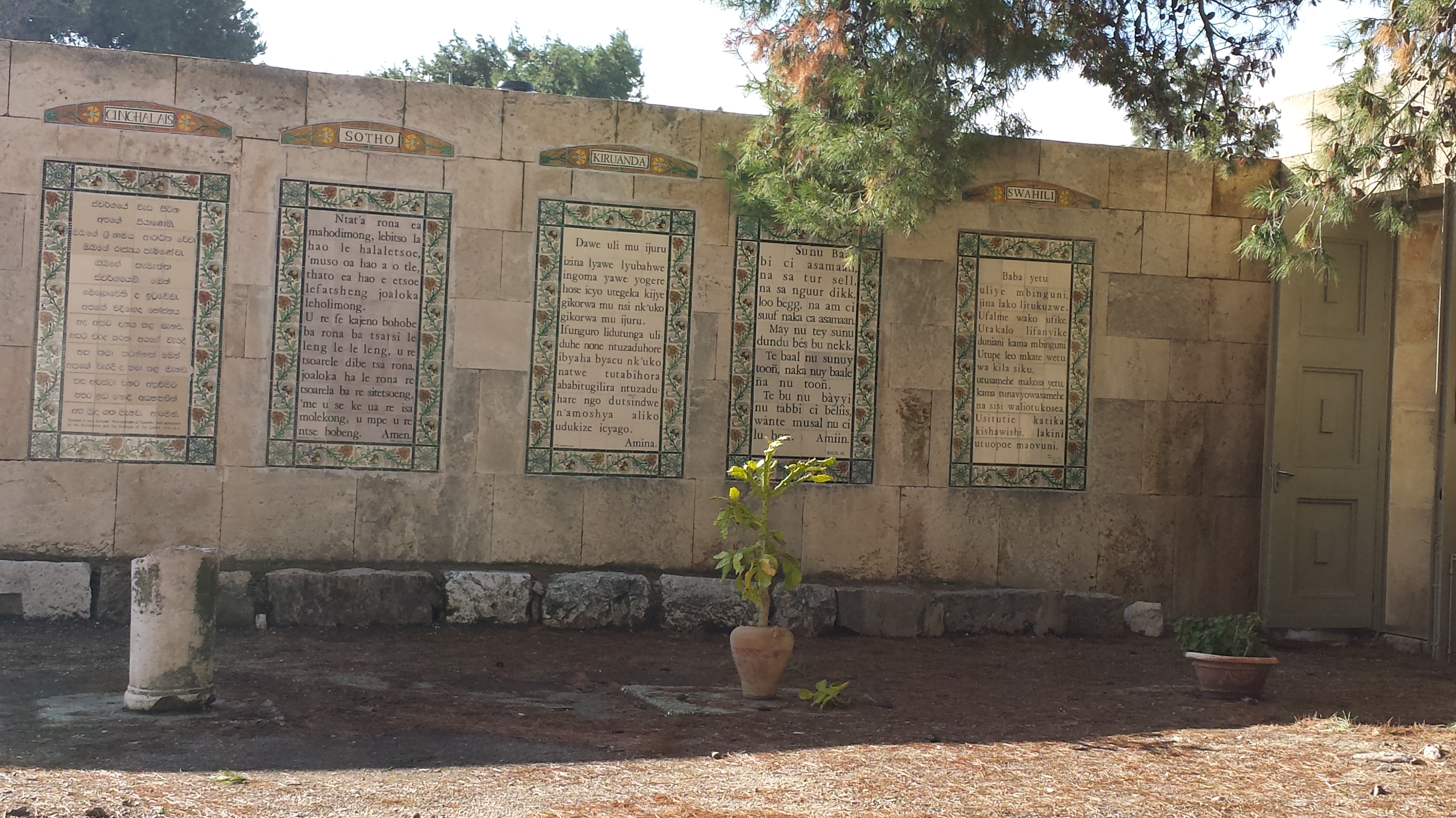
The town of Tiberius soon became so well known, that the inland sea was called the Sea of Tiberius by the Romans.  However, the Hebrews continued to call it by it’s traditional name, Yam Ha-Kinerett (later just “Kinerett” and still later, “Genessaret”, and then”The Sea of Galilee”).

Date trees

Date trees

After winding along narrow roads for about an hour, we left Israel and crossed the boarder into the West Bank.  Soon we arrived at our first destination, the modern town of Jericho, located near the Jordan River on the West Bank. Jericho is 849 feet below sea level, situated in an oasis of the Wadi Qelt in the Jordan Valley.

Jericho Sycamore Fig Tree

Jericho Sycamore Fig Tree

It's a very big tree and deserves two pictures...

It’s a very big tree and deserves two pictures…

Stopping first near a large, old sycamore fig tree which locals like to say was the very fig tree that Zacchaeus climbed when he wanted to see Jesus through the crowds at during one of Jesus’s visits to Jericho (Luke 1-12). Whether this is THE tree is pretty doubtful, but is a very old tree, and is an example of the type of tree mentioned in the Scripture story.  I’m sure you’ll be glad to know that I refrained from peeing on it.  😉

Fortress ruins in Jerico archaeological site.

Fortress ruins in Jerico archaeological site.

After visiting the fig tree, we went to some ancient ruins of a fortress of some antiquity that had been refortified by Herod Antipas who had also built a winter palace at Jericho.  Also, the Gospel story of the Good Samaritan is set in the area – a Hebrew man is traveling through the mountain valley pass from Jericho to Jerusalem when he is set upon by thieves.

The ruins are interesting but in need of better conservation.

The ruins are interesting but in need of better conservation.

Archaeologists have unearthed the remains of more than 20 successive settlements in Jericho, the first of which dates back 11,000 years (9000 BCE). It was an early religious center for the Canaanite people, and the name “Jericho” is a Hebrew word derived from the Canaanite word for “moon.”

The destruction of the city (“when the walls came tumbling down”) actually occurred quite sometime before the Israelites migrated to the area, but it’s likely that they discovered the ruins and developed a story to explain them that also underscored their rise to dominance in the area during the Hasmonean Empire (a Hebrew dynasty descending from the Tribe of Levi, c. 110 BC).

With new friend Emily on the cable car going up to Mt. Temptation.

With new friend Emily on the cable car going up to Mt. Temptation.

After exploring the fortress ruins, our group drove over to a cable car station that takes people up to the top of a low mountain known as The Mount of Temptation.  Christian tradition attributes this mountain as the location of Jesus’ time of discernment in the wilderness. Their are many caves set into the sheer sides of the mountain, many of which are still used to this day by monks, hermits and shepherds.

Freshly squeezed pomegranate juice made from some of the  largest pomegranates I've ever seen!

Freshly squeezed pomegranate juice made from some of the largest pomegranates I’ve ever seen!

Before boarding the cable cars, many of us stopped to grab a quick cup of freshly pressed pomegranate juice.  YUM!!

Mt. Temptation

Mt. Temptation

Traveling in the cable car up to the “Temptation Restaurant” at the top was a lot of fun, with pauses in the ascent now and then for others to be loaded into cars either above or below us.

Marti didn't like it when the car paused or went over the tower juntions.

Marti didn’t like it when the car paused or went over the tower juntions, but she’s smiling nonetheless.

The view from the top gives a sense of Jericho today.

The view of Jericho from the top of Mt. Temptation.

The view of Jericho from the top of Mt. Temptation.

Rachel and I at the top.

Rachel and I at the top.

We didn’t eat at the restaurant (as “tempting” as that was!) but took the cable cars back down to eat in a pilgrim restaurant below.  Outside where we ate, I met a flock of very nice peacocks.

20150116_141422

Outside our restaurant.

Outside our restaurant.

After lunch, we did an amazing thing.  We drove to a site along the Jordan River that hasn’t been open to the public in a long time, due to conflicts between the countries of Israel and Jordan.   The Jordan River is the boarder between Israel and Jordan, so it is a place of much tension.

Armed guards on both sides of the river keep careful watch over those who come to visit the waters. We could see them as we waded into the river and gathered water to bring home with us.

This picture is taken from the Israel side of the Jordan. The open structure on the other side is in Jordan.  Inside it are armed Jordanian soldiers who are keeping a close eye on us.

This picture is taken from the Israel side of the Jordan. The open structure on the other side is in Jordan. Inside it are armed Jordanian soldiers who are keeping a close eye on us.

During our drive into the river area, we passed through the gates of a “No Man’s Land” swatch of territory that is actually a mine field with fencing on both sides of the swatch.

Going through no man's land to Israel's border with Jordan.

Traveling through no man’s land to Israel’s border with Jordan.

However, even in the midst of all of these signs of tension, we found a moment of real peace as Bishop Greg led us through a renewal of our Baptismal promises and then anointed each of us by name.

Bishop Greg anointing Dean Steve Thomason of St. Mark's Cathedral.

Bishop Greg anointing Dean Steve Thomason of St. Mark’s Cathedral.

The water of the Jordan River is very silty in this place, and the mud fine and squishy – much to our remark as we waded along the wooded steps set under water at its bank.

Pilgrims from the diocese of Olympia hanging out in the very cold waters of the Jordan River.

Pilgrims from the diocese of Olympia hanging out in the very cold waters of the Jordan River.

Me and Marti Rickel collecting river water to bring home.  The river is very silty here because it flows quickly and stirs up the thick, soft mud in its banks. It settles out quickly in a still bottle.

Me and Marti Rickel collecting river water to bring home. The river is very silty here because it flows quickly and stirs up the thick, soft mud in its banks. It settles out quickly in a still bottle.

I love this picture!

I love this picture!

Once our time was done, we drove back through the mine field, out through the Wadi Qelt and up through a pass to Bethany.  Gaining lots of altitude very quickly, we passed several modern Bedouin encampments.  These encampments are a mix of old and new – children herd goats and sheep, families build huts of corrugated metal; the port water into their camps and many have generators and televisions.  The Bedouins are a people on the move, moving their camps according to season and location of good grazing for their goats, sheep and camels.

The small shacks are a Bedouin settlement.

The small shacks are a Bedouin settlement.

Bethany is a Palestinian town that has been separated from the nearby city of Jerusalem and the Mount of Olives by the Israeli Separation Wall. Thirty feet high and 430 miles long, the Separation Wall was built by Israel as a security barrier separating Israel from the West Bank.  However, often the wall makes deviations into Palestinian territory.  The wall has a very negative impact on the Palestinian economy and makes travel very challenging.

The Separation Wall blocks the road.

The Separation Wall blocks the road.

At Bethany, we stopped in a church dedicated to the memory of the raising of Lazaras, who (along with Mary and Martha) were very close friends to Jesus.  He seems to have visited them frequently when in the area of Jerusalem.

Inside the Church of Lazaras,  Bethany.

Inside the Church of Lazaras, Bethany.

20150116_151719

The church has some antiquity at least going back to the Byzantine era, and it has beautiful acoustics.  The song during our brief prayer service there was very moving to us Anglicans, who love a well-sung hymn!  David Spring would have liked this very much.

Dome interior.

Dome interior.

Remnant floor mosaics from Byzantine era.

Remnant floor mosaics from Byzantine era of the church.

Once again aboard our bus, we had to drive around the Separation Wall blocking the direct route to Jerusalem.  We stopped in Jerusalem just long enough to drop off our guide to retrieve his own car before continuing our caravan to Bethlehem.

saca souvenir

This portion of the Separation Wall runs through Bethlehem.

The bishops decided to take us to shop at Christian cooperative gift shop that supports about 70 families of Palestinian Christians still living in Bethlehem.  As with Bethany, the economy of Bethlehem is highly impacted by the Separation Wall that excludes it from easy access to Israel.

We were glad to do “exert our economic power” as Dominic put it and support the Christian community by basically shopping our brains out at the cooperative.

My room at the Casa Nova.

My room at the Casa Nova.

Finally, we made the last few minutes of our Journey to our hotel..which is amazingly located on Manger Square, only feet away from the entrance of the Church of the Nativity.

After supper at the hotel and prayer in the nearby Franciscan Chapel in the church complex, it was off to bed after a very full day.  So many thoughts and emotions are running through my head, that all the reflection is exhausting but important.

Here’s to Barking at Squirrels!

Henry

Manger Square in Bethlehem is still decorated for Christmas, and the Armenian tradition celebrates Christmas Eve tomorrow. Jerry Christmas!