The Revolutionary Cry of Our Times

1 Comment
Trinity Episcopal Church, Everett, WA – Sermon given on January 26, 2025

Episcopal Diocese of Washington DC, Bishop Mariann Budde, in her sermon at Washington National Cathedral’s Service of Prayer for the Nation on January 21st, called on all Americans to strive for a renewed unity based in honesty, humility and respect for human dignity – and she directed her final words to the newly inaugurated President, who was seated in the front row.

A segment of Bishop Budde’s sermon included this message:

Millions have put their trust in you. And as you told the nation yesterday, you have felt the providential hand of a loving God. In the name of our God, I ask you to have mercy upon the people in our country who are scared now. There are gay, lesbian and transgender children in Democratic, Republican, and independent families, some who fear for their lives. And the people who pick our crops, and clean our office buildings; who labor in poultry farms and meat packing plants; who wash the dishes after we eat in restaurants and work the night shifts in hospitals. They…may not be citizens or have the proper documentation. But the vast majority of immigrants are not criminals. They pay taxes and are good neighbors. They are faithful members of our churches and mosques, synagogues, gurudwaras and temples. I ask you to have mercy, Mr. President, on those in our communities whose children fear that their parents will be taken away. And that you help those who are fleeing war zones and persecution in their own lands to find compassion and welcome here. Our God teaches us that we are to be merciful to the stranger, for we were all once strangers in this land. May God grant us the strength and courage to honor the dignity of every human being, to speak the truth to one another in love and walk humbly with each other and our God for the good of all people of all people in this nation and the world.

As Tom Pepinsky noted in his reflection, “We Kneel to No Pope, We Kneel to No King,” Bishop Budde was quickly disparaged by the President and his followers, with Senator Josh Brecheen of Oklahoma even filing a House resolution (H. Res. 59) condemning Bishop Budde’s sermon at the National Cathedral as “a display of political activis and condemning its distorted message.”  Yet, my friends, as Pepinsky observes, “Bishop Budde was acting from her solemn responsibility as the embodiment of America’s political and religious establishment, reminding the new administration of the values upon which the United States was founded and its responsibility to uphold them. This was not an act of resistance. It was an act of leadership on behalf of the closest thing that the United States has to a national church”.

Pepinsky’s essay reminds us that the separation of church and state is a foundational principle of our nation as articulated by our nation’s founders and embodied in our national history. Many Christian nationalists today find the separation of church and state to be an obstacle and appeal instead to a version of Christianity very much associated with the principles of empire, the same Christian empires that came to these shores from the Roman Catholic principalities of Portugal, Spain and Protestant England, legitimating slavery, genocide, and commercial destruction of vast natural resources as God’s will for providing for God’s chosen people.

The Constitution of the United States was drafted by wealthy, landowning white men, many of whom were slave owners. However, their faith was not Christian nationalism. Their aspirations reflected the conditions of the founding of this nation. Namely, they kneeled to no pope, and they kneeled to no king. That is because they were mostly Episcopalians. The Episcopal Church of the United States of America is, as Pepinsky notes, is the closest thing that the United States has to a national church, “This is a historical fact, and a living contemporary practice.”

There is an institution in Washington, DC called the National Cathedral. It is truly a national cathedral, established by an Act of Congress, aligned with the vision of the Founders for our national capital. The denomination of the National Cathedral is Episcopalian. Bishop Budde is the bishop of the Episcopal Diocese of Washington and as such, the National Cathedral is her seat as bishop of that diocese. The establishment of the United States of America coincides with the establishment of the Episcopal Church, because the Episcopal Church is the Church of England in the United States.

Pepinsky’s essay additionally reminds us of our church’s unique history. Anglicanism is the belief system and liturgical practices based on the Church of England. As everyone who has learned European history knows, the modern Church of England emerged through a schism between King Henry VIII of England and the Pope Clement VII, which produced the English Reformation. Driven by various spiritual and worldly matters, Henry refused to recognize papal authority over religious affairs in England. Anglicanism recognizes apostolic succession, but it does not recognize papal supremacy. The King of England is the supreme governor of the Church of England. As head of the church, though, and bishop of the See of Canterbury, the Archbishop of Canterbury kneels to no pope, and we in the Episcopal Church – reminding you again – kneels neither to the King of England nor to the Archbishop of Canterbury.

At the conclusion of the Revolutionary War, a newly independent United States of America had rejected the King’s authority over the thirteen colonies and subsequently separated from the Church of England, which required an oath of Supremacy to the King by all clergy. An early American Anglican clergyman could not take the Oath of Supremacy, because it was essentially an oath to the monarchy. The Church of England was disestablished in the United States, and the Episcopal Church was founded through a series of events that preserved apostolic succession and conceived a system of governance very similar the newly established nation. From that time forward, the Episcopal Church in the United States operated independently of the Church of England. In later generations, it joined with the Anglican Communion – a relationship of international expressions of the Anglican/Episcopal provinces around the world, the remnant leftover of past Christian Empires come and gone.

Finally, as Pepinsky underscores, in Bishop Budde’s sermon, she “articulated a national understanding of the responsibility of faithful leadership towards the American people – the faith tradition of a republic that welcomes all those seeking new opportunity and the chance of a new life for themselves and their children.”

Bishop Budde’s sermon additionally echoed the concerns of the Executive Officers of The Episcopal Church in a letter they issued on January 21st letter to the church, issued in response to the President issuing a barrage of executive orders within the first hours of having taken office, many orders targeting migrants, refugees and other peoples.

The letter released by the Executive Officers of The Episcopal Church urges “Our new president and congressional leaders to exercise mercy and compassion, especially toward law-abiding, long-term members of our congregations and communities; parents and children who are under threat of separation in the name of immigration enforcement; and women and children who are vulnerable to abuse in detention and who fear reporting abuse to law enforcement.”

The letter concludes by encouraging congregations to use the resources of the Office of Government Relations and the Episcopal Public Policy Network and to embody the Gospel through direct witness on behalf of immigrants in our communities. This letter was written in response to the executive orders, The order included measures seeking to suspend the federal refugee resettlement program, declare a national emergency at the U.S-Mexico border, block an “invasion” of migrants into the United States, end the right to birthright citizenship that is guaranteed by the Constitution and resume a policy of making asylum-seekers wait in Mexico for their cases to be heard. Other executive orders were related to the federal work force, the economy, energy policy and the environment and they included some measures targeting transgender people. The government, intends to recognize only two sexes, male and female, and seeks to end protections for transgender inmates in federal prisons.

A growing number of Episcopal bishops are speaking out in response to the new administration’s threat to fulfill a campaign promise of mass deportations of undocumented immigrants, possibly including raids in churches and other places that previous presidents had deemed off-limits for such enforcement. These bishops speaking out include the bishops of Arizona, New York, Massachusetts, Western Massachusetts, and Southern California. Now, the President of the United States has suspended the country’s 45-year-old program of refugee resettlement, which has long enjoyed bipartisan support. In addition, the Department of Homeland Security issued directives reversing the Biden administration policies that avoided immigration enforcement  in “sensitive” or “protected” areas, including schools, hospitals and houses of worship.

I want to say to you that Trinity Everett will remain a spoke in the wheel of our diocesan commitment out of the hub of St. Mark’s Cathedral in Seattle to provide sanctuary, protection, and advocacy to immigrants and refugees. Without a warrant signed by a judge, we will not permit entry of federal ICE agents into our buildings. Bishop Budde is correct when she says that people are afraid now. This is not in the abstract. These orders directly affect people seated in this sanctuary today, maybe even the person sitting next to you. For example, initiatives approved by the new Presidential administration includes a directive that unless both sets of grandparents were born in this country, you are at risk for deportation. Refugees from war that this church sponsors – right here – and that we support are at risk for deportation. Trans people known and beloved by members here and now are and will be subjected to having trans identities revoked. Same gender couples married before God at this altar are at risk of having their marriages invalidated. Even Indigenous Americans are being threatened with loss of US citizenship our their lands are even now being reclassified, opening them for mineral and resource extraction. Removing the cap on the cost of insulin and other medications and life prolonging procedures threatens the health of elders right now sitting in this space and in our community.

It is hard enough for women and LGBTQ persons and people of color in this country to endure the daily onslaughts of racial and gender discrimination, much less experiencing the additional burden of a racist, sexist national leaders informed by an imperial version of Christianity. After my personal experience of the bishop search process in the Diocese of Rochester last year, I posted this message on social media:

Resume, experience, expertise, competency, integrity, values and commitment seem less relevant than the state of my hair in the bishop search processes in which I’ve participated. In one instance, I was wearing four braid loops pinned up (a style of my traditional Indigenous tradition) when a young male search committee member remarked while laughing, “What’s going on there? That’s wild! Ha! Ha! Ha!” In a different interview process, I was wearing two braids with a small feather ornamenting one. An older white woman on the search committee who contacted my references then asked each of them, “Does she always dress like that with her hair?” In the most recent discernment process, I decided to wear just one plain braid over my shoulder (as in my profile picture). One clergy person queried of another, “Why does she wear her braid like that?” They were quite troubled by it. My friends,  cultural competency  means understanding and respecting other cultural values and ascetics while not expecting others to conform to dominant culture assimilation (racial biases often referred to as “professional” and is essentially racist). In my culture, long hair and braids are a hallmark of cultural pride and connection to ancestors, community, identity, spiritual values and honor.  If being a leader in dominant culture church means cutting my hair or making my hair less “wild”, then it’s not a church I want to lead.

With their permission, I would like to share an email that I received from parishioner Linda Gabourel and her husband Po that emailed privately to me in response to my post:

Dear Rachel:

Having heard about your recent Facebook post regarding the comments about your hair style during the Rochester discernment I believe voices need to be raised.  I don’t have Facebook, but Kate copy-pasted your comments and sent them to me.  (Thank you, Kate).

My initial response was to be angry on your behalf and yes I am angry and dismayed that comments like that would come from people who should know better and do better.   There was nothing subtle or veiled about the insult to your indigenous heritage from those few petty individuals. I am so sorry for the pain and discouragement it is causing you.  I have some thoughts to share for whatever they are worth. First and foremost, don’t ever let them win! This is where the strong stand up, continue to speak out, lead the way and continue to educate those who need their eyes opened. [Ironically, I say] You are one of the strongest women I have known in my lifetime.  If leaders like you give up our church will suffer.  Never forget that you are extraordinary, strong, and your voice and example are indispensable to the Episcopal Church moving forward. 

When I was in medical school and in training, women like myself, put up with a lot of sexist comments and harassment and we never felt we had the power to change that. It was work hard and keep your head down. What we did do was to stay, keep coming and fight for our place.  My husband had a patient during his residency at the Seattle VA hospital, that refused care from him as he, quote, didn’t want a “gook” touching him. He assumed Po was Vietnamese.  Po wrote basic admission orders and a note including “patient refused care from a gook”. It hurt. He kept moving forward and physicians of color kept coming.  I have great faith in people and believe that they can learn and they can change. With leadership like yours and people like those at Trinity, we will keep coming and swarm the church with love, inclusion and tolerance. To do that they need to hear from people like you. You can change people one at a time.  You have a voice. You be who you are. No conformity required!!! Loud and proud right? The fight is a hard one so what can I do to help and support you?

My friends, I do not get emails like this.

Last weekend, I wasn’t here. Father Allen presided and preached in my place, because I was away attending an annual gathering of Indigenous Episcopalians called Wintertalk, which has traditionally been held on the weekend of the Martin Luther King Jr. holiday. We experienced the presidential inauguration on MLK Monday and the release of the executive orders that followed, including an order opening up long-protected Indigenous lands for mineral and fossil fuel extraction and the removal of any mention of climate change science from the White House webpages. The events and conversations of this past Wintertalk caused me to face a terrible reality – I have not ever in my professional life felt safe enough to share my full self within the predominantly white spaces in which I have worked and which characterize The Episcopal Church, including here at Trinity Episcopal Everett. There is much for us to explore about that which we might chose to do as we go forward together. For now, I would simply remind you that the Episcopal church’s statement that “All are welcome” needs to apply to clergy in our diocese, as much as anyone else. Allen Hicks who is Citizens Potawatomi and me – a Shackan First Nation woman – are granted the authority and responsibility by the canons of this church to lead this congregation in the teachings, values, and practice of our faith.  Yet, I am challenged; I am not seen as an Indigenous woman. I disappear in the words of people who continually say that they do not see color. You must see color. I guarantee you that we see your whiteness.

The actions of the new national leadership are disheartening, and the actions of our government will likely continue to brutalize the vulnerable and further privilege those who are already abundantly privileged within a racist and sexist society. However, Bishop Steven Charleston (Choctaw elder and retired bishop of Alaska) reminds us of the ultimate mission of our church in the following reflection that he posted this past week:

“Shock and awe is a military tactic. Comfort and awe is a spiritual alternative. The military option supports the will to dominate. The spiritual option supports the commitment to liberate.  We share with all people an awesome grace: the path to peace, on the walk of truth and reconciliation, with justice lived for the sake of all creation. We do not seek control, but something much more transformational and enduring. We seek kinship.”

My friends – my kin – the Episcopal Church is a faith tradition formed by and for revolution, rooted in the teachings of a brown-skinned socialist Jew living in the Middle East under occupation of Empire. This is our Messiah. His message of love of one’s neighbor and faithfulness to teachings of mercy, compassion, and peace were so threatening to those in power in his day that he was executed by the Roman government for sedition. St. Paul and eleven of the apostles followed in his steps through their own journeys of resistance, service, and hope until they, too, were martyred and their faith was ultimately retooled to fit the purposes of empire under Constantine I. 

Resurrection, like revolution, is threatening to those who would rule by force and reject the spiritual and divine quality of mercy. Violence and death have never had the last world, not in our wisdom traditions and not in world history. The Episcopal Church – in case you are Episcopo-curious or you have friends who are Episcopo-curious – the Episcopal Church takes seriously, what it means to be the Body of Christ; we hold dear the responsibility of our Baptismal Covenant to strive for justice and peace among all people and to respect the dignity of every human being. We are dedicated to the commandments of the Savior we follow – to love God with all our heart and mind and being, and to love our neighbors as ourselves; and finally, in fidelity to the core principles of the Episcopal founders of the United States of America, we kneel to no ruler but Jesus Christ alone.

We follow the liberating strength of God’s love and come together every week to celebrate the true freedom that is to found in unconditional acceptance and mutual support as a spiritual community equal before the eyes of God. We are a people born of both spiritual and social revolution. We are the Episcopal Church, and in the face of all those who would exclude and deride, harm, who would endanger emigrants, LGBTQ persons, women and children, the elderly, the ill, the hungry, the homeless, the jobless, the poor, the addicted, the imprisoned, the Indigenous, the foreigner, the vulnerable. More than a logo, more than a slogan, more than a glib bumper sticker – we say on behalf this nation and of our church, “All are welcome!”

We say, “All are welcome!” 

We say, “All are welcome!”

Let this be the revolutionary cry of our times!

*******************************************************************************

To view the YouTube livestream version of this sermon, go to: https://www.youtube.com/watch?v=W5T6lC-RWdc

To view the sermon given by Bishop Marianne Edgar Budde at the National Cathedral, go to: https://www.youtube.com/watch?v=xwwaEuDeqM8

To read the letter released by the Executive Officers of The Episcopal Church, click on this link: https://www.youtube.com/watch?v=xwwaEuDeqM8

To read the essay, “We Kneel to no Pope, We Kneel to no King” by Tom Pepinsky, click on this link: https://tompepinsky.com/2025/01/22/we-kneel-to-no-pope-and-we-kneel-to-no-king/
COP28: The Role of Faith in Climate Change Activism

Leave a comment

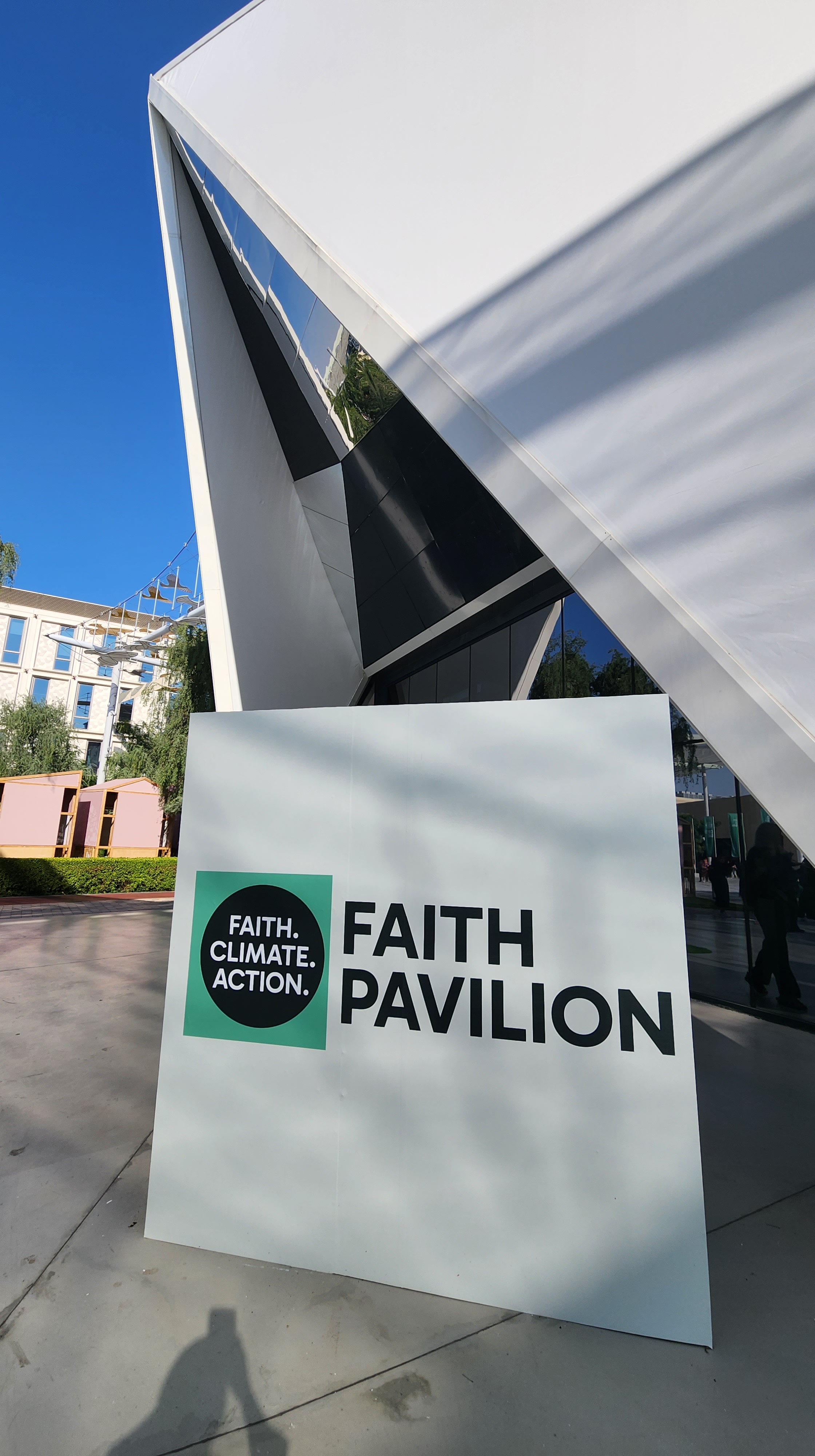
For the first time in its history, the meeting of the Conference of Parities hosted a Faith Pavilion – a dedicated space for interfaith dialogue, prayer, and faithful action on climate change. For me, the Faith Pavilion was a powerful experience in collaboration, theological discourse, and emergence of significant global relationships among diverse faith leaders sharing a mutual commitment to faithfully intercede in meaningful ways on behalf of the world’s suffering in light of climate change.

A Brief Background on COP

The UNFCCC secretariat is the United Nations entity tasked with supporting the global response to the threat of climate change. UNFCCC stands for United Nations Framework Convention on Climate Change. The Convention has near universal membership (198 Parties/Nation States) and is the parent treaty of the 2015 Paris Agreement. The main aim of the Paris Agreement is to keep the global average temperature rise this century as close as possible to 1.5 degrees Celsius above pre-industrial levels. The UNFCCC is also the parent treaty of the 1997 Kyoto Protocol. The ultimate objective of all three agreements under the UNFCCC is to stabilize greenhouse gas concentrations in the atmosphere at a level that will prevent dangerous human interference with the climate system, in a time frame which theoretically is intended to allow ecosystems to adapt naturally while enabling sustainable economic development in human societies.

The annual COP meeting is the supreme decision-making body of the Convention. All States that are Parties to the Convention are represented at the COP, at which they review the implementation of the Convention and any other legal instruments that the COP adopts and take decisions necessary to promote the effective implementation of the Convention. At the United Nations climate change conference in Paris, COP 21, governments agreed that mobilizing stronger and more ambitious climate action is urgently required to achieve the goals of the Paris Agreement.

Further, industrialized nations agree under the Convention to support climate change activities in developing countries by providing financial support for action on climate change beyond any financial assistance already provided to these countries. A system of grants and loans has been set up through the Convention and is managed by the Global Environment Facility. Industrialized countries also agree to share technology with less-advanced nations. Reports submitted by all Parties for 2023 (COP28) are available here: https://unfccc.int/reports

The Faith Pavilion at COP28

Faith-based organizations (FBOs) and religious leaders are an important presence at the UN Framework Convention on Climate Change (UNFCCC) Conference of Parties demonstrating that religious and spiritual communities are essential to the fight against climate change and to achieving the Sustainable Development Goals (SDGs) and the goals of the Paris Agreement. 

The United Nations Environment Program (UNEP), through the Faith for Earth Coalition, the Interfaith Coordination Group on Climate Change served as a coordination hub for collaborative Interfaith engagement towards COP 28. The Group is a global effort made up of approximately 60 actors from 35 different FBOs and civil society NGOs (Non-Governmental Organizations, usually non-profits). The Core Team served a smaller action group that met weekly to provide key strategic direction to the Coordination Group. The Episcopal Diocese of California was one of the six institutions represented on the Core Team by Bishop Marc Andrus, who additionally served as the chair of the Episcopal delegation that participated in COP28.

This year’s COP was the first time for the Faith Pavilion, which in the case of Dubai was facilitated by the local host Muslim Council of Elders. The Pavilion had three strategic objectives:  1) Encourage faith-based organizations (FBOs) to engage with country delegates and increase their capacity to advocate for specific negotiation outcomes at COP28 and beyond, 2) Increase visibility for environmental advocacy work by FBOs and other spiritual and religious actors, particularly those on the frontlines of the climate crisis and how this work contributes to the goals of the Paris Agreement. Promote multi, and 3) highlight faith understanding by creating a space for spiritual reflection, artistic expression and prayer.

Over the course of the two weeks of COP28, the Faith Pavilion hosted 70 events that incorporated more than 350 speakers through a variety of topical panels. In a spontaneous and generous gesture of inclusivity, Rabbi Yonatan Neril invited me to participate on two panels that he facilitated. Rabbi Neril is the founder and current director of the Interfaith Center for Sustainable Development (ICSD), a non-profit organization based in Jerusalem.

Cultivating the Human Heart

Throughout my time participating in the second week of COP28, I heard a common message from leaders of faith, leaders of NGO’s, and governmental representatives about the importance of including the wisdom and perspectives of Indigenous people on issues of both climate change impacts and adaptations. During my daily check ins at the Indigenous Pavilion, I heard the overall Indigenous message to the world as one of returning to traditional Indigenous lifeways that are in harmony/balance with nature and that are inherently more sustainable ways of living that promote environmental wellness for the benefit of all life.

For me, the overarching difficulty about the COP framework is its primary focus on economic development as the foundational principle of human development and development of human societies. This narrow view makes it understandable about why a Faith Pavilion has never been a part of COP previously. Faithful living in every religious tradition is a practice of simplicity, humble service to others, and sharing what gifts we have with one another. In contrast, dominant economic culture worldwide tends to value competition for resources, operate out of self-interest, and practice resource hoarding which in turn relies on the subjugation of an inexpensive work force by the economic elite. Therefore, climate justice is closely tied to human rights advocacy.

Faith activism is attuned to the sacred nature of Creation as a foundational belief across religious traditions. Collectively, people of faith believe that we have a responsibility to not only preserve Creation, but to actively participate in its ongoing cultivation as collaborators/co-conspirers with the Sacred in order to enhance the wellbeing of all life. This is not an easy spiritual discipline. We are called to simplicity in living (living simply so that others may simply live), and cultivating a broad and deep understanding of the interconnected nature of life on earth that requires our proactive advocacy at every level of society and within our faith communities.

I have long believed that the Episcopal Church would benefit from some amount of “Indigenization” in its worldview, polity, and practice. For me, Indigenization includes the goal of turning people’s hearts towards the illuminating sunlight of God’s love that is in keeping with Christ’s teaching of simplicity of life, acceptance of diversity, our spiritual connection to all beings, and the sacred trust given to us to be stewards of Creation as a primary spiritual practice. I fear that like nation states, our institutional life undervalues the perspectives of our marginalized global members, subjugates the voices of protest that seek institutional reform and genuine transformation, and continues to prioritize monetary concerns above the spiritual needs of our communities. There is more than one model of economy from which to choose – the dominant model of capitalism is not sustainable either as a society or as a church. The model of reciprocity not only has Indigenous teaching behind it but also is more in keeping with Christ’s teaching of sharing always from what we have in a continual cycle of blessing that recognizes and values our interdependency and relationship with and within Creation.

As many speakers in the Faith Pavilion shared, the current Climate Crisis is also a spiritual crisis. People around the world, in every culture, are seeking meaningful connection with one another for needful systemic change. However, our understanding of the vital nature of our mutual interdependence on one another and the natural world requires the deeper appreciation of connection that goes far beyond one of commerce. People of faith have the opportunity and imperative of acting both locally and globally in ways that make the power of love real in our world. We do this through inclusion for those who have been marginalized, by making atonement real for those in power who are not serving the people and who denigrate the environment, by making reconciliation real between humanity and the environments in which we live, and by developing mutually supportive relationships between faith communities.

The witness of Christ’s ministry teaches us that the gifts of the earth are not resources for the privileged few to exploit. Rather, the Good Gardiner teaches us that the gifts of the earth are ours to cherish and to cultivate for their own sake. We are to love God and our neighbor, but there is no closer divine neighbor to each of us than the sacred earth beneath our feet that grounds us in sacred places, the sacred water that flows through our veins, and the sacred air that gives us breath.

For God’s sake, let us love our neighbors well.

Sanctuary Earth – A Creation in Peril

4 Comments

Altar Stained Glass Trinity 2020

East Wall Stained Glass Over High Altar – Trinity Episcopal Church, Everett WA

Over a period of five months in the spring and summer of 1892 [April to August], Trinity Episcopal Church grew from an idea in the minds of a few business owners into an incorporated parish with its own lumber-built church on the corner of Wetmore and California Avenues in what is now downtown Everett.

In 1911, the Trinity Vestry called The Rev. Edgar M. Rogers, who lead the Vestry in purchasing the current property at 23rd and Hoyt, breaking ground on the (former) parish hall on March 25, 1912. However, the work on building the church itself was halted as the working men of Snohomish County and many of its clergy went off to join the armed forces in support of the Great War. After Armistice was declared on November 11, 1918, survivors returned home picking up the remnants of old lives and building new ones as best they could.

Work resumed on building the church sanctuary, and the first mass was held in it the Sunday after Easter of 1920 – 100 years ago today. The final dedication of the new building was held the following year, presided over by Bishop Keater on Trinity Sunday, May 22, 1921. On that occasion a plaque was placed in the original entry dedicating the sanctuary as a Victory Memorial to those who died in the Great War.

At the time when the old church property at Wetmore and California was sold, the funds helped to support the work of the architect of the new building, E. T. Osborne. Meanwhile, the stained glass windows were designed and executed by Charles J. Connock, who designed the stained glass windows overlooking our high altar. Connock designed the windows with the theme of Resurrection in mind.

The risen Christ is depicted on the center panel, with Mary his mother to the left and Mary Magdalene and Mary mother of James on the outside left panel. To the right of Christ is Peter and to the far right is Joseph.  The middle panel – depicting the resurrected Christ – was given by the children of the parish in honor of mothers. Surrounded by doves and angels, with Roman soldiers giving up arms at his feet, the resurrected Christ raises a hand in blessing – etched in glass, immortalized in color and light. This blessing reminds us every time we behold it that there is no challenge so great that together we cannot overcome it.

The ancestors of this place dedicated (and gave) their lives to challenging global injustice and to upholding values of international peace and unity. During the years of WWI, Trinity’s parish hall had served as an active hub for community organizing in response to the war efforts – hosting Red Cross meetings, adopting war orphans, selling Liberty Bonds, and hosting an array of guest war time speakers and faith leadership dignitaries from all over the world, including Belgium, France, Greece and Russia. We have multiple photos of rows of scowling clergy to prove it.

Over the years that followed Fr. Roger’s time, the pursuit of justice took different forms in each generation. In the 1960’s issues challenging The Episcopal Church reflected the changing times. The movement for women’s rights, social justice concerns related to in human sexuality, and women’s birth control were foremost issues in international and domestic church meetings.

Voices were also being raised in the streets and in the pews calling for the formulation of environmental laws and policies that would address the then unregulated pollution of the air and water ways – including  the use of chemicals developed during wars being  used commercially as insecticides and herbicides that were poisoning ecosystems and towns. The early environmental movement in The Episcopal Church was in part informed by the Scriptural tradition of the Genesis – a story we heard just last Saturday evening during the Easter Vigil service. In the Genesis story of Creation, God created the heavens and the earth, as well as everything in them, each bit of Creation concluding with the refrain, And God saw that it was good. When finally all things in the heavens and the earth and their multitudes were finished, we hear that, “God saw everything that he had made, and indeed, it was very good.”

From the perspective of many faiths, philosophies, and sciences, Earth Day was a unified response to an environment in crisis — oil spills, smog, rivers and lakes so polluted they literally caught fire.

On April 22, 1970, 20 million Americans — 10% of the U.S. population at the time — took to the streets, college campuses and hundreds of cities to protest environmental injustices and demand a collective new way forward. It is still recognized as the largest civic event on our planet.

This year, this Wednesday on April 22nd, marks the 50th anniversary of Earth Day. The theme for Earth Day 2020 is climate action. Every thinking person with feet firmly planted in scientific reality, comprehends that climate change represents the biggest challenge to the future of humanity and all life on Earth.

The Clean Air, Clean Water and Endangered Species Acts were created in response to the first Earth Day in 1970, as well as the creation of the Environmental Protection Agency (EPA). Many countries soon adopted similar laws. Earth Day continues to hold major international significance: In 2016, the United Nations chose Earth Day as the day when the historic Paris Agreement on climate change was signed into force. At the end of this year, nations will be expected to increase their national commitments to the 2015 Paris Agreement on climate change.

The Paris Agreement entered into force on 4 November 2016.

However, the Creation that God judges as good, very good, has throughout the course of human history been subjected to much human action that is bad –  very, very bad.

On November 8, 2016, four days after the Paris Agreement entered into force in the United States, a new President was elected President of the United States. Only seven months later, on June 1, 2017, the new President announced that the U.S. would cease all participation in the 2015 Paris Agreement on climate change mitigation.

In accordance with Article 28 of the Paris Agreement, a country cannot give notice of withdrawal from the agreement before three years of its start date. So, on November 4, 2019, the new administration gave formal notification of intention to withdraw, which takes 12 months to take effect. So, the earliest possible effective withdrawal date by the United States cannot be before November 4, 2020. [The election for the next president of the United States is to be held the day before, on November 3rd. ]

When the President made his preliminary announcement on June 1, 2017, that afternoon the governors of several U.S. states formed the United States Climate Alliance to continue to advance the objectives of the Paris Agreement at the state level despite the federal withdrawal. The formation of the Alliance was announced by three state governors: Jay Inslee of Washington, Andrew Cuomo of New York, and Jerry Brown of California. The founding statement noted that: “New York, California and Washington, representing over one-fifth of U.S. Gross Domestic Product, are committed to achieving the U.S. goal of reducing emissions 26–28 percent from 2005 levels and meeting or exceeding the targets of the federal Clean Power Plan.”

To date 24 governors both democrat and republican have signed onto the statement, including Michigan, Wisconsin, Puerto Rico, Minnesota, Maryland, and Massachusetts among others. Several mayors and businesses have also signed onto the agreement.

Beginning with federal withdrawal from the Paris Agreement, the current administration has since rolled back 95 environmental regulations that effectively remove oversight of oil, natural gas, and methane and power production. All previous targets for standards set to reduce greenhouse gas emissions have been abandoned by the administration in its gutting of the environmental policies and the Environmental Protection Agency itself.

On January 9th of this year, the administration announced its proposal to obliterate the National Environmental Policy Act, or NEPA. NEPA is the nation’s first major environmental law, signed by President Richard Nixon in 1970. That law requires that our government consider the environmental consequences of its major actions, including those that impact our climate.

The current administration wants to ease up on fuel efficiency regulations and has subsequently increased the amount of permitted poisonous nitrogen oxides in the air. As air quality is goes down, respiratory illnesses go up. If the Earth is not healthy, life upon it doesn’t have a chance.

With regard to protected public lands, the current administration is responsible for the largest reduction in the boundaries of protected land in US history, including shrinking protected land at the Grand-Staircase Escalante National Monument and Bears Ears National Monument, both significant sites in Utah. The changes open up both areas to mining and oil and gas development. Additionally, the administration is expanding more than 180,000 acres of the Tongess National Forest in Alaska, the country’s largest national forest, known as America’s Amazon, for logging and fossil fuel exploration and mineral extraction. The administration is actively seeking to open oil and gas lease sales in the environmentally sensitive Arctic National Wildlife Refuge. The administration seeks to change the Forest Service’s Roadless Area Conservation Act to allow logging in our country’s largest and most pristine old growth forest and to allow the massive proposed Pebble Mine to move forward with catastrophic effects on the world’s largest fishery of wild sockeye salmon.

The federal administration currently managing the EPA announced that it will additionally rescind Clean Water Act protections from critical streams and wetlands. This follows on last year’s announcement by the Interior Department that significant changes are being made to the Endangered Species Act to allow for more oil and gas drilling, placing a cap on how much regulators consider the impacts of the climate crisis.

The administration has made changes to the Migratory Bird Treaty Act, which has severely limited any penalties for bird deaths across the United States, allowing the destruction of millions of birds and marking a radical departure from decades of federal policy that protected more than 1,000 migratory species.

The administration has increased the allowable levels of the herbicide Atrazine, which is used commercially to kill weeds on crops and lawns and which has the proven added effect of contributing to the loss of pollinators, bird populations, and contaminating water supplies and that has been linked to reproductive abnormalities including premature birth.

While our nation reels from the coronavirus pandemic, the current administration is accelerating an agenda that is extraordinarily harmful to all life on the planet — rollbacks that dismantle critical health and environmental protections, and that will inevitably deepen the climate crisis. The lives of American citizens are being impacted right now by a vindictive leadership that seems intent on taking vengeance on the governors and citizens of the states that dared to contradict the President on June 1, 2017 by supporting the Paris Agreement in the face of federal withdrawal. I believe the administration’s actions have been and are now intentional and malicious, constituting not only crimes against humanity but crimes against all life on Earth now and for generations to come.

The sanctuary of our church is 100 years old on its anniversary today. The stained glass windows of Christ’s resurrection are also 100 years old but carry the same message for our community today as they did for those who lived through the Great War and built a new world afterwards – there is no challenge so great that together we cannot overcome it.

Though we are not able to gather to celebrate in our church sanctuary today, we yet share the greater sanctuary of God’s Creation that shelters us all. Just as we few are tasked with caring for the heritage of our church building in memory of the sacrifices of those who have gone before for principles of liberty, fellowship, and peace, so we are bound as God’s stewards to protect the sanctuary of Creation on behalf of the liberty, fellowship, and peace of all the Earth. The national struggle in which we find ourselves today is not a matter of party affiliation or religious affiliation, it is not confined to our national boarders or even to our species – what we are called to confront in this present moment is a matter of life and death – whether the Earth as we know it can survive the impact of humankind or not.

I believe this Earth is the only one we have, I do not believe in the myth of a new Earth or new Creation that is anything other than made manifest in how we live together on this one. This. Is. It. And in the one mortal life we have upon the Earth, we must chose every day whether we stand with her or against her, whether we work with God as stewards of all that God has made or whether we turn our backs on God and let the sacred earth burn with human greed, with corruption, with the unrelieved fever of human illness in so many forms that must be challenged by every generation.

This church sanctuary is very beautiful, and we care for it as those entrusted with its care. How much more should we then care for the greater sanctuary of Creation where the God that unites us by the Spirit that rejoices in all that God has made, this sacred and glorious Creation where the Spirit of God entrusted to us truly lives  –  still.

“There Was a Little Girl”

1 Comment

Longfellow & Daughter

Henry Wadsworth Longfellow and his daughter, Edith, ca. 1868 / G. P. A. (George Peter Alexander) Healy, photographer


Much quality ink has been spilled in multiple academic fields concerning gender studies.

Research in the areas of world history, anthropology, literature, ecology, human sexuality, business leadership, religious studies, neurological sciences, and so many more have explored the millennia-long phenomenon of the oppression of the feminine and the suppression of women’s experience.

There are always the notable exceptions of examples of women’s empowerment in certain minority cultures or within societal moments in time. In the same way, there is always the revealed truth that women are frequently enculturated participants in enabling the patriarchal torture and abuse of their own daughters and sisters.

Additionally, there are those men in various places and times who are faithful allies in the struggle for women’s equality, who somehow – in spite of being subjected to the forces of patriarchal formation inflicted upon them –believe that women are people and that “man” is not the default for societal preferment or even the best moniker for the human species.

The most recent cultural manifestation of our continuing gender dialog has emerged in the conceptual language of “toxic masculinity” and “fragile masculinity.”  The former refers to unhealthy male empowerment that manifest as violence, including violence towards women (or patriarchal conceptions of the feminine), while the latter refers to unhealthy emotional responses to societal challenges to and critique of toxic masculinity.

The newest television advertisement for Gillette products depicted a series of instances in which men are seen intervening in the sexual abuse, bullying, or marginalization of others. [The ad can be viewed here: https://www.youtube.com/watch?v=koPmuEyP3a0%5D  Newly released during the recent Super Bowl, the ad campaign caused men informed by toxic masculinity to enter into the arena of social media commentary as though they were contestants in a communication version of WrestleMania.

Myriad comment strings foamed profusely with written hyper masculine spittle and smack. Their emotionally violent response – bullying, alienating, sexualizing Gillette’s ad and message – proved the point that Gillette was making. As the commercial stated, for men to be their best, men need to do more to be better people. A close facial shave is insufficient.

I would add that it’s vital to society and to men’s wellbeing that men need to be emotionally healthier in general.  Sadly, the concepts of masculinity and femininity within traditional patriarchal expectations of men and women don’t make it easy for anyone living within patriarchal culture (the current dominant culture) to become personally and socially healthy.  It’s an uphill, cold, muddy slog for all of us.

Various cutting edge corporate models and psychological profiles of leadership categorize me as an alpha female with a shared leadership style and commitment to empowering every voice, encouraging the contribution of diverse experience and perspectives. Evaluations conclude that I am a leader with multiple and broad leadership strengths that include competence, confidence, resilience, and grit. None of those qualities are associated with the feminine within patriarchal societal gender expectations. All of those qualities are required for leading organizations through the current global and national changes our world is currently experiencing.

The very premise of how we understand the role of what has constituted our social institutions for multiple generations is undergoing radical and rapid change. The tectonic plates of former international alliances, former tenets of religious belief, and former economic structures are all heaving under the socio-cultural pressures to shift from a global patriarchal worldview to one in which all playing fields are made level.

Throughout this global shift, the world that is passing away will recognize its demise in the rising influence of what it is not: of what is not traditionally masculine, what is not male, what is not white, what is not heterosexual, and in what is not resource wealthy.  The dying patriarchal culture will respond with what it has always relied upon to keep both men and women of all types in thrall – violence. That violence must not be tolerated, and it must not be met with the same.

Every society has the key within it to ending its own violence. In the case of a democratic society, that key is the vote. However, the key can only be turned by harnessing the anger (unrealized hope) of its citizens. Right now in the United States, influencers both within and outside of our borders are trying to direct and influence our anger by bending it towards one another, shifting our focus away from our national government –  a leadership that embodies traditional patriarchal tenets at every possible level.

Psychological warfare is an old game, but with the rise of social media it has become easier to influence large portions of the population within short amounts of time. Toxic masculinity is at the global controls of this mind game, and we all must be “woke” to its influence and impact, as well as its goal of self preservation.

I had a recent experience in my professional life that reminded me anew that I am an alpha female leader helping to shift the global tectonic plates within the patriarchal institution in which I work. Once again, I had the experience of the reality that women in leadership are not rewarded for the same attributes that are rewarded in men, which is an ongoing frustration for me.

Since the most recent reminder, I have been struggling with my feelings of anger (unrealized hope) as well as the subsequent guilt of how my anger has slipped out sideways to cause harm in my personal relationships and work over the past few days. For a man, this is simply considered to be career stress. For a woman, it is a personal failing. An angry woman plays into the pejorative judgment of patriarchy, even though anger in men is considered normative when their expectations, needs or hopes are not met.

Yesterday, I remembered a couplet from a poem by Henry Wadsworth Longfellow (1807-1882), “When she was good, She was very, very good, And when she was bad she was horrid.”

You see, within the gender norms of patriarchal culture, women and girls are not permitted to be angry and are expected to sublimate their anger (sit on it), which can cause as many problems as when men are permitted to be as angry as they feel by expressing that feeling through violent action. Neither extreme is personally or socially healthy.

Longfellow’s poem is entitled, “There Was a Little Girl. Longfellow’s son, Earnest, recalled that his father composed and sang the poem while pacing back and forth with Edith [his daughter], then a baby, in his arms. Here is the full version of the poem:

There was a little girl,
And she had a little curl
Right in the middle of her forehead.
When she was good
She was very, very good,
And when she was bad she was horrid.

One day she went upstairs,
When her parents, unawares,
In the kitchen were occupied with meals,
And she stood upon her head
In her little trundle-bed,
And then began hooraying with her heels.

Her mother heard the noise,
And she thought it was the boys
A-playing at a combat in the attic;
But when she climbed the stair,
And found Jemima* there,
She took and she did spank her most emphatic.

Yes, that’s right. The little girl is punished by her mother for expressing her frustration at her needs being ignored, while her brothers are expected to play war. That’s patriarchal culture in a nutshell.

The fact that the poem is composed during a moment in which Longfellow is apparently engaged in a nurturing act towards his daughter is rather akin to the gas lighting indicative of patriarchal behavior towards women – indoctrinating girls from an early age to perceive and receive oppressive and abusive messaging as loving action from a male. And gosh-golly, who could ever dare to judge Longfellow harshly – he was and is known as a great man and artist. Therein lies the trouble of the past and current age.

Men and women of every culture, nation, and generation are not passive products of their time and circumstance. Longfellow doesn’t get a pass in 1853 when Edith was born and neither does the President of the United States in 2019 when I’m an American citizen. People make choices in every generation. Resistance and persistence are not newly invented cries against the injustice and illness of patriarchy. These words of psychological and social wellness have been rediscovered and unearthed for our time. They should be uttered like a charm against disease, as a mantra of societal healing and global transformation.

My own promise is that I will continue to make noise no matter what the punishment, to work to change structures, and to give voice to my experiences so that they do not live harmfully within me or arise to cause harm in the very relationships that are dearest to me. I can be better, and sharing all this in a constructive way helps me achieve the health that I want for myself and to encourage for all.

To be better as a society and within a dramatically shifting world is something we can only achieve through healthy communication and commitment to being in relationship with one another, within our nation, and within our international alliances. At this epoch in the life of the world, it’s not about a having a close shave. It’s about whether we live or die. We cannot allow anyone to keep us from one another (domestic or foreign) in order to achieve greater mutual human understanding.

We are all people. We must not neglect one another’s needs. We must not allow violence to go without intervention. We must be awake to the changing world around us and find courage in one another so that in our day we can realize the hope that has been longed for by many peoples throughout many cultures, disciplines, and centuries – to be the best we can be – together.


*[Note: The pseudonym reference of “Jemima” in Longfellow’s poem refers to one of the daughters of the biblical patriarch, Job; Jemima was valued for her beauty].

.

Edward R. Murrow Vs. Donald Trump

Leave a comment

Murrow quote

American broadcast journalist, Edward R. Murrow, was an astute observer of the media realm in which he worked.  Murrow shared, “We have currently a built-in allergy to unpleasant or disturbing information. Our mass media reflect this. But unless we get up off our fat surpluses and recognize that television in the main is being used to distract, delude, amuse, and insulate us, then television and those who finance it, those who look at it, and those who work at it, may see a totally different picture too late.”

The book, Mockingjay, recently made into a trilogy of movies under the title, Hunger Games, tells the tale of a world (and people) so thoroughly shaped by media, that society is governed (and experiences revolution) through the manipulation of message and image.  Within the scenario, the wealthy government controls media, and success of the people’s revolution includes strategies of gaining control of the communication assets as well as control over the messaging. When the rebellion’s heroine, Katniss Everdeen, realizes that rebel leader simply intends to maintain an oppressive status quo while hiding behind Katniss’ heroic image, Katniss assassinates the rebel leader.

In an interview with the novel’s author, Suzanne Collins, it was noted that the series “tackles issues like severe poverty, starvation, oppression, and the effects of war.” Collins replied that the inspiration for these themes was from her father.  A veteran of the Vietnam War, Collin’s father made sure that his children understood the consequences and effects of war.

All too often, the ideals that inspire military service are challenged by a reality that falls far short of those ideals, and soldiers become casualties of moral harm and the effects of emotional ambiguity, as well as physical injury.  And yet, those who have served and returned home can, perhaps, best appreciate Murrow’s insight, “Anyone who isn’t confused really doesn’t understand the situation.”

Throughout Collin’s novel (and subsequent movie trilogy) a central question of “Real or not real?” is asked repeated by the character Peeta, who has suffered the effects of torture and post-traumatic stress.  Within the context of a war, loyalties are unclear within a reality that destroys illusions even as it destroys a populace and the lives of those who fought in the war. Media communication has a long history of being used as the tail that wags the dog, and those who can best afford to manipulate the resources of communication can insulate the populace from truth by providing a more appealing alternative in its place. Rome burns, but Nero plays his fiddle.

Recent changes in the news programming of a local television station in Seattle have concerned me a greatly.  Since February of this year, I have observed significant changes in the production and messaging of what is categorized as “news.”  Women evening newscasters have gone from previously wearing business attire to wearing a shared uniform of figure-fitting dresses and high heals. Accompanying the visual of professional to vapid, appears to be a correlative change from investigative journalism to sharing opinions about large cookies and small dogs.  Meanwhile, priceless works of art are at risk of flooding in Paris and nearly 600,000 people are besieged in 19 different areas in Syria, with two-thirds trapped by government forces, the rest by armed opposition groups and Islamic State militants.

Admittedly, topics of Climate Change and global war are challenging to cover, analyze and present to the public.  They are also hard sells to sponsors who want to sell gas-fueled cars and network owners with ties to corporate global interests. However, it’s really not possible to single out producers of news media as the source of our social ills. Rather than stepping on their heads, I’m aware that I actually feel a great deal of empathy for journalists and broadcasters.  The public consumer is an important partner in shaping what they prefer to consume – in both subtle and not so subtle ways.

I have a similar challenge when preparing sermons.  I consider impact as well as content, because even if I believe that what I’m saying contains important truth, the reality is that the financial bottom line of our congregation can be impacted by who may be unhappy with what I’m saying.  That doesn’t necessarily keep me from speaking, but I am aware that I engage in the phenomenon of “choosing my battles,” a self-inflicted censorship which at times serves to preserve some other good – my parish budget, my relationships with parishioners, or my own mental health.

Now, with all of this said, there is one word – one name – that I will share here and which will not be spoken by me within any sermon, and that name is, “Trump.”

I believe that the phenomenon of Donald Trump in our current presidential race is a direct result of a collective failure to speak the truth, and thereby break bullies and stop a social/political process of the objectification and persecution of the marginalized “other.” There is, by this point, no minority or underprivileged group that Donald Trump has not held in contempt or denigrated in thought, word or action.

This past week, our nation and our church recognized Memorial Day – an occasion in the United States to honor and remember the people who have died while serving in our country’s armed forces. This Memorial Day, I could not help but remember another quote by Edward R. Murrow, “We cannot defend freedom abroad by deserting it at home.”  As citizens, whenever we fail to defend any instance and every insult inflicted on the diverse peoples who call this country home, we fail those whose lives were given to defend what they gave their lives to preserve – the opportunity to be a better world for all people.

As people of faith, we cannot abdicate our responsibility to call out every bully, whether that bully be in a house of government or in a house of God.  We must renew a quality and practice of moral courage that the world and our country have engaged before in our history under the persecution of Senator McCarthy. In Murrow’s words, “We will not walk in fear, one of another. We will not be driven by fear into an age of unreason, if we dig deep in our own history and our doctrine and remember that we are not descended from fearful men. Not from men who feared to write, to speak, to associate, and to defend causes that were, for the moment, unpopular…. There is no way for a citizen of the Republic to abdicate his responsibility.”

“No one can terrorize a whole nation, unless we are all his accomplices,” said Murrow then, and we must not be accomplices now.

What Donald Trump lacks in social empathy, moral character and global awareness is precisely what our country and others must uphold today if we – all of us – are going to create together a world in which future generations will thrive.  Through mutual understanding, collaboration and commitment to shared principles of governance, that all people – being equal before God – “are endowed by their Creator with certain unalienable rights, that among these are life, liberty and the pursuit of happiness.”

About the nature of the American politician, Murrow has said, “The politician in my country seeks votes, affection and respect, in that order. With few notable exceptions, they are simply men who want to be loved.”  The ego of Donald Trump is such that he is bottomless pit of narcissistic need which we – as citizens of this country – are under no obligation to meet.  We will love him best by being tough with our love, by holding him accountable to the basic principles upon which this country was founded; by holding him accountable to those we have sent to war in every age and who have not returned; by holding him accountable for the utter lack of compassion which he inflicts on every other person but desires most especially for himself.

By holding him accountable, we do our most basic duty as citizens – whether we are journalists and reporters or whether we are teachers and preachers.  Donald Trump is only aided by our silence.  Therefore, let us not be silent.

If this were a sermon, I would conclude here with the words, “In Christ’s name – Amen.”  If this was a homage to Edward R. Murrow, I could end with, “Good night and good luck.”  However, my friends, I feel strongly that this time in our life as a country requires great things from all of us, and there is no easy blessing to give for the work we must do.

Let us  courageously create the world that we would have come upon the earth, the world that has not yet come but which is relying fully upon us alive now to make possible.  Love and hope must dare today and every day to compete with hate and despair in the market place and in the political forum. Let us speak again and always of the value and imperative of truth, and let us absolutely insist upon it from those who would lead this nation.

Murrow quote 2