Union & Liberty: An American Heritage of Civic Responsibility

Leave a comment

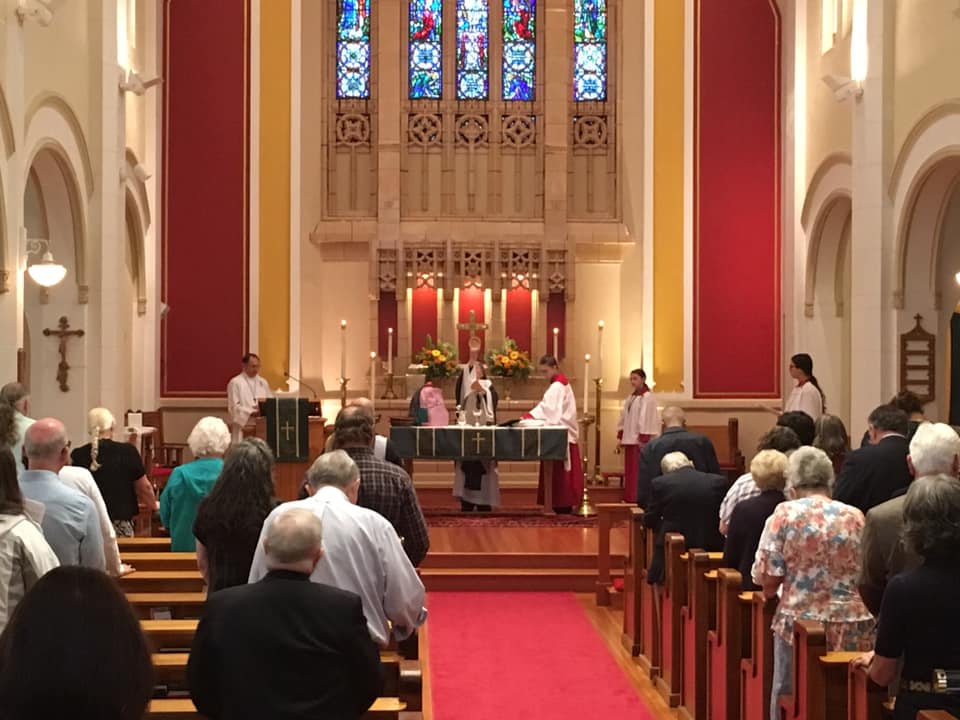
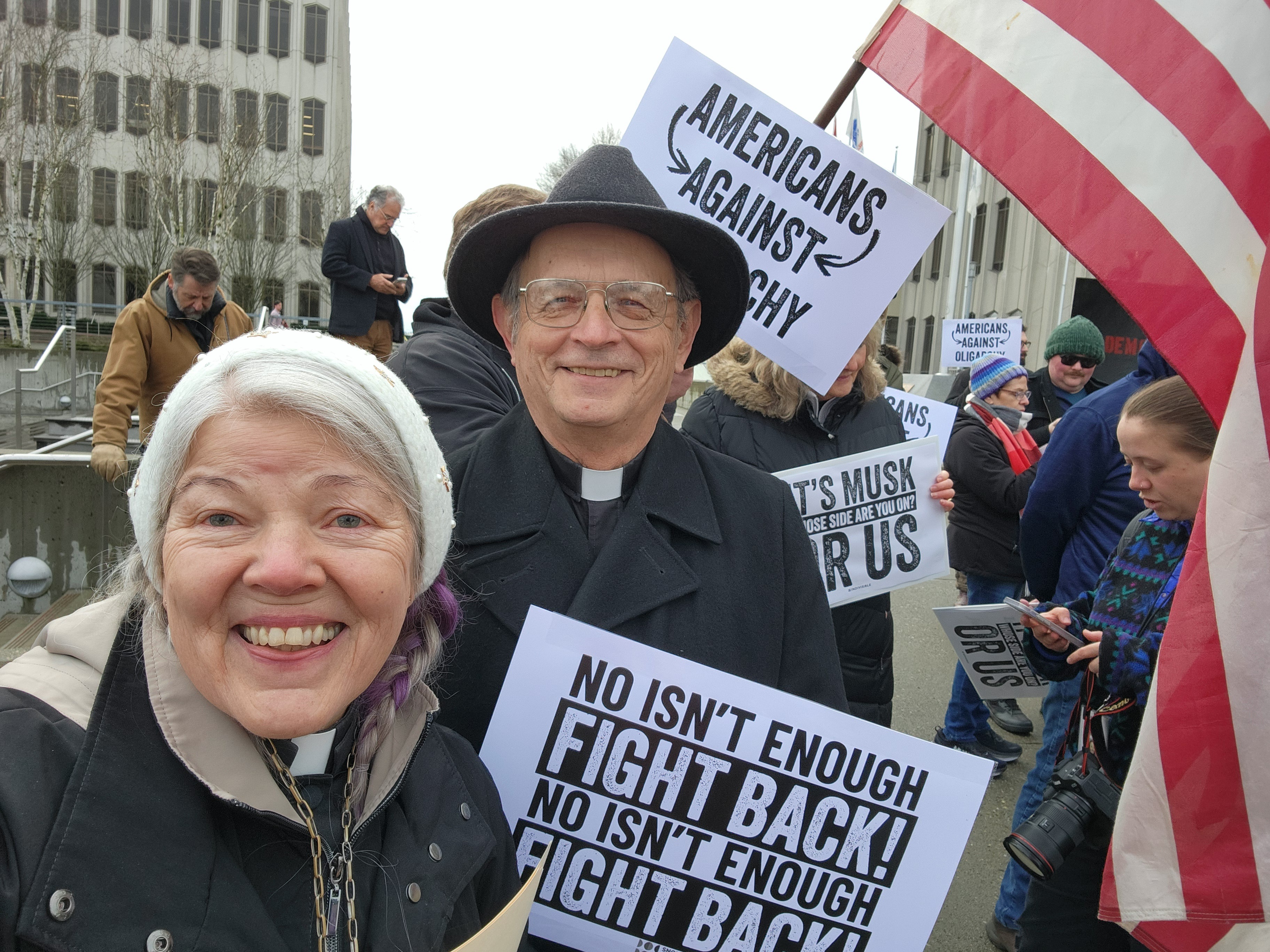
Public Address Given at “Freeze the Senate” rally, Snohomish Indivisible – February 5, 2025; Photo Credit R. Taber-Hamilton, with The Rev. Allen Hicks – Trinity Episcopal Church, Everett, WA

In less than two weeks from now, America will celebrate Presidents Day on Monday, February 17th. The observed federal holiday is officially called “Washington’s Birthday.” The holiday Presidents’ Day helps us reflect on not just the first president but also our nation’s founding, its values, and what Washington calls in his Farewell Address the “beloved Constitution and union, as received from the Founders.” Also, Abraham Lincoln’s birthday is February 12, so by calling the holiday “Presidents’ Day,” we can also include another remarkable presidents in our celebrations.

Since 1862 there has been an often forgotten tradition in the United States Senate that George Washington’s Farewell Address should be read on his birthday. I would like offer the following sampling taken from his speech:

George Washington’s Farewell Address

Your Union ought to be considered as a main prop of your liberty, and that the love of the one ought to endear you to preserve the other.

To put in the place of the delegated will of the nation the will of a part, often a small but artful and enterprising minority of the community, are likely in the course of time and things, to become a potent engine by which cunning ambitious and unprincipled men will be enabled to subvert the power of the people and to usurp for themselves the reins of government, destroying afterwards the very engines which have lifted them to unjust dominion. The domination of one faction over another, sharpened by the spirit of revenge, natural to party dissension…the disorders and miseries which result gradually incline the minds of men to seek security and repose in the absolutely power of an individual, and sooner or later the chief of some prevailing faction, more able or more fortunate than his competitors, turns… to the purposes of his own elevation, on the ruins of public liberty….

The continual mischiefs of the party are sufficient to make the interest and duty of a wise people to discourage and restrain it. It serves always to distract the public councils and enfeeble the public administration. It agitates the community with ill-founded jealousies and false alarms, kindles the animosity of one part against another, and foments occasionally riot and insurrection. It opens the door to foreign influence and corruption, which finds facilitated access to the government itself through the channels of party passions. Thus, the policy and the will of one country are subjected to the policy and will of another. 

It is important, [therefore] that the habits of thinking in a free country should inspire caution in those entrusted with its administration to confine themselves within their respective constitutional spheres, avoiding in the exercise of powers of one department to encroach upon another. The spirit of encroachment tends to consolidate the powers of all the departments in one, and thus to create, whatever the form of government, a real despotism. To preserve reciprocal checks in the exercise of political power must be as necessary as to institute them.

Real patriots who may resist the intrigues of the favorite are liable to become suspected and odious…while it’s tools and dupes usurp the applause and confidence of the people, to surrender their interests.

My friends, our union as a nation was not created by the mere signing of a declaration and writing of a constitution. Rather, our union has been forged from the iron of the blood of millions of Americans who have died in service to the ideals and values they believed in, who fought to institute and sought to preserve the principles of liberty. From this nation’s founding and the Revolutionary War, through the domestic turmoil of our Civil War, and in the two world wars in which we fought beside allied nations against forces of tyranny and fascism, the blood of this nations ancestors is speaking to us now.  

Our ancestors are with us today, they stand beside us and fill our hearts and minds with their wisdom, their foresight, and their ongoing commitment to those who have followed them and who are gathered here today. I say this as both a Shackan First Nations woman in the heritage of my mother and as a descendent of revolutionary soldiers and soldiers who served in the Union Army of the Potomac within my father’s American lineage dating back to the 17th century.

In our generation, through the words of Abraham Lincoln, “We the people are the rightful masters of both Congress and the courts; not to overthrow the Constitution but to overthrow the men who would pervert the Constitution.” Lincoln also said, “I am a firm believer in the people. If given the truth, they can be depended upon to meet any national crisis. The great point is to bring them the real facts.”

The words spoken by Abraham Lincoln on November 19, 1863 to commemorate the memorial monument area on the battlefields of Gettysburg, Pennsylvania contain an important message to us today. Listen; hear it word for word beyond the din of current events that are even now circumscribing the national and global battlefields of our time. Listen:

Four score and seven years ago our fathers brought forth on this continent, a new nation, conceived in Liberty, and dedicated to the proposition that all men are created equal.

Now we are engaged in a great civil war, testing whether that nation, or any nation so conceived and so dedicated, can long endure. We are met on a great battlefield of that war. We have come to dedicate a portion of that field, as a final resting place for those who here gave their lives that that nation might live. It is altogether fitting and proper that we should do this.

But, in a larger sense, we can not dedicate — we can not consecrate — we can not hallow — this ground. The brave men, living and dead, who struggled here, have consecrated it, far above our poor power to add or detract. The world will little note, nor long remember what we say here, but it can never forget what they did here. It is for us the living, rather, to be dedicated here to the unfinished work which they who fought here have thus far so nobly advanced. It is rather for us to be here dedicated to the great task remaining before us — that from these honored dead we take increased devotion to that cause for which they gave the last full measure of devotion — that we here highly resolve that these dead shall not have died in vain — that this nation, under God, shall have a new birth of freedom — and that government of the people, by the people, for the people, shall not perish from the earth.

Col. Joshua Lawrence Chamberlain, Commander of the 20th Maine Regiment of the Union Army said to his troops before marching to Gettysburg:

[We] are here for something new. This has not happened much in the history of the world. We are an army out to set other men free. America should be free ground — all of it. Not divided by a line between slave state and free — all the way, from here to the Pacific Ocean. No man has to bow. No man born to royalty. Here, we judge you by what you do, not by who your father was. Here, you can be something. Here, is the place to build a home. But it’s not the land. There’s always more land. It’s the idea that we all have value — you and me. What we’re fighting for, in the end, we’re fighting for each other.

26 years later during the commemoration of a monument to those members of the 20th Maine who fell during the battle of Little Round Top within the larger strife of the Battle of Gettysburg, Chamberlain concluded his memorial speech with these remarks:

Honor and sacred remembrance to those who fell here, and buried part of our hearts with them. Honor to the memory of those who fought here with us and for us, and who fell elsewhere, or have died since, heart-broken at the harshness or injustice of a political government. Honor to you, who have wrought and endured so much and so well. And so, farewell.

Today, you and I have come to this place from all walks of life, representing a diversity of heritage and culture, of origin and experience. Yet we are here united and indivisible in the face of forces that would seek to divide us and plunder this nation. We are also united by the common ancestors of every kind who have forged this nation and given it unto our keeping for its preservation. We are here for something that our first president seems to have anticipated, we are here for something new that has not existed before. We have each of us been set in this time and in this place to answer a call that none of us thought would be laid upon us – we are the inheritors of the urgings and lessons of those who have gone before us in the aspirational but slow and painful process of freedom for all. We are those who have been summoned across time and place to take up their call to action in our time.

Across the four centuries of American history that unite us in a shared experience of pain and struggle, sacrifice and hope, we are those who have inherited the legacy of preserving the union that is the foundation of our nation’s liberty. Indeed, we are here to fight for one another, to stand beside one another even as they did, with courage of heart and determination of will in order to assure that a “government of the people, by the people, for the people, shall not perish from the earth.”

Amen.

*******************************************************************

Link to Everett Herald Article: https://www.heraldnet.com/news/more-than-100-people-gather-in-everett-to-protest-recent-trump-actions/

Link to George Washington’s Full Farewell Address: https://www.owleyes.org/text/farewell-address/read/text-of-washingtons-address#root-54

Link to Col. Joshua Lawrence 20th Maine Memorial Dedication: https://www.battlefields.org/learn/primary-sources/chamberlains-address-20th-maine-monument-gettysburg


Leadership for the Now

1 Comment

In February of 2023, the first person asked me to consider running for the role of President of the House of Deputies (i.e. PHoD). The next election for the position will take place during the upcoming General Convention in Louisville, KY in June of this year. If the invitation to discernment had come from one or two individuals or from a special interest group or even a modest set of unhappy folks, I would not have given the request consideration, which was my initial response. Becoming PHoD has never been a goal of mine. If I had even imagined or wanted the position, I would have run for President rather than Vice President at General Convention #80 in Baltimore (2022). At that time, I genuinely wanted to support a layperson (rather than an ordained person) for the role of President, since the previous three terms the position had been filled by a priest. My feeling was that the tradition of alternating the leadership position between ordained and lay was equitable and desirable.

As the early weeks of 2023 turned into months of passing time, more and more people (independently of one another) made the same request, that I discern running for election for the role of PHoD. Some of these same faithful people also warned me that it would be challenging and costly for me to do so, that I would need to raise money for a “war chest” in order to wage a competitive campaign and get the most reach. I was advised by caring people that I would need to be prepared to endure character assassination, that prospects for my future career could be ruined if I were not elected, that if I continued a discernment for the episcopacy my loyalty to the House of Deputies would be thrown into question. One might ask why so many genuinely good, faithful, and dedicated people would hold such worries on my behalf and advise me of the need for such preparations. Are they melodramatic or crazy people? No, they are not. They are, rather, people who have worked for and in the church for many years in local, national, and international contexts of the church. In spite of the many frustrations and pains they have experienced over years of service, many remain dedicated to the work and mission of the church while some have needed to step away for the sake of their own wellbeing. As is unfortunately very common, many are in work situations where they cannot take the risk of speaking out publically because of very real personal and professional consequences.

For over a year, I have been engaged in discernment with people across our church about this question. This has been a weighty decision, and I do not take their cautions lightly. Many skilled and knowledgeable people whom I admire shared with me their concerns and hopes for both the governance and future of our church. Processing the frustrations and pains that people are experiencing is an important pastoral aspect of our conversations. Similarly, encouraging vision development and long-term goals for strategic planning contributed to a significant organizational assessment process for me. Taking the requests to enter into discernment seriously, I asked for personal space to discern until the fall of 2023.  People are hurting, and I recognize that I am one among them. For me, vocational discernment requires sincere vulnerability and allowing others to peer at me as one to speculate upon, imagine possibilities, ascribe every worst and best possible motivation to, critique, enjoy, get to know, view as a living Rorschach test, and ultimately have the choice to either reject or support. The choice is the important part.

For me, discernment can feel like falling in love – it is at once both joyful and terrifying.  Whenever I have entered into prayers of discernment, an image arises in my mind in which I see two visions of Christ, one imposed over another – something like a lenticular photo in which one or the other image is clearest depending on how the photo is tilted. In my discernment vision, I see the resurrected Christ superimposed over a crucified Christ. Depending on any given moment, one or the other is in view. When I perceive both at once, I know in my bones that no matter the outcome, I must show up.

I’m not certain that I will be elected as President of the House of Deputies at this year’s General Convention, but I have no doubt that I must participate in the conversation that gets us there. I am convinced that the House of Deputies needs a choice. As a House we need to enter a communal time of discernment about who God is calling us to be as church, about how we are to govern and lead through challenging and transformational times, and about what qualities and skills of leadership we will need in order to incarnate God’s love authentically one relationship at a time.

If we want a church that seeks truth and justice, then it is incumbent upon us to:

  • proactively develop safe and intentional opportunities for truth telling
  • to see and touch the living wounds among us in our church that even now are being inflicted
  • to care about the human development and spiritual wellbeing of our staff and the diverse volunteer members of our governing bodies
  • understand that when we say nothing we are not keeping the peace, we are keeping the tension
  • to promote leaders who are skilled in emotional intelligence; who are competent in leading crucial conversations in moments of conflict; who take personal responsibility and are intentional about their own accountability; who promote and communicate transparent processes; and who include even dissenting voices and challenging perspectives into decision making processes – the outcomes of which affect us all

For me, the full gambit of leadership elections that will take place during General Convention are about equipping our church organization with leaders in every aspect of our governance who have the ability and capacity to cultivate healthy corporate culture. They must have a genuine and lasting commitment to closing relational divides and building bridges that are based in mutual respect. We need compassionate and skilled leaders of every order who understand that our corporate journey is not about controlling for self interest but about empowering all of us for authentic community.

Through the lens of over 30 years of experience in organizational assessment and development, I am disheatened by what I have experienced and observed over the two years that I have served as Vice President of the House of Deputies. Behind the prose and photos that are public facing, there are unaddressed internal dynamics that in my professional opinion are contributing to an unhealthy corporate culture, jeopardizing our ability for forming the collaborative relationships necessary for effectively moving forward in the crucial work of The General Convention. I am in awe of the staff and volunteer members of our commissions and committees who are doing extraordinary work and maintaining a goal oriented focus in spite of relational challenges, but there are those who are exhausted from expending the amount of emotional labor it takes to function within compromised management systems. Additionally, there are some who are simply striving to stay out of harms way. I call this survival isolationism, and it is indicative of an organizational culture that is unsafe for personal and professional growth. The added messaging from leadership that we are “loving and faithful together in this work” is not especially in touch with our current corporate reality.

I have never had and do not now harbor an ambition to become the President of the House of Deputies – this to me is too narrow a goal. What I do have is an ambition to create a healthy church. I believe that what is at stake at this time in our corporate life is more than how we govern, more than our program reach, more than curriculum development, more than resolving to do all things in all places for all beings, more than any given social justice issue, more than our fiduciary viability and obligations, and more than becoming Beloved Community. While all these things are vital elements of our mission and values as a church, there is for me an overarching concern that encompasses of all this and unites all of us. When we walk on into the eternal life that is to come and thereby transition from being elders into being ancestors, what will be crucial to future generations is what we are prepared to do right now, the legacy we leave to them. What are we willing to hold ourselves responsible to create in our day and with our votes and with our courage, for this is the guide by which they will judge us and will either be a foundation for their renewal or a burden they must leave behind. My friends, what exactly are we waiting for to create? We must do justice NOW, we must be bold NOW, we must use our voices NOW, we must demand organizational health NOW, we must stop strategies that harm and manipulate NOW, and we must elect and hire and call and support healthy leaders NOW.

The outcome of our elections is not about me or any other candidate. It is rather about those who will inherit this church. Whatever the outcome, I am running for President of the House of Deputies NOW, because I want us all to experience a healthier organization NOW. The next discernment is NOW yours.

In Christ’s Peace,

The Rev. Rachel Taber-Hamilton,

Vice President of the House of Deputies of The General Convention of The Episcopal Church

P.S. If any deputy is interested to run for President or Vice President of the House of Deputies, the required application for background checks is open and available until April 24. Click on this link to navigate to the application page: https://gco.formstack.com/forms/house_of_deputies_background_check_application_2024

COP28: The Role of Faith in Climate Change Activism

Leave a comment

For the first time in its history, the meeting of the Conference of Parities hosted a Faith Pavilion – a dedicated space for interfaith dialogue, prayer, and faithful action on climate change. For me, the Faith Pavilion was a powerful experience in collaboration, theological discourse, and emergence of significant global relationships among diverse faith leaders sharing a mutual commitment to faithfully intercede in meaningful ways on behalf of the world’s suffering in light of climate change.

A Brief Background on COP

The UNFCCC secretariat is the United Nations entity tasked with supporting the global response to the threat of climate change. UNFCCC stands for United Nations Framework Convention on Climate Change. The Convention has near universal membership (198 Parties/Nation States) and is the parent treaty of the 2015 Paris Agreement. The main aim of the Paris Agreement is to keep the global average temperature rise this century as close as possible to 1.5 degrees Celsius above pre-industrial levels. The UNFCCC is also the parent treaty of the 1997 Kyoto Protocol. The ultimate objective of all three agreements under the UNFCCC is to stabilize greenhouse gas concentrations in the atmosphere at a level that will prevent dangerous human interference with the climate system, in a time frame which theoretically is intended to allow ecosystems to adapt naturally while enabling sustainable economic development in human societies.

The annual COP meeting is the supreme decision-making body of the Convention. All States that are Parties to the Convention are represented at the COP, at which they review the implementation of the Convention and any other legal instruments that the COP adopts and take decisions necessary to promote the effective implementation of the Convention. At the United Nations climate change conference in Paris, COP 21, governments agreed that mobilizing stronger and more ambitious climate action is urgently required to achieve the goals of the Paris Agreement.

Further, industrialized nations agree under the Convention to support climate change activities in developing countries by providing financial support for action on climate change beyond any financial assistance already provided to these countries. A system of grants and loans has been set up through the Convention and is managed by the Global Environment Facility. Industrialized countries also agree to share technology with less-advanced nations. Reports submitted by all Parties for 2023 (COP28) are available here: https://unfccc.int/reports

The Faith Pavilion at COP28

Faith-based organizations (FBOs) and religious leaders are an important presence at the UN Framework Convention on Climate Change (UNFCCC) Conference of Parties demonstrating that religious and spiritual communities are essential to the fight against climate change and to achieving the Sustainable Development Goals (SDGs) and the goals of the Paris Agreement. 

The United Nations Environment Program (UNEP), through the Faith for Earth Coalition, the Interfaith Coordination Group on Climate Change served as a coordination hub for collaborative Interfaith engagement towards COP 28. The Group is a global effort made up of approximately 60 actors from 35 different FBOs and civil society NGOs (Non-Governmental Organizations, usually non-profits). The Core Team served a smaller action group that met weekly to provide key strategic direction to the Coordination Group. The Episcopal Diocese of California was one of the six institutions represented on the Core Team by Bishop Marc Andrus, who additionally served as the chair of the Episcopal delegation that participated in COP28.

This year’s COP was the first time for the Faith Pavilion, which in the case of Dubai was facilitated by the local host Muslim Council of Elders. The Pavilion had three strategic objectives:  1) Encourage faith-based organizations (FBOs) to engage with country delegates and increase their capacity to advocate for specific negotiation outcomes at COP28 and beyond, 2) Increase visibility for environmental advocacy work by FBOs and other spiritual and religious actors, particularly those on the frontlines of the climate crisis and how this work contributes to the goals of the Paris Agreement. Promote multi, and 3) highlight faith understanding by creating a space for spiritual reflection, artistic expression and prayer.

Over the course of the two weeks of COP28, the Faith Pavilion hosted 70 events that incorporated more than 350 speakers through a variety of topical panels. In a spontaneous and generous gesture of inclusivity, Rabbi Yonatan Neril invited me to participate on two panels that he facilitated. Rabbi Neril is the founder and current director of the Interfaith Center for Sustainable Development (ICSD), a non-profit organization based in Jerusalem.

Cultivating the Human Heart

Throughout my time participating in the second week of COP28, I heard a common message from leaders of faith, leaders of NGO’s, and governmental representatives about the importance of including the wisdom and perspectives of Indigenous people on issues of both climate change impacts and adaptations. During my daily check ins at the Indigenous Pavilion, I heard the overall Indigenous message to the world as one of returning to traditional Indigenous lifeways that are in harmony/balance with nature and that are inherently more sustainable ways of living that promote environmental wellness for the benefit of all life.

For me, the overarching difficulty about the COP framework is its primary focus on economic development as the foundational principle of human development and development of human societies. This narrow view makes it understandable about why a Faith Pavilion has never been a part of COP previously. Faithful living in every religious tradition is a practice of simplicity, humble service to others, and sharing what gifts we have with one another. In contrast, dominant economic culture worldwide tends to value competition for resources, operate out of self-interest, and practice resource hoarding which in turn relies on the subjugation of an inexpensive work force by the economic elite. Therefore, climate justice is closely tied to human rights advocacy.

Faith activism is attuned to the sacred nature of Creation as a foundational belief across religious traditions. Collectively, people of faith believe that we have a responsibility to not only preserve Creation, but to actively participate in its ongoing cultivation as collaborators/co-conspirers with the Sacred in order to enhance the wellbeing of all life. This is not an easy spiritual discipline. We are called to simplicity in living (living simply so that others may simply live), and cultivating a broad and deep understanding of the interconnected nature of life on earth that requires our proactive advocacy at every level of society and within our faith communities.

I have long believed that the Episcopal Church would benefit from some amount of “Indigenization” in its worldview, polity, and practice. For me, Indigenization includes the goal of turning people’s hearts towards the illuminating sunlight of God’s love that is in keeping with Christ’s teaching of simplicity of life, acceptance of diversity, our spiritual connection to all beings, and the sacred trust given to us to be stewards of Creation as a primary spiritual practice. I fear that like nation states, our institutional life undervalues the perspectives of our marginalized global members, subjugates the voices of protest that seek institutional reform and genuine transformation, and continues to prioritize monetary concerns above the spiritual needs of our communities. There is more than one model of economy from which to choose – the dominant model of capitalism is not sustainable either as a society or as a church. The model of reciprocity not only has Indigenous teaching behind it but also is more in keeping with Christ’s teaching of sharing always from what we have in a continual cycle of blessing that recognizes and values our interdependency and relationship with and within Creation.

As many speakers in the Faith Pavilion shared, the current Climate Crisis is also a spiritual crisis. People around the world, in every culture, are seeking meaningful connection with one another for needful systemic change. However, our understanding of the vital nature of our mutual interdependence on one another and the natural world requires the deeper appreciation of connection that goes far beyond one of commerce. People of faith have the opportunity and imperative of acting both locally and globally in ways that make the power of love real in our world. We do this through inclusion for those who have been marginalized, by making atonement real for those in power who are not serving the people and who denigrate the environment, by making reconciliation real between humanity and the environments in which we live, and by developing mutually supportive relationships between faith communities.

The witness of Christ’s ministry teaches us that the gifts of the earth are not resources for the privileged few to exploit. Rather, the Good Gardiner teaches us that the gifts of the earth are ours to cherish and to cultivate for their own sake. We are to love God and our neighbor, but there is no closer divine neighbor to each of us than the sacred earth beneath our feet that grounds us in sacred places, the sacred water that flows through our veins, and the sacred air that gives us breath.

For God’s sake, let us love our neighbors well.

Episcopal Leadership

Leave a comment
Trinity Episcopal Church, Everett, WA

The Catechism or Outline of Faith of the Episcopal Church includes the question, “Who are the ministers of the Church?” The answer responds,” The ministers of the Church are lay persons, bishops, priests, and deacons.”  I believe that leadership formation is a vital and ongoing component of each of the four orders of ministry – the life and mission of the Church relies upon the leadership skills of members within each order for the sustainability of the purpose-driven service of the Church.

Leaders are formed and called within each of the four orders of ministry. However, not all those who are elected/selected/self-injected into leadership roles possess the traits and skills necessary for the required relational and organizational work. Part of the difficulty of addressing leadership issues related to ministerial calling has to do with the (usually) unarticulated assumptions of what constitutes a desirable leader within the dominant culture system of the Church. For example, self-promotional arrogance is often mistaken for competence while humility and vulnerability are frequently deemed to be weaknesses. It’s an old story and a reoccurring theme that I have seen repeated in clergy/bishop search processes as well as in parochial ministries and academic settings. For people of color who are informed by alternative cultural values, navigating the dominant culture assumptions around leadership can be especially frustrating within a vocational discernment or call process.

My understanding and aspirations of leadership are informed by both my Indigenous cultural values and more than thirty years of organizational assessment and development. I find that leadership has an ephemeral quality to it when done well. A leader in harmony with community has a feather-light touch that communicates trust and uplifts others with confidence in their abilities, a quality of love for who others are as people, a commitment to their lifelong development and realization of potential.  Leadership invites diverse people of genuine talent whose joy and imagination is unthreatening to a leader who is secure in who they are. Leaders do not need to manipulate those around them or expect others to protect the leader’s deficiencies or cater to the leader’s ego needs. Leaders do not marginalize dissenting voices but do insist on mutual respect. Leader’s create safe space for all voices, invite the humble, and moderate the entitled. Leaders model vulnerability while standing in great strength. Leaders challenge injustice and never ever fail to speak up for fear of retaliation or cost. Leaders lead for the sake of the lives of others, for the well being and health of the community.  This is the leadership formation I learned in my Indigenous matriarchal culture. I have a preference for these values to what I experience in much of the dominant culture church.

That said, even within dominant culture, there is a common understanding that baptism, ordination, consecration, certifications or academic degrees do not make people leaders; neither do such things assure leadership competencies. Leadership in every sphere of the Church requires a high level of self-awareness, a mature emotional intelligence, a collaborative management approach, and a genuine passion for service that prioritizes the needs of the community over the needs of one’s own ego.

Too often, I have experienced leaders in every order of ministry more focused on establishing their own authority and fiefdoms within the Church than they are actually interested in serving and cultivating others. Once established within the institutional order of things, egocentric leaders can spend the rest of their tenure controlling assets and access to power, assisting only those people willing to facilitate the established rewards system while alienating those unwilling to be codependent to a false loyalty program. It doesn’t take an expert in organizational development to identify leadership dysfunction – usually those most affected are well aware of the issues at hand and only require the supported opportunity to verbalize the emotional exhaustion and pain commonly associated with leadership voids and systems failure.

As one of the best-known and most influential chefs in the world, Gordon Ramsay has developed an intuitive (even if fiery) ability to assess for leadership and organizational dysfunction in every failing hotel or restaurant that he is invited to help turn around. In many instances, Chef Ramsay’s assessment includes the recognition of the loss of passion and vision that originally inspired the operating chef. The capability of leadership and organizational possibilities usually exist, but the instinctive creativity of the chef has become suppressed (even depressed) within systemic/relational dysfunctions. The amazing art of cultivating human encounter through cuisine that shares from the resplendent diversity of human identity to feed the world shares much in common with the mission and challenges of the Church today.

Many of our leaders in each order of ministry are struggling to regather a sense of meaning and creative vision amid the pressures of antiquated (even damaging) ways of being Church. Financial concerns, changes in attendance patterns, unrealistic expectations within limited resources, and aging infrastructure may all be very real issues. However, I believe that the power of adaptive change requires reconnecting with our passion – the original inspiration of our calling as sources of God’s creative and joyful presence in the world.

Leadership at every level and in every order of the Church in every setting needs to stop making excuses for why things aren’t working, take responsibility for our respective ministries, and make the personal and organizational changes necessary to un-hobble God’s next creative endeavor through us. Egocentric leaders need to be challenged or moved out, dysfunctional systems need to be named and changed, and cultural values that do not serve the community need to be replaced by values that do.  The alternative is to admit to ourselves that our passion just isn’t there anymore, we don’t have the necessary skills, and it’s time to close up shop.

There are ways in which I identify with Chef Ramsay’s lack of tolerance and bluntness in the face of poor leadership and systems that fail both employees and those being served. I have had my Ramsay moments in the Church and then worked hard to initiate and lead meaningful change. When working for change within the system hasn’t been effective, I have been willing to name issues publicly. While some may say that’s not a prudent choice to make, I feel sure that our Church is on course to die a prudent death in the absence of truth telling regarding leadership and/or organizational dysfunction. Only with courage can we find the way forward together and discover anew the delight of creating the Church we envision, by realizing the amazing art of cultivating human encounter through Christ that shares from the resplendent diversity of human identity to feed the world.

Trinity Episcopal Church in Everett, WA Mission Statement:

Forming leaders and building community by seeking and serving Christ in all God’s creation.

A Wilderness People Seek Holy Ground

1 Comment
Photo by Don Wayne – Mt. Rainier National Park

Results of Our Six Diocesan Resolutions

Circles of Color sponsored six resolutions to Diocesan Convention. We led a preconvention workshop on the Thursday evening before the Friday/Saturday convention schedule. During Convention, we provided a Friday morning introductory workshop to the Circles of Color and a panel discussion on Saturday. The sum of work was intensive, but the rewards were exponential.

The overarching intention of the six resolutions was to draw collective attention to the needs for diocesan institutional reform to support the work, leadership formation, and ministries essential to the communities and people of color in our diocese. Before 2007, this work had been facilitated by the supervision of a fulltime ethnic missioner, a fulltime suffragan bishop, a full-time assistant, and a part-time dedicated communications assistant. From 2007 onward, staff cuts and budget cuts served to deconstruct the centralized programing and support that had previously existed for our Episcopalians of color. In the absence of a proactive staff presence for providing advocacy, support and connection, the recruitment and leadership formation BIPOC people suffered as did several of our faith communities of color. In short, an administrative goal to cut costs had the impact of deconstructing ethnic ministries, which had been a vital community for BIPOC people in the diocese that provided significant partnerships, education, and consultation resources throughout the diocese.

The Circles of Color resolutions addressed the importance and need to keep BIPOC concerns and needs in the forefront of diocesan mission and commitment. During our panel discussion on Saturday, we heard from a member of the Diocesan Budget and Finance Committee that a diocesan survey some years ago indicated that ethnic ministries was a low priority for our diocese. However, based on the outstanding support of members of Convention this year, I believe the sense of diocesan priorities may have changed somewhat in response to the current issues of our time – most especially the influence of the Black Lives Matter movement and revitalized interest in the intersectionality of indigenous peoples concerns and environmental justice issues.

Convention passed all six resolutions sponsored on behalf of Circles of Color. The resolutions themselves provided an important opportunity for reflection and education. They served as a lens through which to view and understand the needs of BIPOC Episcopalians. The majority of the diocese was likely unaware of the disenfranchisement experienced by our BIPOC church members and communities. I believe that I speak for all members of Circles of Color that we felt deeply grateful and were very emotionally and spiritually moved by the Convention’s support of the resolutions and by the witness and testimony provided by white allies who spoke in support of the resolutions. Many tears of gratitude were shed, and by the end of Convention we felt that we had been seen, heard, and valued. We hope that the community gift of being seen, heard, and valued will continue as we all grow in the depth of our relationships with one another in the Diocese of Olympia.

Whoever’s in Charge is Who’s Responsible

The greatest organizational challenges for needed changes are in areas of governance and leadership, getting to the heart of addressing issues of systemic racism in the church. Bishop Rickel has noted that now that the resolutions have been passed, the real work begins. From a values and community perspective, the work of addressing systemic racism is all of ours to do and rests with no single individual but with every individual, wherever we are on the organizational flow chart, however much social power we have, and whatever color we are. In our Baptismal Covenant, each of us has made the promise to strive for justice and peace among all people, and respect the dignity of every human being. Fulfilling our Baptismal promises constitutes the work of a lifetime.

However, from a leadership and organizational perspective in which the reality of church hierarchy determines institutional and budgetary priorities, the bishop and his office as well as the dean and the diocesan cathedral need to do some soul searching. People of color in the Diocese of Olympia are asking for mutuality in our relationships with church leaders, input into institutional operations that directly affect us, and pastoral responses from diocesan and cathedral leadership. Asking for mutuality and decision-making that cares for the needs of the marginalized – which are community value of our faith – is at odds with the hegemonic nature of a hierarchical institution that equates leadership with higher authority possessing greater power and control.

In terms of systems theory, it is not possible to reconcile issues of inequality within a hierarchal structure that by its nature derives authority from the unequal social strata over which it has power. The democratic principles that seemingly empower the bicameral decision making of diocesan conventions and the General Convention of the Episcopal Church may be legislative bodies that attempt to balance the hierarchical influence of bishops and other leaders. Yet, the canon law that undergirds the Church polity and empowerment of hierarchal decision making is cumbersome and time consuming to change in response to the facile and rapidly changing needs of our time – including adapting to real-time needs of our growing communities of color.  Therefore, organizational adaptation is highly localized and is utterly dependent on how a given diocesan bishop or leadership system is willing to flex in the way in which authority operates on a continuum of unilateral hierarchical decision making to allowing for corporate influence in decision-making and collaborative organizational management.

Hierarchical decision-making says, “I have decided this is how it will be – you figure out how to execute my expectation and thereby you are ‘empowered’ to do things my way, and I will hold you accountable.” Whereas, corporate input into decision making that leads to genuine collective responsibility says, “We need to hear from one another regularly and intentionally so that we keep learning what we each need from a shared commitment to creating what we envision together; in this way we empower one another to assume the responsibilities we each have toward one another through our shared leadership, holding ourselves accountable.”

When hierarchical systems are incapable or unwilling to listen to the needs of the marginalized, the people will insist on transformative change, frequently perceived as a hostile corporate takeover by those whom the system genuinely empowers. Corporate challenge is the first indicator to those in charge within a system from which only the few derive authority that the system is not serving the people. Hierarchical systems rely on a system of rewards and punishments, usually generating a cosmology that promotes fear of retribution and extends relationship only to the compliant.  Within a hierarchal church system, forgiveness is about successfully placating angry gods.

Fortunately, in the face of the hierarchical machinations of empire and religious institution, Jesus offers a compelling alternative.

New Testament Leadership is Corporate and so is God

Jesus and early church leadership introduced significant social and theological innovations to the  hierarchical values and cultural beliefs enforced during their lifetime. Their perceived attempt at corporate takeover was considered threatening enough by those in hierarchical power to get nearly all of them killed. Yet, history shows us that good ideas are hard to entomb or coopt and have a tendency to be resurrected and liberated in successive generations. Just as creation is an ongoing phenomenon not limited to the allegory of seven days, Christ’s resurrection was never limited to just three days but continues unabated in our time.

The reality that the savior of dominant culture is an articulate, educated, brown-skinned, socially progressive young adult we know as Jesus is entirely relevant to the call confronting the Church today. Having lived his entire human life as an indigenous man living under Roman occupation and frustrated by the failure of his religious leaders to take a stand on behalf of the people in order to help mitigate their suffering, Jesus empowered others through his leadership. He leveraged whatever social privilege he held to cultivate relationships with the whole spectrum of his society, subverting multitudinous dominant paradigms with the certitude of the core principles of his faith. He elevated the law to love one another into a rallying cry for social, personal, and spiritual transformation. He seemingly challenged everyone he met to garner the fortitude to grow beyond the social limitations/expectations placed upon them like manacles, while chastising those who had created those bonds.

Jesus did not seek to overthrow but to create level ground for all. For those dwelling in high places of power, level ground was an anathema. Yet, early church writers picked up the theme of human value within corporate ways of being, and a triune God in collaboration with itself became the new model for leadership and community. In a challenge to ascribed social and religious privilege, Paul deconstructed social strata in human society and in religious institution, reframing the new community as the Body of Christ:

For in the one Spirit we were all baptized into one body—Jews or Greeks, slaves or free—and we were all made to drink of one Spirit. Indeed, the body does not consist of one member but of many. The eye cannot say to the hand, ‘I have no need of you’, nor again the head to the feet, ‘I have no need of you.’ On the contrary, the members of the body that seem to be weaker are indispensable.  But God has so arranged the body, giving the greater honor to the inferior member, that there may be no dissension within the body, but the members may have the same care for one another. (1 Cor 13-14, 22, 24b-25).

Identifying a basis for common ground amidst social and cultural diversity, Paul also provides a basis for unity and social leveling in the idea that all social assignments that ascribe our identity – including ethnicity and gender – are subsumed into the singular identity of Christ, whose own identity in/as God transcends all:

Therefore the law was our disciplinarian until Christ came, so that we might be justified by faith. But now that faith has come, we are no longer subject to a disciplinarian, for in Christ Jesus you are all children of God through faith. As many of you as were baptized into Christ have clothed yourselves with Christ. There is no longer Jew or Greek, there is no longer slave or free, there is no longer male and female; for all of you are one in Christ Jesus. (Gal 3:24-28)

Surely, when members of Christ’s body are hurting, we need to tend to those wounds collectively. People of color in the diocese of Olympia are hurting. Passing the six resolutions at our convention was an important beginning. Hearing Bishop Rickel state at convention that he is aware that he is responsible for causing much of the pain that was shared during the listening session panel was incredibly important. The next step is in developing mutual relationships in which people value one another through deepening trust and understanding. However, there is no program, training module, or personal inventory in existence that can substitute for doing the actual work of relationship building. One phone call at a time. One email at a time. One Zoom at a time. One meal at a time. One conversation at a time. Jesus never said the love we should have for one another would be easy, but he did say that it’s the most important work we can ever do for God.

It is laudable and appreciated that our bishop and cathedral are developing partnerships with diverse churches and ethnic communities outside of The Episcopal Church and with Episcopal leaders of color outside of our diocese. Yet, in doing so, leadership has overlooked our own people of color in the Diocese of Olympia and neglected the need we have for being in transformative and liberative relationship with our bishop and our cathedral. I hear that some hierarchical leaders feel at risk and are afraid; I hear that some of our people of color feel at risk and are afraid. Yet, I believe that all of us long for a relationship rooted on the level social landscape as Christ’s body that is Holy Ground, where “We will not all die, but we will all be changed.” 1 Cor 15:51

The Measure of a Priest: Racial Bias and White Privilege in The Episcopal Church

19 Comments

Church Mould

The yard was the original standard adopted by the early English sovereigns as a basis of calculation. Under the historical influence of the British Empire, the term “yardstick” became associated as the ideal standard for making critical judgments about a person. Consequently, “taking the measure of a man” gained more meaning than simply assessing the amount of cloth required for making him a suit.

In many ways, the yardstick by which The Episcopal Church evaluates the suitability of would-be clergy is inextricably linked to the ideology of British colonialism. The standard for measuring candidates for ordination is subsequently biased towards Euro-centric models of education, formation, and proficiency/fluency in navigating dominant culture. As a product of colonialism and dominant culture, The Episcopal Church in the United States evaluates for whiteness in its people of color.

Several years ago, when I took the General Ordination Exams, the test writers included a question that asked for candidates to reflect on how The Episcopal Church was doing with regard to racism within the Church. I heard later from a member of the examining board how surprised they were by the scathing critiques that answered that question. Nothing has changed since then, because the way the Church prepares and evaluates for pastoral competencies is gravely culturally biased. It has been my personal experience that every single person of color and white ally intending to work in ministry with communities of color is at some point asked by evaluators if they believe they are “sufficiently Anglican.”

For example, anything other than a prayer life centralizing the Book of Common Prayer is suspect.  In my case, all it took for a Commission on Ministry to be concerned was when I shared that I incorporate my indigenous practices of burning sacred herbs and indigenous traditions of interacting with nature as important aspects of my spiritual practice and formation.  Within a diocese with a history of Native missions, this may not have been such a concern since such a context is generally more cross cultural, with education and information flowing in both directions. However, I am an “urban Native,” and my Commission on Ministry was primarily driven by white liberalism rather than by any real knowledge of or interest in my Native culture.  I was well aware that it was my burden to measure up and not their burden to alter their standard of measure.

Most recently, there has been a growing trend in The Episcopal Church in the United States to use the curriculum of the Iona Center as a standard of education as an option for local training for postulants seeking ordination. The local adaptation of the Iona material used in the Diocese of Olympia has taken the form of  “The Iona Olympia School” which is self-described as “a three-year program with a rigorous, curriculum (comprised of textbooks, videos, discussion and activities, and field study) provided by the Iona Institute of the Seminary of the Southwest.” It follows “a traditional school calendar year, beginning in September” and expects paid tuition as well as participation in large blocks of time away from home, work, and family.

None of these expectations is realistic for the majority of people of color, particularly Native people. Course content is not adapted for the indigenous context or context of the communities of color with regard to types of learning and the application of experience. Ultimately, those who undertake local option training are not expected to be paid much if at all once they are ordained – being mostly either deacons or people of color who may become priests.

The argument may be that (by setting “rigorous curriculum” that includes the Euro-centric history of the Church and its subsequent traditions of worship and governance) those who graduate from local training will not be considered second-class clergy. What standard has established that concern in the first place and who yet holds that standard of expectation? White people? Western academics? Bishops? General Convention? People in the pews? All of the above?

The General Board of Examining Chaplains in The Episcopal Church is charged with creating ordination exams that test for the seven canonical areas of study as ascribed by Canons of the Church. These areas of desired proficiency include: 1) The Holy Scriptures, 2) Church History, 3) Christian Theology, 4) Christian Ethics and Moral Theology, 5) Studies in contemporary society (i.e. familiarity with minority groups), 6) Liturgics and Church Music, and 7) the Theory and Practice of Ministry.

Informing each of these canonical areas of study is a massive amount of dominant culture history, perspective, and assumption that yardstick people into seemingly “standard” units of measure. The current ordination process is not benign, and its colonial nature is nowhere more apparent than in how it forms its people of color as leaders for the church. Any training program that does not address the academic areas from a dominant culture perspective towards overlaying a dominant culture identity is deemed little more than finger painting. The “Anglican” in Anglican identity is at its core white history and white identity.

The pedagogy of the dominant culture Church seems to need to shape the foreign into the friendly and familiar, rather than taking the risk of losing a Euro-centric identity. A genuine adult learner approach to leadership formation assumes diversity in experience, perspective, and practice. Therefore, evaluators must be tasked with their own formation before becoming evaluators – they must care about postulants and candidates as people and not as potential interchangeable widgets within the machinations of the institution. Candidates should not be in the position of trying to fulfill the evaluator’s own unexamined cultural biases and assumptions.

How the Church delivers spiritual care and organizational development will depend on genuinely collaborative efforts, not just patronizing gestures of tolerance. Barriers between levels of the diocesan structure need to be replaced with semi-permeable organizational membranes through which education, formation, and cultural influence can flow in both directions. Our candidates for ordination are not empty vessels to be filled with colonized history and identity; they are unique peers, partners, colleagues, and friends who should be joining a community already committed to learning new perspectives and willing to adapt structures and expectations to reflect new and emerging truths. Traditions are not immutable and timeless or universal things – rather, tradition is best understood as the adaptive mechanism within culture that provides the basis for creative change.

There is more than one way to form a leader, just as there is more than one way to be a church within the Church. Our Church faces many challenges, and I believe that our people of color hold adaptive strategies worthy of our collective attention – they are, after all, experts in having to adapt to ways and methods not their own. It is beyond time for the dominant culture Church to learn to do the same.

Patriarchy and the National Struggle to Embody Christ

2 Comments

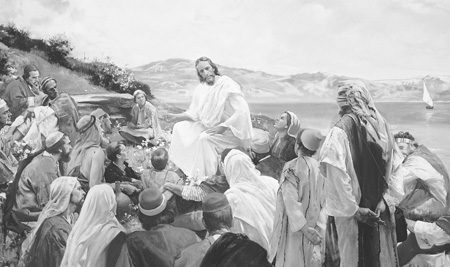
Jesus Teaching at Galilee 3

Prelude: I don’t normally post my sermons to my blog site, but for me personally, the sermon I shared on June 10th was one the most important sermons that I’ve ever given. It’s about my identity and yours, and the struggle for everyone’s identity within the patriarchal tradition of  faith and of society, of Christianity and of The Episcopal Church as we have it today.  

This sermon is also one of my longest, and I am grateful to those who gave me their forbearance that day, those who have continued to view it on YouTube [a link is at the end of this column], and to anyone who now gives of their time to read it here.

Thank you, most especially, to the Sons of the Church who are thereby also my Sons, many of whom are also fathers of one kind or another. Your struggle is my struggle. Christ models for all of us a way to make freedom and peace truly real for one another.

Sermon: Pentecost 3 – June 10, 2018

The history of the rise of monotheism and the system of belief in the God of Israel emerges from a socio-cultural history of patriarchal social systems and belief systems within the context of greater ancient Mesopotamia. Western history and Christianity and the forces of colonialism stem from the advent of patriarchy and governance by men as social and religious leaders within patriarchal structures. What I have just said is evidentially true. The World has been both enriched and enslaved within this model over successive generations, in part due to the struggle inherent to patriarchy – the essential question of what male leadership is to look like. This struggle is as much with us today in our context as it was in First Century Jerusalem, during the time in which Jesus lived.

There are two basic models within patriarchal paradigms which struggle together to inform the underlying value system – the “stern father” vs. “nurturant parent.” In this duel understanding, the Nurturant Parenting contrasts with Stern Father parenting as two distinct metaphors each used as icons of contrasting value and political systems, i.e. Regressive (Stern Father, authoritarian) and Progressive (Nurturant Parent, small “d” democratic).

Within patriarchal society, there are men and women who are enculturated in or identify with the Stern Father cultiral cosmology, and there are men and women who are enculturated in or identify with the Nurturant Parent cultural cosmology. The struggle is not between men and women, but between two essentially different ways of conceptualizing authority and it’s exercise.

The struggle of patriarchy to identify its primary model of leadership continues to inform and impact the nations and communities of our world today. As a female leader within the patriarchially informed church, I can tell you that I love and care about God’s sons.  If I did not, I would not be here before you, and I would not have dedicated the service of my life to the church. That said, as a woman who is called to nurture the people of God’s kingdom, in my role as a spiritual mother in the church, the time has come for me to speak to my sons and to share something vitally important about their history and about the challenges they must rise to meet in the current time of world events.

Let us begin with our Old Testament reading – Samuel’s parents give him to Eli, the high priest, to raise as a nazarite dedicated to God. Samuel plays a key role in the transition from the period of the biblical judges to the institution of a kingdom under Saul, and again in the transition from Saul to David. Samuel initially appointed his two sons as his successors; however, just like Eli’s sons, Samuel’s proved unworthy. The Israelites rejected them. Because of the external threat from other tribes, such as the Philistines, the tribal leaders decided that there was a need for a more unified, central government, and demanded Samuel appoint a king so that they could be like other nations. Samuel interpreted this as a personal rejection, and at first was reluctant to oblige, until reassured by a divine revelation.

Within the discourse between Samuel and God, two types of kings are identified, “He will take your sons and appoint them to his chariots and to be his horsemen, and to run before his chariots; and he will appoint for himself commanders of thousands and commanders of fifties, and some to plow his ground and to reap his harvest, and to make his implements of war and the equipment of his chariots. He will take your daughters to be perfumers and cooks and bakers. He will take the best of your fields and vineyards and olive orchards and give them to his courtiers. He will take one-tenth of your grain and of your vineyards and give it to his officers and his courtiers. He will take your male and female slaves, and the best of your cattle and donkeys, and put them to his work. He will take one-tenth of your flocks, and you shall be his slaves.”

Alexander Hamilton had a similar concern about the nature of kings. In his Federalist Papers, Hamilton outlined the premises of a republic that favored an office of the President in contrast to a king. In paper #69, Hamilton points to the fact that the president is elected, whereas the king of England inherits his position. The president furthermore has only a qualified negative on legislative acts—i.e. his veto can be overturned—whereas the king has an absolute negative. Both the president and the king serve as commander in chief, but the king also has the power to raise and maintain armies—a power reserved for the legislature in America. The president can only make treaties with the approval of the Senate. The king can make binding treaties as he sees fit. Similarly, the president can only appoint officers with the approval of the Senate, whereas the king can grant whatever titles he likes. The powers of the president in terms of commerce and currency are severely limited, whereas the king is “in several respects the arbiter of commerce.” In many respects, the president would have less powers over his constituents than the governor of New York has over his.

As the first president of the United States, George Washington served from 1789 to 1797.  Though he was born into Colonial Virginia gentry to a family of wealthy planters, he was a modest man when it came to claiming the boundaries of his authority as president. He believed quite clearly that the new nation that he helped established should be governed by the people.

In the 32 handwritten pages of his farewell address, Washington gave much advise to both the governed and those who would govern. He recognized the pitfalls of a party system, writing, “The alternate domination of one faction over another, sharpened by the spirit of revenge, natural to party dissension, which in different ages and countries has perpetrated the most horrid enormities, is itself a frightful despotism. But this leads at length to a more formal and permanent despotism. The disorders and miseries which result gradually incline the minds of men to seek security and repose in the absolute power of an individual; and sooner or later the chief of some prevailing faction, more able or more fortunate than his competitors, turns this disposition to the purposes of his own elevation, on the ruins of public liberty.”

He added, “It is important, likewise, that the habits of thinking in a free country should inspire caution in those entrusted with its administration, to confine themselves within their respective constitutional spheres, avoiding in the exercise of the powers of one department to encroach upon another. The spirit of encroachment tends to consolidate the powers of all the departments in one, and thus to create, whatever the form of government, a real despotism. A just estimate of that love of power, and proneness to abuse it, which predominates in the human heart, is sufficient to satisfy us of the truth of this position.”

Having endured the intrigues of several foreign powers during the Revolutionary War, Washington was cautious about international relationship. He advised, “Against the insidious wiles of foreign influence (I conjure you to believe me, fellow-citizens) the jealousy of a free people ought to be constantly awake, since history and experience prove that foreign influence is one of the most baneful foes of republican government…. Excessive partiality for one foreign nation and excessive dislike of another cause those whom they actuate to see danger only on one side, and serve to veil and even second the arts of influence on the other. Real patriots who may resist the intrigues of the favorite are liable to become suspected and odious, while its tools and dupes usurp the applause and confidence of the people, to surrender their interests.”

Human beings – and let’s be honest, we are speaking of the history of men – have struggled with forms of governance over the millennia since the time of Samuel. WWI was a global war originating in Europe that lasted from 28 July 1914 to 11 November 1918. The trigger for the war was the assassination of Archduke Franz Ferdinand of Austria, heir to the throne of Austria-Hungary, by Yugoslav nationalist Gavrilo Princip in Sarajevo on 28 June 1914. The war drew in all the world’s economic great powers, assembled in two opposing alliances: the Allies (the Russian Empire, the French Third Republic, and the United Kingdom of Great Britain and Ireland) versus the Central Powers of Germany and Austria-Hungary. Italy, Japan and the United States joined the Allies, while the Ottoman Empire and Bulgaria joined the Central Powers.

At the outbreak of the war, the United States pursued a policy of non-intervention, avoiding conflict while trying to broker a peace. When the German U-boat U-20 sank the British liner RMS Lusitania on 7 May 1915 with 128 Americans among the dead, President Woodrow Wilson demanded an end to attacks on passenger ships, and Germany complied. However, after the sinking of seven US merchant ships by submarines and a revelation that Germany intended to support a Mexican war against the United States, Wilson called for war on Germany on 2 April 1917, which the US Congress declared 4 days later.

Over nine million combatants and seven million civilians died as a result of the war (including the victims of a number of genocides). In the aftermath of the war, four empires disappeared: the German, Austro-Hungarian, Ottoman, and Russian. Numerous nations regained their former independence, and new ones were created. The end of the war was formally effected with the Treaty of Versailles with Germany on 28 June 1919.

The League of Nations was an intergovernmental organization founded on 10 January 1920 as a result of the Paris Peace Conference that ended the First World War. The diplomatic philosophy behind the League represented a fundamental shift from the preceding hundred years. The League ultimately proved incapable of preventing aggression by the Axis powers in the 1930’s. The credibility of the organization was weakened by the fact that the United States never officially joined the League and the Soviet Union joined late and only briefly.

The onset of the Second World War showed that the League had failed its primary purpose, which was to prevent any future world war. However, the League lasted for 26 years. After WWII, the United Nations (UN) replaced it.

The UN Charter was drafted at a conference between April–June 1945 in San Francisco, and was signed on 26 June 1945 at the conclusion of the conference; this charter took effect on 24 October 1945, and the UN began operation. At its founding, the UN had 51 member states; there are now 193. The headquarters of the UN is in Manhattan, New York City, and is subject to extraterritoriality. Further main offices are situated in Geneva, Nairobi, and Vienna. The organization is financed by assessed and voluntary contributions from its member states. Its objectives include maintaining international peace and security, promoting human rights, fostering social and economic development, protecting the environment, and providing humanitarian aid in cases of famine, natural disaster, and armed conflict. The UN is the largest, most familiar, most internationally represented and most powerful intergovernmental organization in the world. The UN’s mission to preserve world peace was complicated in its early decades by the Cold War between the United States and Soviet Union and their respective allies.

Global economic relations have emerged that include a forum for the world’s major industrialized countries. The Group of Seven (also known as the G7) emerged before the 1973 oil crisis. On Sunday, 25 March 1973, the U.S. Secretary of the Treasury, George Shultz, convened an informal gathering of finance ministers from West Germany, France, and the United Kingdom before an upcoming meeting in Washington, D.C. The meeting was subsequently held in the White House library on the ground floor.

Today the G7 is a group consisting of Canada, France, Germany, Italy, Japan, the United Kingdom, and the United States. These countries, with the seven largest advanced economies in the world, represent more than 62% of the global net wealth ($280 trillion). The G7 countries also represent more than 46% of the global gross domestic product (GDP) based on nominal values, and more than 32% of the global GDP based on purchasing power parity. The European Union is also represented at the G7 summit.

On 2 March 2014, the G7 condemned the “Russian Federation’s violation of the sovereignty and territorial integrity of Ukraine.” On 4 June 2014 leaders at the G7 summit in Brussels, condemned Moscow for its “continuing violation” of Ukraine’s sovereignty, in their joint statement and stated they were prepared to impose further sanctions on Russia. This meeting was the first since Russia was expelled from the G8 following its annexation of Crimea in March.

At the G7 meeting this past week, the President of the United States has made some stunning comments that have furthered an alienation of our country from our historic allies by condemning the G7 group as irrelevant and insisting on the return of Russia to the group. It is known to us that Russia has egregiously interfered in our democratic processes, and the President’s choices reflect an increasingly disturbing position against both the ideals of western democracy and the interests of the American people.

The most revealing comment the President made was when he indicated that he would remove America from participation in the G7. He said, “Do what you want, we have a world to run.”  I am not sure who “we” is, but I’m fairly certain that he doesn’t mean you and me, but rather the “strong men,” with whom he personally identifies – world leaders that tend towards autocracy and fascist dictatorship.

Make no mistake, the masculine imagery and patriarchal governance structures of history continue to inform our world order. European leaders attending the G7 were horrified. Several commented that they felt as though the formerly nurturing father role of America had become like that of an authoritarian and abusive father, one that rejected the sons previously claimed and supported.

The societal “king” described by Samuel and about which we are cautioned by George Washington is a man who does not value peace; it is a man who holds women and children and foreigners as subservient, it is a man who alienates the weak (the ill, the poor, the powerless); it is a man who values himself more than others, who sees in the world only what he can get from it and not what the world has to give to all; it is a man who believes that power is found in violence and threat of violence and the beating down of all those who would challenge him.

Christ offers a different model of what it is to be a man of power. Firstly, he was not threatened by women and children – they were included at his table along with phrases and Sadducees, royalty and homeless.  He modeled himself after his own Father, the second version of a king that Samuel and God had discussed – a father who leads by the ultimate strength – the power to bring diverse peoples together, the power to heal grievous personal and social woundedness, the power to reconcile.

Jesus uses the language of a loving father, as coming from a place of nurture and love and encouragement, of forgiveness, forbearance and unconditional love. He models a different style of male leadership that is one of the Nurturant Parent, not the Stern Father – he came into the world to forgive sinners and love all of God’s children, not to condemn them to eternal damnation and judgement.

He did not come to create a position of power for himself on earth, or he would have made friends with Herod Antipas and Caiaphas.  He would have been a friend of Empire. In point of fact, he quite intentionally presented a diametrically opposed version of God than the image of God of Israel had been until that point. He had only one law – Love your God with all your heart and mind and being and love your neighbor as yourself.

The image of radical inclusion that Jesus lived by was through the use of the table. He invites everyone to have a meal with him, none are excluded – he eats and talks with the wealthy, with Pharisees and Sadducees as readily as he eats with the poor and with women or the homeless or the ill and the marginalized.  He includes everyone and is willing to teach anyone with hearts to listen and to “eat” and “drink” of the bread and wine he offers – all who hunger for God.

The transformative and eternal power he shared of the omnipotent God of all things was Love.

The king of heaven creates a new world based on love, founded in a mutual commitment to peace, existing for the good of the people and of Creation.

In a contemporary commentary on our current President of the United States, artist Tim O’Brien created this week’s cover of Time magazine. The cover art depicts the President wearing a business suit, as he looks into the mirror and sees himself enrobed and crowned as a king.  This image is akin to Samuel’s fearful king who subjugates and extorts the people.

When Christ looks into the divine mirror of the Holy Spirit, he sees us –  we are reflected in his sight as the image of God, the children of God. We the People of our God recognize in Christ the model of our true and loving father.

Christ lived his life showing his followers and his country and for all future generations that love is by far the greatest strength in a man.  It is a power that goes beyond men, because it dwells as the holy spirit in the hearts of every man, woman and child of every community and nation and faith.

I believe, in the midst of all worldly trials, that love will rule. For Christ did not come into the world to run the world but to save it.

As a Mother of the Church, I say to you, to all men and women, to elders and to children, to the marginalized and the privileged – love one other and thereby, go out and save the world – in Christ’s name and for all peoples.  We can and we will make a New Creation, through the ultimate power of Love.


NOTE: This sermon can be found as delivered on YouTube at: https://www.youtube.com/watch?v=qAjkhuUgaik   As I was giving the sermon, I edited out some of the content of the written version for the sake of time. So, the full content is included in this blog post.

The Episcopal Spiritual Warrior

Leave a comment

Author’s Note: I originally wrote this reflection after the results of the presidential election in November 2016.  I have meant to post it here for some time, but the last quarter of the year was intensely busy, and I will be playing catch up in my writing for a while. Thank you for your patience, Dear Readers. One of my personal resolutions for 2017 is to return to a more regular discipline as a writer as an important aspect of my own self care, since writing is a source of great joy for me as is like oxygen to the lungs of my soul.

oceti-sakowin-camp-clergy-gathering

As many of you may be aware, I have recently returned from participating in an interfaith gathering at the Oceti Sakowin Camp of the Standing Rock Sioux Nation in North Dakota. The faith leadership that that came together was very diverse. Between us, we represented 22 different faith traditions – both lay and ordained. One leader noted with some irony that though many of our traditions are struggling with internal unity within our respective faith communities, we had been drawn together in a common purpose upon which we could all agree – “Mni Wiconi,” Water Is Sacred.

At the camp, I witnessed that though burdened by centuries of injustice, Lakota youth, young adults and elders alike are responding with tremendous dignity, strength and courage to the current situation in which they are being physically brutalized and their concerns ignored. They have not accepted the role of victim that would have their spirit ground into the earth beneath them. Rather, they seem to have taken strength from the earth for which they fight; they have roots in their faith and identity that are far deeper than prejudice and hatred can rip from them. Their tribal governance calls them to non-violent action, and their traditional faith calls them to live from an understanding of their deep interconnection with all things. They are genuinely Spiritual Warriors, grounded in their cultural values of prayer, respect, compassion, honesty, generosity, humility and wisdom.

Against the backdrop of the faith leadership gathering at Standing Rock and the examples of spiritual courage that I repeatedly witnessed among the Lakota people there, I could not help but reflect on the ways my faith tradition of the Episcopal Church and my identity as an Episcopalian equip me for times of challenge and conflict. For, indeed, our faith tradition was born from a time of conflict, having emerged at the end of the American Revolution when our fledgling nation gained it’s independence from England. The historical journey of our faith tradition has not been an easy one, with internal conflicts arising over every possible concern – from what liturgical garments to wear (if any) to the role of women in church governance and holy orders; from the language of our prayer books to the services we use in worship; and from the segregation of black worshipers to the assimilation of indigenous peoples. There are certainly many more historical tensions that could be listed.

Out of our history of institutional and social conflict and rebellion, it seems to me that something tremendously life giving has arisen. Through the course of time, The Episcopal Church has grown into its spiritual values and identity in ways that comfort the afflicted and afflict the comfortable. Today, through our Canons and Resolves, we are committed to inclusion of all persons – of all gender identities, orientations of love, and ethnicities- in all levels of our governance and in all ecclesiastical orders of the church. We recognize the sanctity of the Earth and are dedicated to Environmental Justice; we strive to safeguard the integrity of creation and sustain and renew the life of the earth. We provide relief to human need by providing loving service throughout the world – regardless of faith, creed or nationality. We seek to transform unjust structures of society, to challenge violence of every kind and to pursue peace and reconciliation. We proclaim and teach the Good News of the Kingdom – not as a cudgel by which to beat others into submission, but as an empowering source of liberation for all of life in the precious diversity that God has made and blessed by calling The Diversity, “Good.”

No matter what the polity of our nation or those who hold authority, as Episcopalians, we have vowed through the promises of our Baptismal Covenant to seek and serve Christ in all persons, loving your neighbor as ourselves and – with the help of God – to strive for justice and peace among all people, and respect the dignity of every human being. Our church will not alter this commitment, regardless of who is president or what party is in power. In the separation of church and state within this nation, the relevance of the values of our faith tradition is clear. The Episcopal Church will continue to stand with the poor and the marginalized, to challenge injustice, to strive for greater justice and equality among all peoples, and to advocate for those who have come to this country seeking a life free from fear and in the fullness of the liberty from which our Church itself arose.

Through the lens of my experiences at the Oceti Sakowin camp, I have come to understand that Episcopalians are Spiritual Warriors. We strive to be co-creators in achieving the liberating reality of justice in this world that is the Kingdom of God. We are grounded in values of inclusivity, love, peace, stewardship and prayer. We seek authenticity in our language and actions. We are committed to life-long education and honoring the diverse worldviews, cultures and peoples of God’s Creation. We encourage the growth of the whole person in body, mind and spirit – so that all who enter through our red doors will feel able to bring their whole self into the Sanctuary of our Church.

At Trinity Episcopal Church in Everett – as with many congregations – we have a very big tent. All Are Welcome in this place. This promise will not change.