Leadership for the Now

1 Comment

In February of 2023, the first person asked me to consider running for the role of President of the House of Deputies (i.e. PHoD). The next election for the position will take place during the upcoming General Convention in Louisville, KY in June of this year. If the invitation to discernment had come from one or two individuals or from a special interest group or even a modest set of unhappy folks, I would not have given the request consideration, which was my initial response. Becoming PHoD has never been a goal of mine. If I had even imagined or wanted the position, I would have run for President rather than Vice President at General Convention #80 in Baltimore (2022). At that time, I genuinely wanted to support a layperson (rather than an ordained person) for the role of President, since the previous three terms the position had been filled by a priest. My feeling was that the tradition of alternating the leadership position between ordained and lay was equitable and desirable.

As the early weeks of 2023 turned into months of passing time, more and more people (independently of one another) made the same request, that I discern running for election for the role of PHoD. Some of these same faithful people also warned me that it would be challenging and costly for me to do so, that I would need to raise money for a “war chest” in order to wage a competitive campaign and get the most reach. I was advised by caring people that I would need to be prepared to endure character assassination, that prospects for my future career could be ruined if I were not elected, that if I continued a discernment for the episcopacy my loyalty to the House of Deputies would be thrown into question. One might ask why so many genuinely good, faithful, and dedicated people would hold such worries on my behalf and advise me of the need for such preparations. Are they melodramatic or crazy people? No, they are not. They are, rather, people who have worked for and in the church for many years in local, national, and international contexts of the church. In spite of the many frustrations and pains they have experienced over years of service, many remain dedicated to the work and mission of the church while some have needed to step away for the sake of their own wellbeing. As is unfortunately very common, many are in work situations where they cannot take the risk of speaking out publically because of very real personal and professional consequences.

For over a year, I have been engaged in discernment with people across our church about this question. This has been a weighty decision, and I do not take their cautions lightly. Many skilled and knowledgeable people whom I admire shared with me their concerns and hopes for both the governance and future of our church. Processing the frustrations and pains that people are experiencing is an important pastoral aspect of our conversations. Similarly, encouraging vision development and long-term goals for strategic planning contributed to a significant organizational assessment process for me. Taking the requests to enter into discernment seriously, I asked for personal space to discern until the fall of 2023.  People are hurting, and I recognize that I am one among them. For me, vocational discernment requires sincere vulnerability and allowing others to peer at me as one to speculate upon, imagine possibilities, ascribe every worst and best possible motivation to, critique, enjoy, get to know, view as a living Rorschach test, and ultimately have the choice to either reject or support. The choice is the important part.

For me, discernment can feel like falling in love – it is at once both joyful and terrifying.  Whenever I have entered into prayers of discernment, an image arises in my mind in which I see two visions of Christ, one imposed over another – something like a lenticular photo in which one or the other image is clearest depending on how the photo is tilted. In my discernment vision, I see the resurrected Christ superimposed over a crucified Christ. Depending on any given moment, one or the other is in view. When I perceive both at once, I know in my bones that no matter the outcome, I must show up.

I’m not certain that I will be elected as President of the House of Deputies at this year’s General Convention, but I have no doubt that I must participate in the conversation that gets us there. I am convinced that the House of Deputies needs a choice. As a House we need to enter a communal time of discernment about who God is calling us to be as church, about how we are to govern and lead through challenging and transformational times, and about what qualities and skills of leadership we will need in order to incarnate God’s love authentically one relationship at a time.

If we want a church that seeks truth and justice, then it is incumbent upon us to:

  • proactively develop safe and intentional opportunities for truth telling
  • to see and touch the living wounds among us in our church that even now are being inflicted
  • to care about the human development and spiritual wellbeing of our staff and the diverse volunteer members of our governing bodies
  • understand that when we say nothing we are not keeping the peace, we are keeping the tension
  • to promote leaders who are skilled in emotional intelligence; who are competent in leading crucial conversations in moments of conflict; who take personal responsibility and are intentional about their own accountability; who promote and communicate transparent processes; and who include even dissenting voices and challenging perspectives into decision making processes – the outcomes of which affect us all

For me, the full gambit of leadership elections that will take place during General Convention are about equipping our church organization with leaders in every aspect of our governance who have the ability and capacity to cultivate healthy corporate culture. They must have a genuine and lasting commitment to closing relational divides and building bridges that are based in mutual respect. We need compassionate and skilled leaders of every order who understand that our corporate journey is not about controlling for self interest but about empowering all of us for authentic community.

Through the lens of over 30 years of experience in organizational assessment and development, I am disheatened by what I have experienced and observed over the two years that I have served as Vice President of the House of Deputies. Behind the prose and photos that are public facing, there are unaddressed internal dynamics that in my professional opinion are contributing to an unhealthy corporate culture, jeopardizing our ability for forming the collaborative relationships necessary for effectively moving forward in the crucial work of The General Convention. I am in awe of the staff and volunteer members of our commissions and committees who are doing extraordinary work and maintaining a goal oriented focus in spite of relational challenges, but there are those who are exhausted from expending the amount of emotional labor it takes to function within compromised management systems. Additionally, there are some who are simply striving to stay out of harms way. I call this survival isolationism, and it is indicative of an organizational culture that is unsafe for personal and professional growth. The added messaging from leadership that we are “loving and faithful together in this work” is not especially in touch with our current corporate reality.

I have never had and do not now harbor an ambition to become the President of the House of Deputies – this to me is too narrow a goal. What I do have is an ambition to create a healthy church. I believe that what is at stake at this time in our corporate life is more than how we govern, more than our program reach, more than curriculum development, more than resolving to do all things in all places for all beings, more than any given social justice issue, more than our fiduciary viability and obligations, and more than becoming Beloved Community. While all these things are vital elements of our mission and values as a church, there is for me an overarching concern that encompasses of all this and unites all of us. When we walk on into the eternal life that is to come and thereby transition from being elders into being ancestors, what will be crucial to future generations is what we are prepared to do right now, the legacy we leave to them. What are we willing to hold ourselves responsible to create in our day and with our votes and with our courage, for this is the guide by which they will judge us and will either be a foundation for their renewal or a burden they must leave behind. My friends, what exactly are we waiting for to create? We must do justice NOW, we must be bold NOW, we must use our voices NOW, we must demand organizational health NOW, we must stop strategies that harm and manipulate NOW, and we must elect and hire and call and support healthy leaders NOW.

The outcome of our elections is not about me or any other candidate. It is rather about those who will inherit this church. Whatever the outcome, I am running for President of the House of Deputies NOW, because I want us all to experience a healthier organization NOW. The next discernment is NOW yours.

In Christ’s Peace,

The Rev. Rachel Taber-Hamilton,

Vice President of the House of Deputies of The General Convention of The Episcopal Church

P.S. If any deputy is interested to run for President or Vice President of the House of Deputies, the required application for background checks is open and available until April 24. Click on this link to navigate to the application page: https://gco.formstack.com/forms/house_of_deputies_background_check_application_2024
Episcopal Leadership

Leave a comment
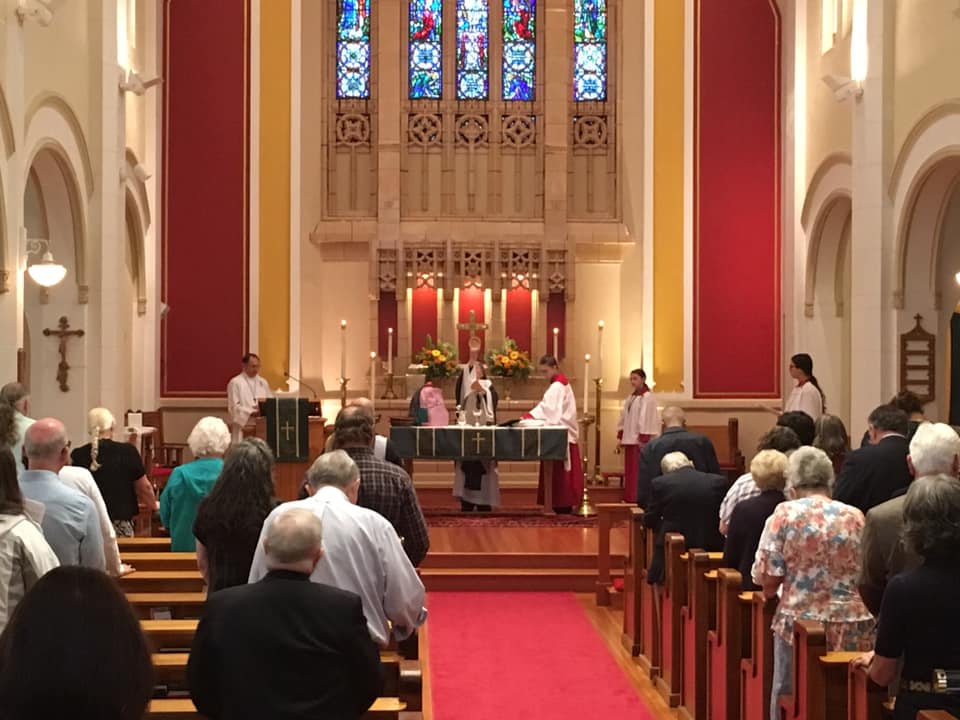
Trinity Episcopal Church, Everett, WA

The Catechism or Outline of Faith of the Episcopal Church includes the question, “Who are the ministers of the Church?” The answer responds,” The ministers of the Church are lay persons, bishops, priests, and deacons.”  I believe that leadership formation is a vital and ongoing component of each of the four orders of ministry – the life and mission of the Church relies upon the leadership skills of members within each order for the sustainability of the purpose-driven service of the Church.

Leaders are formed and called within each of the four orders of ministry. However, not all those who are elected/selected/self-injected into leadership roles possess the traits and skills necessary for the required relational and organizational work. Part of the difficulty of addressing leadership issues related to ministerial calling has to do with the (usually) unarticulated assumptions of what constitutes a desirable leader within the dominant culture system of the Church. For example, self-promotional arrogance is often mistaken for competence while humility and vulnerability are frequently deemed to be weaknesses. It’s an old story and a reoccurring theme that I have seen repeated in clergy/bishop search processes as well as in parochial ministries and academic settings. For people of color who are informed by alternative cultural values, navigating the dominant culture assumptions around leadership can be especially frustrating within a vocational discernment or call process.

My understanding and aspirations of leadership are informed by both my Indigenous cultural values and more than thirty years of organizational assessment and development. I find that leadership has an ephemeral quality to it when done well. A leader in harmony with community has a feather-light touch that communicates trust and uplifts others with confidence in their abilities, a quality of love for who others are as people, a commitment to their lifelong development and realization of potential.  Leadership invites diverse people of genuine talent whose joy and imagination is unthreatening to a leader who is secure in who they are. Leaders do not need to manipulate those around them or expect others to protect the leader’s deficiencies or cater to the leader’s ego needs. Leaders do not marginalize dissenting voices but do insist on mutual respect. Leader’s create safe space for all voices, invite the humble, and moderate the entitled. Leaders model vulnerability while standing in great strength. Leaders challenge injustice and never ever fail to speak up for fear of retaliation or cost. Leaders lead for the sake of the lives of others, for the well being and health of the community.  This is the leadership formation I learned in my Indigenous matriarchal culture. I have a preference for these values to what I experience in much of the dominant culture church.

That said, even within dominant culture, there is a common understanding that baptism, ordination, consecration, certifications or academic degrees do not make people leaders; neither do such things assure leadership competencies. Leadership in every sphere of the Church requires a high level of self-awareness, a mature emotional intelligence, a collaborative management approach, and a genuine passion for service that prioritizes the needs of the community over the needs of one’s own ego.

Too often, I have experienced leaders in every order of ministry more focused on establishing their own authority and fiefdoms within the Church than they are actually interested in serving and cultivating others. Once established within the institutional order of things, egocentric leaders can spend the rest of their tenure controlling assets and access to power, assisting only those people willing to facilitate the established rewards system while alienating those unwilling to be codependent to a false loyalty program. It doesn’t take an expert in organizational development to identify leadership dysfunction – usually those most affected are well aware of the issues at hand and only require the supported opportunity to verbalize the emotional exhaustion and pain commonly associated with leadership voids and systems failure.

As one of the best-known and most influential chefs in the world, Gordon Ramsay has developed an intuitive (even if fiery) ability to assess for leadership and organizational dysfunction in every failing hotel or restaurant that he is invited to help turn around. In many instances, Chef Ramsay’s assessment includes the recognition of the loss of passion and vision that originally inspired the operating chef. The capability of leadership and organizational possibilities usually exist, but the instinctive creativity of the chef has become suppressed (even depressed) within systemic/relational dysfunctions. The amazing art of cultivating human encounter through cuisine that shares from the resplendent diversity of human identity to feed the world shares much in common with the mission and challenges of the Church today.

Many of our leaders in each order of ministry are struggling to regather a sense of meaning and creative vision amid the pressures of antiquated (even damaging) ways of being Church. Financial concerns, changes in attendance patterns, unrealistic expectations within limited resources, and aging infrastructure may all be very real issues. However, I believe that the power of adaptive change requires reconnecting with our passion – the original inspiration of our calling as sources of God’s creative and joyful presence in the world.

Leadership at every level and in every order of the Church in every setting needs to stop making excuses for why things aren’t working, take responsibility for our respective ministries, and make the personal and organizational changes necessary to un-hobble God’s next creative endeavor through us. Egocentric leaders need to be challenged or moved out, dysfunctional systems need to be named and changed, and cultural values that do not serve the community need to be replaced by values that do.  The alternative is to admit to ourselves that our passion just isn’t there anymore, we don’t have the necessary skills, and it’s time to close up shop.

There are ways in which I identify with Chef Ramsay’s lack of tolerance and bluntness in the face of poor leadership and systems that fail both employees and those being served. I have had my Ramsay moments in the Church and then worked hard to initiate and lead meaningful change. When working for change within the system hasn’t been effective, I have been willing to name issues publicly. While some may say that’s not a prudent choice to make, I feel sure that our Church is on course to die a prudent death in the absence of truth telling regarding leadership and/or organizational dysfunction. Only with courage can we find the way forward together and discover anew the delight of creating the Church we envision, by realizing the amazing art of cultivating human encounter through Christ that shares from the resplendent diversity of human identity to feed the world.

Trinity Episcopal Church in Everett, WA Mission Statement:

Forming leaders and building community by seeking and serving Christ in all God’s creation.

A Wilderness People Seek Holy Ground

1 Comment
Photo by Don Wayne – Mt. Rainier National Park

Results of Our Six Diocesan Resolutions

Circles of Color sponsored six resolutions to Diocesan Convention. We led a preconvention workshop on the Thursday evening before the Friday/Saturday convention schedule. During Convention, we provided a Friday morning introductory workshop to the Circles of Color and a panel discussion on Saturday. The sum of work was intensive, but the rewards were exponential.

The overarching intention of the six resolutions was to draw collective attention to the needs for diocesan institutional reform to support the work, leadership formation, and ministries essential to the communities and people of color in our diocese. Before 2007, this work had been facilitated by the supervision of a fulltime ethnic missioner, a fulltime suffragan bishop, a full-time assistant, and a part-time dedicated communications assistant. From 2007 onward, staff cuts and budget cuts served to deconstruct the centralized programing and support that had previously existed for our Episcopalians of color. In the absence of a proactive staff presence for providing advocacy, support and connection, the recruitment and leadership formation BIPOC people suffered as did several of our faith communities of color. In short, an administrative goal to cut costs had the impact of deconstructing ethnic ministries, which had been a vital community for BIPOC people in the diocese that provided significant partnerships, education, and consultation resources throughout the diocese.

The Circles of Color resolutions addressed the importance and need to keep BIPOC concerns and needs in the forefront of diocesan mission and commitment. During our panel discussion on Saturday, we heard from a member of the Diocesan Budget and Finance Committee that a diocesan survey some years ago indicated that ethnic ministries was a low priority for our diocese. However, based on the outstanding support of members of Convention this year, I believe the sense of diocesan priorities may have changed somewhat in response to the current issues of our time – most especially the influence of the Black Lives Matter movement and revitalized interest in the intersectionality of indigenous peoples concerns and environmental justice issues.

Convention passed all six resolutions sponsored on behalf of Circles of Color. The resolutions themselves provided an important opportunity for reflection and education. They served as a lens through which to view and understand the needs of BIPOC Episcopalians. The majority of the diocese was likely unaware of the disenfranchisement experienced by our BIPOC church members and communities. I believe that I speak for all members of Circles of Color that we felt deeply grateful and were very emotionally and spiritually moved by the Convention’s support of the resolutions and by the witness and testimony provided by white allies who spoke in support of the resolutions. Many tears of gratitude were shed, and by the end of Convention we felt that we had been seen, heard, and valued. We hope that the community gift of being seen, heard, and valued will continue as we all grow in the depth of our relationships with one another in the Diocese of Olympia.

Whoever’s in Charge is Who’s Responsible

The greatest organizational challenges for needed changes are in areas of governance and leadership, getting to the heart of addressing issues of systemic racism in the church. Bishop Rickel has noted that now that the resolutions have been passed, the real work begins. From a values and community perspective, the work of addressing systemic racism is all of ours to do and rests with no single individual but with every individual, wherever we are on the organizational flow chart, however much social power we have, and whatever color we are. In our Baptismal Covenant, each of us has made the promise to strive for justice and peace among all people, and respect the dignity of every human being. Fulfilling our Baptismal promises constitutes the work of a lifetime.

However, from a leadership and organizational perspective in which the reality of church hierarchy determines institutional and budgetary priorities, the bishop and his office as well as the dean and the diocesan cathedral need to do some soul searching. People of color in the Diocese of Olympia are asking for mutuality in our relationships with church leaders, input into institutional operations that directly affect us, and pastoral responses from diocesan and cathedral leadership. Asking for mutuality and decision-making that cares for the needs of the marginalized – which are community value of our faith – is at odds with the hegemonic nature of a hierarchical institution that equates leadership with higher authority possessing greater power and control.

In terms of systems theory, it is not possible to reconcile issues of inequality within a hierarchal structure that by its nature derives authority from the unequal social strata over which it has power. The democratic principles that seemingly empower the bicameral decision making of diocesan conventions and the General Convention of the Episcopal Church may be legislative bodies that attempt to balance the hierarchical influence of bishops and other leaders. Yet, the canon law that undergirds the Church polity and empowerment of hierarchal decision making is cumbersome and time consuming to change in response to the facile and rapidly changing needs of our time – including adapting to real-time needs of our growing communities of color.  Therefore, organizational adaptation is highly localized and is utterly dependent on how a given diocesan bishop or leadership system is willing to flex in the way in which authority operates on a continuum of unilateral hierarchical decision making to allowing for corporate influence in decision-making and collaborative organizational management.

Hierarchical decision-making says, “I have decided this is how it will be – you figure out how to execute my expectation and thereby you are ‘empowered’ to do things my way, and I will hold you accountable.” Whereas, corporate input into decision making that leads to genuine collective responsibility says, “We need to hear from one another regularly and intentionally so that we keep learning what we each need from a shared commitment to creating what we envision together; in this way we empower one another to assume the responsibilities we each have toward one another through our shared leadership, holding ourselves accountable.”

When hierarchical systems are incapable or unwilling to listen to the needs of the marginalized, the people will insist on transformative change, frequently perceived as a hostile corporate takeover by those whom the system genuinely empowers. Corporate challenge is the first indicator to those in charge within a system from which only the few derive authority that the system is not serving the people. Hierarchical systems rely on a system of rewards and punishments, usually generating a cosmology that promotes fear of retribution and extends relationship only to the compliant.  Within a hierarchal church system, forgiveness is about successfully placating angry gods.

Fortunately, in the face of the hierarchical machinations of empire and religious institution, Jesus offers a compelling alternative.

New Testament Leadership is Corporate and so is God

Jesus and early church leadership introduced significant social and theological innovations to the  hierarchical values and cultural beliefs enforced during their lifetime. Their perceived attempt at corporate takeover was considered threatening enough by those in hierarchical power to get nearly all of them killed. Yet, history shows us that good ideas are hard to entomb or coopt and have a tendency to be resurrected and liberated in successive generations. Just as creation is an ongoing phenomenon not limited to the allegory of seven days, Christ’s resurrection was never limited to just three days but continues unabated in our time.

The reality that the savior of dominant culture is an articulate, educated, brown-skinned, socially progressive young adult we know as Jesus is entirely relevant to the call confronting the Church today. Having lived his entire human life as an indigenous man living under Roman occupation and frustrated by the failure of his religious leaders to take a stand on behalf of the people in order to help mitigate their suffering, Jesus empowered others through his leadership. He leveraged whatever social privilege he held to cultivate relationships with the whole spectrum of his society, subverting multitudinous dominant paradigms with the certitude of the core principles of his faith. He elevated the law to love one another into a rallying cry for social, personal, and spiritual transformation. He seemingly challenged everyone he met to garner the fortitude to grow beyond the social limitations/expectations placed upon them like manacles, while chastising those who had created those bonds.

Jesus did not seek to overthrow but to create level ground for all. For those dwelling in high places of power, level ground was an anathema. Yet, early church writers picked up the theme of human value within corporate ways of being, and a triune God in collaboration with itself became the new model for leadership and community. In a challenge to ascribed social and religious privilege, Paul deconstructed social strata in human society and in religious institution, reframing the new community as the Body of Christ:

For in the one Spirit we were all baptized into one body—Jews or Greeks, slaves or free—and we were all made to drink of one Spirit. Indeed, the body does not consist of one member but of many. The eye cannot say to the hand, ‘I have no need of you’, nor again the head to the feet, ‘I have no need of you.’ On the contrary, the members of the body that seem to be weaker are indispensable.  But God has so arranged the body, giving the greater honor to the inferior member, that there may be no dissension within the body, but the members may have the same care for one another. (1 Cor 13-14, 22, 24b-25).

Identifying a basis for common ground amidst social and cultural diversity, Paul also provides a basis for unity and social leveling in the idea that all social assignments that ascribe our identity – including ethnicity and gender – are subsumed into the singular identity of Christ, whose own identity in/as God transcends all:

Therefore the law was our disciplinarian until Christ came, so that we might be justified by faith. But now that faith has come, we are no longer subject to a disciplinarian, for in Christ Jesus you are all children of God through faith. As many of you as were baptized into Christ have clothed yourselves with Christ. There is no longer Jew or Greek, there is no longer slave or free, there is no longer male and female; for all of you are one in Christ Jesus. (Gal 3:24-28)

Surely, when members of Christ’s body are hurting, we need to tend to those wounds collectively. People of color in the diocese of Olympia are hurting. Passing the six resolutions at our convention was an important beginning. Hearing Bishop Rickel state at convention that he is aware that he is responsible for causing much of the pain that was shared during the listening session panel was incredibly important. The next step is in developing mutual relationships in which people value one another through deepening trust and understanding. However, there is no program, training module, or personal inventory in existence that can substitute for doing the actual work of relationship building. One phone call at a time. One email at a time. One Zoom at a time. One meal at a time. One conversation at a time. Jesus never said the love we should have for one another would be easy, but he did say that it’s the most important work we can ever do for God.

It is laudable and appreciated that our bishop and cathedral are developing partnerships with diverse churches and ethnic communities outside of The Episcopal Church and with Episcopal leaders of color outside of our diocese. Yet, in doing so, leadership has overlooked our own people of color in the Diocese of Olympia and neglected the need we have for being in transformative and liberative relationship with our bishop and our cathedral. I hear that some hierarchical leaders feel at risk and are afraid; I hear that some of our people of color feel at risk and are afraid. Yet, I believe that all of us long for a relationship rooted on the level social landscape as Christ’s body that is Holy Ground, where “We will not all die, but we will all be changed.” 1 Cor 15:51