10 Spiritual Practices toward a Peaceful Christmas

2 Comments

God_Rest_Ye_Merry_Gentlemen“God rest ye, merry gentlemen – let nothing you dismay.

Remember, Christ our Savior was born on Christmas Day!”

For many of us, the Advent and Christmas seasons can often mean the onset of a couple of unwelcome guests – Stress and Depression. In the midst of what is presented as a joyous time, we can often experience a burden of expectations (imposed by others or by the self) that can create a long list of demands upon us – parties, gatherings, watching a seemingly endless series of traditional movies, attending the theater or ballet, shopping, baking, Christmas pageant preparations, cleaning and entertaining, as well as decorating and driving around looking for “needed” items (just to name just a few stress triggers).

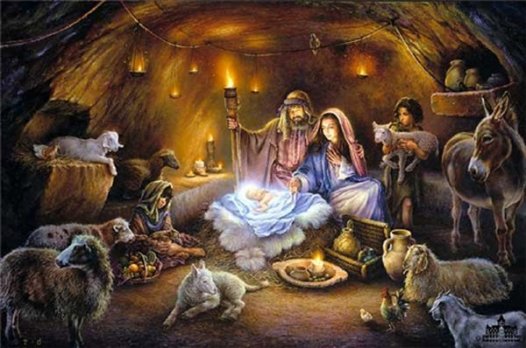
It’s so important to remind ourselves and our families that the Spirit of Christmas is not some kind of divine bullwhip driving us into a manic frenzy of over-commitment and consumerism. Rather, the Spirit of Christmas is a gently-whispered invitation to enter the quiet contemplation of the Holy Nativity scene – the hidden Crèche within each of our hearts, wherein lies the sleeping Christ Child.

Through some practical spiritual practices, we can help ourselves to minimize the stress that accompanies the Season and ensure that the King of Peace really is born into our world (into and through each one of us) this Christmas. To this end, here are 10 Spiritual Practices I have put together for your consideration in this Season of the Spirit.

1) Acknowledge you feelings. Whatever your feelings about this time of year or Christmas, acknowledge them. If someone close to you has recently died or you can’t be with those you love, realize that it’s normal to feel sadness and even grief at significant holidays and anniversary dates. It’s alright to take time to mourn or express your feelings. Try not to “force yourself” or permit others to force you to be artificially cheerful just because it’s the holiday season. Choose how you will manage your feelings and care for yourself, so that you can be authentically present to others (and to God), honoring your own needs as well as those of others.

2) Reach out. If you feel lonely or isolated, seek out community; come to our various church services or other social events around you – even if it’s just for a little while. These resources and gatherings can offer support and companionship, even if all you talk about is the sale at Macy’s, contemplate the weather, or just rest and take in what’s happening around you. Volunteering your time to help others is a great way to change your focus as well as broaden your friendships. Practice community – by bringing your whole and sacred self into the presence of the Season.

3) Be realistic. The holidays don’t have to be perfect or just like years gone by. As families change and grow, traditions and rituals can change as well. Feeling nostalgic is natural, but we also follow a God who promises to renew all things. So, choose a few traditions to hold on to, but be open to creating new ones. For example, if your adult children can’t come to your house, find new ways to celebrate together, such as sharing pictures, emails, videos or Skype!

4) Set aside differences. (This is not asking the same as asking for reconciliation, which can be a life-long spiritual work). As a spiritual practice for the Season, try to accept family members and friends as they are, even if they don’t live up to all of your expectations. Set aside grievances until a more appropriate time for discussion. If you really cannot tolerate someone’s unhealthy behavior, limit your exposure to them through clear boundary setting of your time and participation – plan for a low-key, healthy exit strategy for the times when you may need one. You may even want to create a rescue code word or phrase (like “fruitcake!” or “the penguins must be hungry!”) in order to alert a close friend to quietly support you as you remove yourself from a given situation. However, be understanding if others get upset or distressed when something goes awry with planned events. Chances are good that they’re experiencing the effects of holiday stress and depression, too, but they haven’t identified those feelings.

5) Budget. Be a Good Steward of the resources God has provided to you, and stick to a budget you can afford. Before you go gift and food shopping, decide how much money you can afford to spend. Then, stick to your budget! Don’t try to buy happiness or gratitude with gifts – guilt is always bad credit. Instead, remember the Pearl of Great Price – the genuine article of Love that can only ever be truly given when it is given with no expectation of return. Try these alternatives: Donate to a charity in someone’s name, give homemade gifts, or write a handwritten letter – a personal letter is a precious and rare thing these days!

6) Plan ahead. Scripture consistently reminds us to be prepared – this spiritual practice applies to daily living as well as waiting for Christ (which very much characterizes Advent). Set aside specific days and times for preparations such as shopping, baking, visiting friends, Advent prayers/reading at home and other activities. If you’ve committed to assisting at church services, be sure to arrive a little early for personal prayer and centering – church isn’t just one more “task” to check off at this time of year. Rather, church services and service to others can help keep us grounded and fed by the Season instead of exhausted and depleted by it.

7) Learn to say a holy, healthy “no.” Saying yes when you should say no can leave you feeling resentful and overwhelmed later. Friends and colleagues will understand if you can’t participate in every project or activity. If it’s not possible to say no to something, try to remove something else from your agenda to make up for the given time – set your priorities and stay with them. The spiritual practice of a holy, healthy “no” helps preserve and sustain our best health during a time when God asks us for the gift of our attention – inviting us to be fully present to the in-breaking of the Divine on Earth and within our own hearts.

8) Don’t abandon healthy habits. Christmas is a time for celebration but not for reckless abandon – try not to let the Season become an excuse for losing your spiritual mindfulness. Overindulgence only adds to stress and guilt later. So, have a healthy snack before attending holiday parties so that you don’t go overboard on sweets, cheese or drinks. Use small plates for buffets and servings. Also, continue to get plenty of sleep and physical activity, offsetting any extra calories you may choose to take in.

9) Relax. Remember: the song is “God REST Ye, Merry Gentlemen!” Be intentional about scheduling some time for yourself. Spend at least 15 minutes alone every day of Advent as a Mini Sabbath – a sacred time without distractions or agenda; this can refresh you enough to handle what you need to accomplish. Take a walk at night and stargaze. Listen to soothing music. Find an image of the Sacred within your inward vision that reduces stress for you – then, clear your mind, slow your breathing, and restore your inner calm.

10) Don’t hesitate to seek professional help. Despite your best efforts and best spiritual practices, you may find yourself feeling persistently sad or anxious, plagued by physical discomfort, unable to sleep, feeling irritable or hopeless – the season may disjoint you completely, causing you to feel unable to face even routine chores. If these feelings last for a while, please talk to your doctor or a mental health professional. You may feel more comfortable initially speaking with a clergy person, such as [*gasp!*] your Pastor. If you would like to speak with me, please be assured that I will help find a referral resource for you for ongoing professional support while maintaining your confidentiality and respecting your privacy.

Ultimately, the most valuable gift we can bring to Christ at Christmastide is ourselves – complete and whole, just as we are – with all our feelings, all our messiness, all our hopes and fears, all our talents and insecurities. We are asked to leave it all at the Manger, in the sure and certain confidence that to God it is all priceless treasure. Even as much as Advent is a time of preparation, it is also a journey of remembrance – timelessly reminding us that we are unconditionally loved by the Christ who is Emanuel, “God with Us.” Now, always…and forever.

May you have a truly Blessed Advent and Merry Christmas,

Experiencing a truly sacred Season of the Spirit.
Greccio 6

Respect as a Spiritual Practice in Community

2 Comments

Respect is  a Living Energy Between Beings

Several years ago I was introduced to a description of “10 Rules for Respect” that seem to me to be more relevant and central to my work with every passing year – especially within a parish setting.

During my visit to Austin, Texas three years ago, The Rev. Greg Rickel (now The Rt. Rev. Gregory Rickel, Bishop of the Episcopal Diocese of Olympia in Western Washington) handed me a copy of 10 Rules for Respect, reflecting the original that was framed and hung on his office wall. He had come across the list of rules through another associate mentor and modified them slightly to his own circumstances.

I’ve worked within other organizational settings and attended a myriad of leadership seminars that address the topic of “respect” in ways that seemed to take what should be understood as THE central dynamic of healthy community and dissected it to such an extent as to leave it lifeless and gutless, spread-eagle and pinned on an endless series of flip-chart sheets.

Respect is a living energy between beings that – when it is present – inspires innovative problem-solving processes and creative vision. Additionally, mutual respect promotes individual confidence as well as team trust, whether the team is composed of 2 people or 20.

Often, I have felt deeply troubled by the variety of ways that people avoid healthy and direct communication in the church environment – the very place where everyone should reasonably expect to be heard and committed to treating one another respectfully.  As an ordained leader, when I have parishioners saying to me that they are personally negatively impacted when I am not treated with respect, then I know there is a significant problem to address systemically within the culture of our church environment.

Respect is particularly at risk within the context of disagreement or conflict.  The attitude seems to be, “Because I disagree with you or don’t like you, I can behave badly toward you.”  Anyone parenting a teenager knows how that bird doesn’t fly.  If disrespect doesn’t serve a family setting well, it definitely doesn’t support the vital life of an organization or community.

The Rules for Respect that I would like to encourage as a spiritual practice within my leadership and parish include:

1.   If you have a problem with me, come to me (privately).

I want people to raise their concerns or observations with me.  However, often the group setting is not the appropriate place to raise them – especially if the concern is of an interpersonal nature and contributes to a dynamic that can derail the work and purpose of the group or task at hand. Taking the time and mustering the healthy courage to meet with leadership privately shows respect in itself, as well as a commitment to both a relationship with me and regard for the work of the group.  If we can develop greater mutual understanding between us, our work together will positively impact work within the group or community setting.

2.  If I have a problem with you, I will come to you (privately).

Leaders can be as guilty as anyone of triangulating – with other parishioners or with their bishop.  So, it’s important in healthy leadership to seek opportunities to speak directly with the person with whom they are having difficulty.  There are times, though, when individuals can also be conflict avoidant, preferring to air their complaints to everyone except the leader.  When people decline to meet or speak with me, it signals to me that an individual is more interested in controlling a situation than in improving it. Genuine respect and commitment to communal health means making the time to talk when we disagree and to always seek reconciliation, which is part of our biblical mandate as a community of faith.

3.  If someone has a problem with me and comes to you, send them to me. (I will do the same for you).

Avoid getting sucked into a triangle. Respect means not encouraging conversations about others that devolve into collusive gripe sessions.  Rather please encourage people to have direct conversation with the only person who can actually do anything to address the concerns being raised – the rector.  I won’t encourage the formation of coalitions or “sides” against someone, and I expect the same if someone has an issue with me. It can take a while to develop trust in one another, but without directly addressing our issues with one another, we will not be able to know either individual holistic growth or communal spiritual growth.

4.  If someone consistently will not come to me, say, “Let’s go to Rachel together.  I am sure she will meet with us.” (I will do the same for you).

Sometimes, people get stuck in a complaining mode and don’t really want relationships and communal life to be any different, because the way things are (even if they aren’t good) is comfortable and familiar.  Engaging the difficult work of healthy communication is just that – work!  In the church community, we need to be present for one another and to challenge one another toward our greatest potential in healthy and whole relationships.  I am committed to listening to you, though there is always the possibility that you may not like what you hear in return – especially if it’s something with which you do not agree.  We can disagree, and we can be mutually respectful as we disagree.

5.   Be careful how you interpret me; I would rather do that.  On matters that are unclear, do not feel pressured to interpret my feelings or thoughts.  It is easy to misinterpret intentions, which can cause further problems.
I take lots and lots of time and opportunity to provide education explaining why and what I am doing and why I may be making a given change.  However, someone may still have confusion or unanswered questions about what I am saying, instructing or envisioning. I always hope that when there are questions people will share those – if not in the moment, then later or privately.  Chances are good that if one person has a need for clarity, others do as well.  However, one thing that really does frustrate me is – after having carefully explained a change – I overhear the person I have carefully explained it to say to someone else, “We’re doing it this way because Rachel said so!”

I want to bang my head on a wall whenever I overhear this, because I am actually not a dictator – as convenient as someone may find it to evoke my name in order to get something done quickly.  I prefer and strive to model collaborative leadership by continually seeking input from others.  If you wonder why something “dreadful” is happening, it’s quite likely that I would not want you to have the experience of it as dreadful. So, please check out the motivations that may be assigned to me by actually asking me if it’s what I intended to communicate, be or do. If someone has questions about my intentions, please direct them to speak with me directly. Just because a person may be scared to talk with me doesn’t mean I’m actually a scary person.

6.  I will be careful how I interpret you.

It has been said, “It’s lonely at the top.” This can be especially true when leaders of a community imagine that “the villagers” are coming after them with pitchforks and bearing kindling for a one-stake fire. In the same way that parishioners can allow their thoughts to run along the line of, “The rector hasn’t visited or phoned and therefore doesn’t care,” rector’s can allow the negative comments of a volatile few to overwhelm the extremely positive comments of the other 200 people in their pews.  Chances are high that if a parishioner is having the experience that “no one at church cares about my illness/condition/surgery/plight,” it’s because no one has thought to pass along the fact that the parishioner even has an illness/condition/surgery/ plight to the rector. Chances are also high that the parishioner with a simple process question is not one who is leading a campaign to burn down the rectory.

7.  If it’s confidential, do not share it. If you or anyone comes to me in confidence, I will not share it unless: a) the person is going to harm himself/herself, b) the person is going to physically harm someone else, or c) a child has been physically or sexually abused.  I expect the same from you.

The number one reason why “things fall apart” within a church organization is due to the inability to maintain confidentiality.  People serving in professional corporate settings where confidentiality is critical are used to keeping confidences.  However, not everyone serving in the various volunteer ministries and leadership groups within a parish has had the experience of keeping confidential information.

The great thing about me being a priest is that you can say anything you need to say to me in the way you need to say it, and I will always assure you of God’s (and my) love and confidentiality.  Remember that I am ethically (and in the case of sexual abuse of minors, legally) obliged to take steps to prevent harm to self or others.  When I share privileged information with my pastoral peers (and that means lay leaders and parishioners as well as clergy), it’s because I have determined that you need to be aware of the information for the greater care of people. Please keep that care always before you, even when it’s challenging, and never pressure anyone to reveal confidential information for which they are responsible.

8.  I do not read unsigned letters or notes.

Anonymity is the epitome of opting out of relationship.  The foundation of community is relationship.  Not providing a name is not about a commitment to relationship or to community building.  Anonymity is about fear and violence directed toward individuals in positions of authority or responsibility who have influence that the anonymous person seeks to challenge in the unhealthiest of ways; intimidation is the hallmark of a bully, and I will not indulge bullies.

9.  I do not manipulate; I will not be manipulated; do not let others manipulate you.  Do not let others manipulate me through you.

As much as people might like to apply the term “family” to a church community, not every family has known the experience of healthy and mature communication or ways of relating to one another.  A healthy community requires pushing back on those who would hide their intentions by asking others to represent them.  If someone encourages you to do or say something on their behalf, challenge them to speak for themselves; do not shield them from either the responsibility or consequences of their sentiments or actions.

10.  When in doubt, just say it. The only problematic questions are those that don’t get asked.  At the end of the day, our relationships with one another are the most important aspect of our communal life and shared work.  So, if you have a concern, pray and then (if led) speak up.  If I can answer it without misrepresenting someone or breaking a confidence, I will.

“Trust” is the watchword of healthy relationship.  Developing trust in relationships with one another and within relationships with leaders may take time for some but it also takes commitment from everyone.  The wellbeing of parishioners and the development and implementation of the vision and life of the community does not belong to only to the ordained leadership but to the full Body of Christ that is the membership and the ministry of the Baptized.

We serve one another; without words and actions that embody authentic respect for one another we have nothing different to offer the world beyond our doors except more of what it is already used to.  Respect must be our spiritual practice as a community of faith.

The Divine in Me Honors the Divine in You

The Grand Journey

11 Comments

People take lots of kinds of journeys throughout life, to places geographical, emotional, spiritual, internal, difficult, joyful, perplexing, mysterious or unknown – as ever journeys can be.  There are journeys we are on as individuals and journeys we are on as societies. The impact of a journey can be as powerfully and immediately transformational as a meteor strike, or it can be as soft and beckoned as the gradual morning dawn.

Dirt Road to the Haulapai Nation, Grand Canyon West, AZ

A series of steps and encounters during my life has brought me to an unexpected place of feeling a powerful need to advocate for a people that have been so much a part of my life that, in the naiveté of my own acceptance of them, I did not fully realize were/are fighting and dying for their basic human rights and dignity on a level of global cultural genocide.  They have never, not a one, ever asked or sought my help, you see.  They are a proud people.  I have been living beside them and with them for years as a steadfast confidant, friend or pastoral care giver.

While I could see and respond to their individual suffering as they gifted me with the sharing of it throughout my life, it took me standing on the edge of the Grand Canyon last week for me to finally see the broad global pattern of socially institutionalized persecution that has held them in thrall for millennia.  Their degradation, humiliation and even annihilation is so deeply imbedded in three of the world’s largest faith traditions – which maintain encoded prejudices from sources held in common – that I now perceive an abyss representing both historic time and cultural divide that cause me both inarticulate amazement and abject horror.  I truly did not “get it” until now.

Walk with me.

Grand Canyon Ground Squirrel

When I was little, my mother told me stories about her early life as a vocalist with the Pennsylvania Light Opera and flutist with Pittsburgh Philharmonic.  At some point in her career she had the opportunity to work with conductor Leonard Bernstein, unarguably one of the most talented composers and musicians in America.  He enjoyed her company, and they attended parties and gatherings together that my mother recalled with great fondness.  My mother obviously liked and admired him very much.

My six year old self once asked her, “Why didn’t you marry him?”

“He never asked me,” said my mother.

“Why not?”  I demanded (thinking my mother unparalleled).

“Well, dear, he was gay,” she answered as she gently cupped my chin with her hand, tilting my gaze upward to meet hers. “He eventually did marry a woman, but he preferred to be with men. I knew that was the case and decided that I would make a better friend to him than a wife. But, oh! He was handsome!”

“Are lots of men gay?” I asked, somewhat uncertain of the new word that had been introduced to me, since until then I thought it just meant “happy.”

“Some men are, and some women, too.  But you mustn’t mind it; it doesn’t make the quality of a person any less or more.  But it is an important thing to know beforehand, if you think you might like a certain boy,” responded my mother with her usual common sense.

From that moment onward, I never minded “gay” as an aspect of anyone I would meet going forward in life.  On some level I felt that if my mother loved an extraordinary man like Leonard Bernstein, gay was a human quality that was ultimately very lovable and was just one of the many ways of being that humans can come in.

Grand Canyon Raven

Though I would learn that some of my friends in high school were gay, lesbian, bisexual or transgendered, I was utterly unaware of it at the time.  Like most people who live from a privileged status within a culture (in this case, heterosexual), it rarely occurred to me that heterosexuality could be a challenge for anyone else outside of the approved social “norm” – that measure  having been established by those claiming to represent the normative by which everyone else is judged substandard or defective.

In high school “gay” was something the jocks (male and female) flung around like dirty socks at anyone who didn’t live and die by the calendar of sporting events.  Since I was in choir, theater and the debating club, you can imagine that I had a few such socks thrown in my direction.  I didn’t mind it or respond to it in any way, because it wasn’t my issue; it was clearly theirs.  I also thought they were very stupid, and I had been raised to be nice to the imbecilic.

Watchtower, Hopi Artist Fred Kabotie, Grand Canyon

It wasn’t until college that I came to know young men and women who were actively struggling with a “coming out” process.  Most didn’t fully emerge during those four years but came to grips with their true personhood after college.  One exception was my dear friend Joe (who I nick named Jody), who finally came out to me after breaking up with an overly-dramatic girlfriend that most of us thought was a lunatic anyway.  I’ll never forget the night in a local pub when – over a pitcher of light beer and a bag of peanut M&Ms – we realized that we had both spent heaps of emotional energy agonizing over the same guy.  We both dropped our crush in that instant, and I attribute our strong bond to that hoot-and-howl of a sister recognition moment.

Jody could never tell his parents that he was gay, and he took that secret to his grave.  He was their only son and their only hope for continuing the family name in a presumed marriage that would and could never be.  Not long after college, Jody was in a car accident.  He survived his injuries but not the pneumonia he developed during his hospital stay.  I phoned his parents after I read the news of his death posted in the college alumni newsletter.  While speaking with Jody’s mother, I could hear the subtext accusation in her voice, “He cared for you so much!”  Apparently, either I or another close girl friend of his was supposed to have made their wedding and family dreams come true.  None of us could have done it, and I didn’t correct their impression.  I just held his mother’s grief in the cradle of my ear, even as I mourned for the Joe (Jody) I had known and loved as my friend.

Grand Canyon, South Rim

When I became a professional healthcare chaplain in the early ‘90s, issues of who could be a healthcare representative were in the forefront of emergency room conversations.  Within heterosexual relationships, family members and fiancés were considered the unquestioned primary candidates to make decisions on behalf of a patient who could not speak for him or herself.

When it came to homosexual relationships, however, even family members who had historically disowned a homosexual child or sibling were suddenly empowered by the medical institution and law to enter the ICU or ER and make life and death decisions about someone they hadn’t even spoken to in twenty years.  Meanwhile, the person the patient had shared a home and a life with in all that time was not permitted access to the patient without the family’s consent.  The life partner was certainly not permitted to make healthcare decisions, even if they were allowed in the patient’s room.

Healthcare representation has mellowed in the law, depending on which state of the union one lives in.  My early work as a hospice chaplain was in Indiana.  If the appropriate forms were completed while the patient was alive, awake and coherent, the patient could appoint the health care representative of their choosing; a representative didn’t have to be blood family.  Without that paperwork, family was legally recognized as the rightful decision makers.  In addition, funerary law states that the family “owns” the body post mortem unless legal documents have been prepared that state other wishes.

Grand Canyon, Desert View Drive

Toni was one of the hospice patients in the inpatient facility where I worked.  He had been with his partner, Stephen, for nearly 30 years.  For Stephen’s two children (by then young adults) Toni was the only mother they had known.  They shared stories with me about Toni’s care in preparing their lunches for school when they were kids and how Toni took their daughter to prom when she had no date because of the stigma of her same-gendered parents.  At the prom he wowed everyone with his dancing – wowing them again when he fixed a student’s car in the parking lot that night so the student and his date could drive home safely and not get in trouble for being late.

As Toni’s legal healthcare representative and partner for life, Stephen cared for Toni throughout his struggle with non Hodgkin’s lymphoma.  With tireless devotion and love, Stephen helped Toni bathe, eat, prepare for bed, groom his hair and wipe the tears from his face when Toni could no longer speak in any other way.

One evening before leaving work for the day, I stepped into Toni’s room on an impulse to say goodbye (I came to listen to those intuitions while working in hospice).  Stephen was at the bedside, holding Toni’s hand in the quiet twilight of the room as Toni’s breathing gradually became labored and irregular in his dying.

“I’m glad you came by,” Stephen said in a hushed voice reminiscent of a chapel whisper, “I have something for you from Toni and me.  It’s not much, but we thought you could understand it.” Stephen then poured a silver ball-chain with a series of rainbow colored aluminum rings on it into my open palm.

Stephen explained, “They’re called Freedom Rings.  The rainbow colors of the rings represent us and the hope that freedom will someday ring in our country for all people.  You’ve helped make this a safe place for us to be who we are and allowed us to love one another in these last days as any two people committed to one another do. Toni and I want to thank you for being our chaplain.  No minister or church has ever welcomed us and our family, but you did.  Thank you.”

Rain in the East Canyon, Grand Canyon

I still have the Freedom Rings necklace they gifted to me.  When Gene Robinson was consecrated the Episcopal Bishop of New Hampshire, I wore it to the special clergy day that was called for the clergy of the Diocese of Olympia, an opportunity for us to voice our concerns or opinions.  I received several puzzled looks as I sat adorned with rainbow rings and holding Nigel’s (my husband’s) hand.  I wish I could say that I spoke up that day and shared Stephen and Toni’s story, but I did not.  The remarks of conservative clergy were harsh and strident; somehow the tenderness of a beloved man dying beside the man and family who loved him seemed too sacrosanct for the churning vitriol in the air.  It felt like I was trying to gently launch gossamer seeds into a hurricane wind, and I lost my voice before I could utter a syllable of peace.

I met my dear friend and colleague, Sean, while working at hospice, and I have been promising him for many years that we would one day go to the Grand Canyon.  It’s a gift to me that finally – at the age of 60 – he feels safe enough with someone to be utterly free to be himself, in a place both far away enough and grand enough to accept him.  People easily mistook us for a heterosexual couple.  And yet, seeing what is truly there is far more challenging and compelling.

See with me.

Desert View Drive, Watchtower View

Standing on the edge of the Grand Canyon, the distance between the past and the future is deeply chiseled as a journey through time – from the base rock of our cultural and theological past to the uncomfortable expanse of the rim above, we are all challenged to read the record of how things have been. Then, like the Colorado River (which has never changed its width), we must patiently but inevitably carve the way forward. We must commit to creating a different legacy, in a country founded on freedoms that has yet to find freedom for all.

At last, at the end, after all; I see something even larger than the millennial abyss of frightening despair, prejudice and hatred.

I see in the canyon a parable carved in stone about the vast heart of God.  Sean stands on the edge, and there I stand with him, my hand in his, and I will not let go.  We dare to stand side-by-side on the edge of hope, held to this sacred place by gravity and divine love. Each life on this earth, having been created by the God who called it good, deserves nurture and protection in order to live into the fullest promise of what God has made – the life abiding in the canyon, and the life abiding in each of us.

God promises love.  God asks only that we love one another as Christ loved us.

Stand here. See all that God has made…and…

Love with me.

Grand Canyon Sunset, Lipan Point

Furry Siblings: Partners for Life

4 Comments

It’s heady stuff to contemplate introducing a new animal into the household system.  Nigel and I have been recently contemplating adopting a dog or two, and it’s a careful and reflective process for us both.

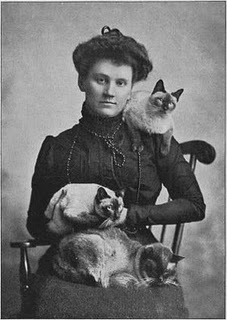
Victorian Greeting Card

I come from a long line of pet owners, with documented photos of cats-in-arms going back to my great-grandfather on my father’s side.  Looking through his daughter’s journals (my grandmother), I discovered that my father’s first word was “kitty.” My father’s admiration and deep affection for cats lasted a life time, and he was especially fond of Siamese cats.

The first cat I remember was my father’s seal-point Siamese, Simba. After an initial worry expressed by my grandmother on my mother’s side (due the old adage that cats could “steal a baby’s breath away”- a folk belief explanation for crib death), Simba was gradually permitted to nap with me in my crib. She did tend to like to sleep by my face and on my head, but she never seemed intent on smothering me, just on keeping warm.  She was also quite fixated on keeping my ears clean, an experience which always ended the nap abruptly with squeals of ticklish laughter from my little self.

“Hamsters Require All the Comforts of Home”

For some reason which I have never explored, a social hierarchy of pets existed in my childhood household.  Only the adults, my parents, were permitted to have cats. My two brothers and I were permitted to raise any number of hamsters, gerbils and mice.  However, cats were clearly named and owned and raised by mother and father.  I believe that this is what contributed to my earliest relationship with cats as siblings, rather than as pets.  Cats were emotional and spiritual equals, deserving respect and understanding of their language, needs and culture. In retrospect, I now realize that my mother very much expected me to care for animals (cats especially) with the sense of responsibility an older sibling should have for younger siblings.

“Adopt a Cat Today!”

There was only a single adventure into having a dog by my parents, when my mother briefly kept a Pomeranian.  The subsequent story of “Fang” (as he was called by my father) ended quite badly, as that particular Pomeranian had a penchant for howling while my father played his alto recorder, for running out of the house unbidden in the worst sort of weather, for peeing wherever it liked and for biting small children’s toes and noses. Animated like a possessed fluffy bedroom slipper, this dog also tended to greet visitors to our home by firmly locking his forelegs around a person’s calf in order to zestfully “make love” to their ankle.

Fang was soon given a new home with a gay couple who adored him. However, I’m quite sure my mother never forgave my father for having to give up the Pom, since later in life she often fanaticized of getting a miniature apricot poodle, “After your father dies, so that it can accompany me whenever I visit your father’s grave.”

“Fang” was actually named “Frederick Bartholomew”

There were many cat siblings in my parent’s home throughout my growing up years. After Simba came Bazarras (father’s Siamese) and Mindy (mother’s tortoiseshell Persian), who had a lovely litter that all found homes among my parent’s friends. Then there was Baba (father’s Siamese) and Tarus (mother’s chinchilla Persian).  Later there was Miss Kitty (father’s Siamese) who continued to companion my father after my mother’s death.

Willow & Sylva’s Baby Picture

I didn’t adopt cats myself until after I was married and setting up my own household.  Willow and Sylva came into our lives after in the second year of our marriage when the kittens were discovered at four days old in someone’s open garage and brought to my vets.  Asked if I would be willing to foster them until they were of an adoptable age, I readily agreed to take the two gray tabby babies home. Needing to be fed a special formula at least 4 times a day, Nigel began getting up with me to nurse them with syringe barrels at first and later with small bottles as they grew.  Even after the first week, we knew we could not give them to anyone else.  They were ours for life.

“Sylva in the Cupboard”

“Willow After a Sunbath”

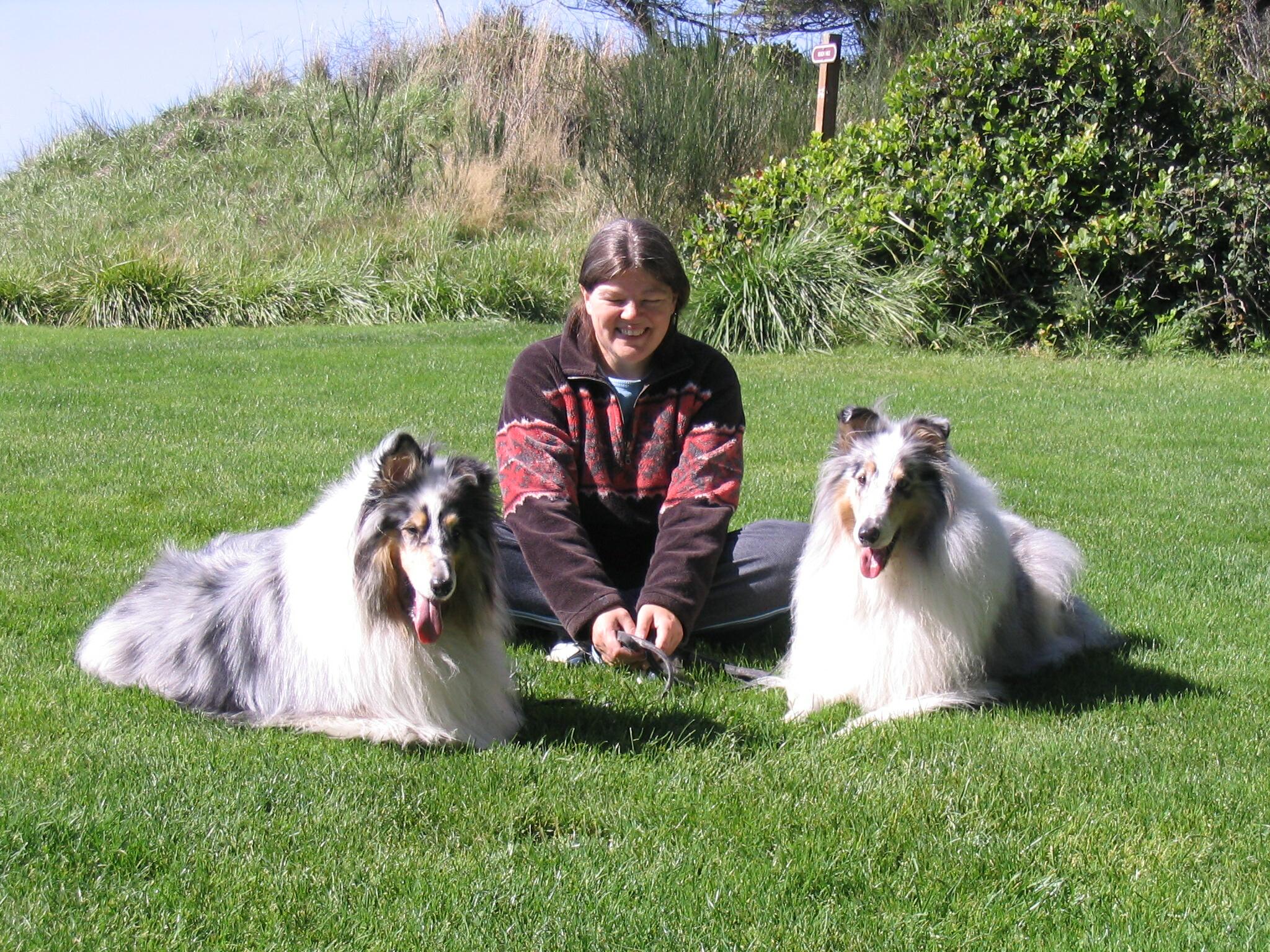
When the cats were 4 years old, a friend who raised collies asked me if I would be willing to adopt the only surviving puppy of a litter exposed to bacterial mastitis.  The puppy had been resuscitated 3 times, and my friend did not feel she should sell the puppy but rather adopt it out.  That’s how I came home with Bonnie, the blue merle collie.  A year later, the same friend approached me with another collie puppy that had stopped breathing and had been resuscitated after its mother mistakenly rolled over on him. And that’s how we got Bonnie’s half-brother, Dougal.

Bonnie & Dougal Visit Fort Casey, 2004

We enjoyed all our furry children very much and have been deeply saddened over the 4 year period when one-after-the-other, they each came to the end of their lives with us.  Sylva died first in 2006 at 11 years old.  Bonnie died in February of 2009, nearing the age of 10.  She was followed by Willow at the age of 15 in October of 2010, and Dougal who was nearly 11 years old died in February 2011.

I truly hope they will be in my heaven.

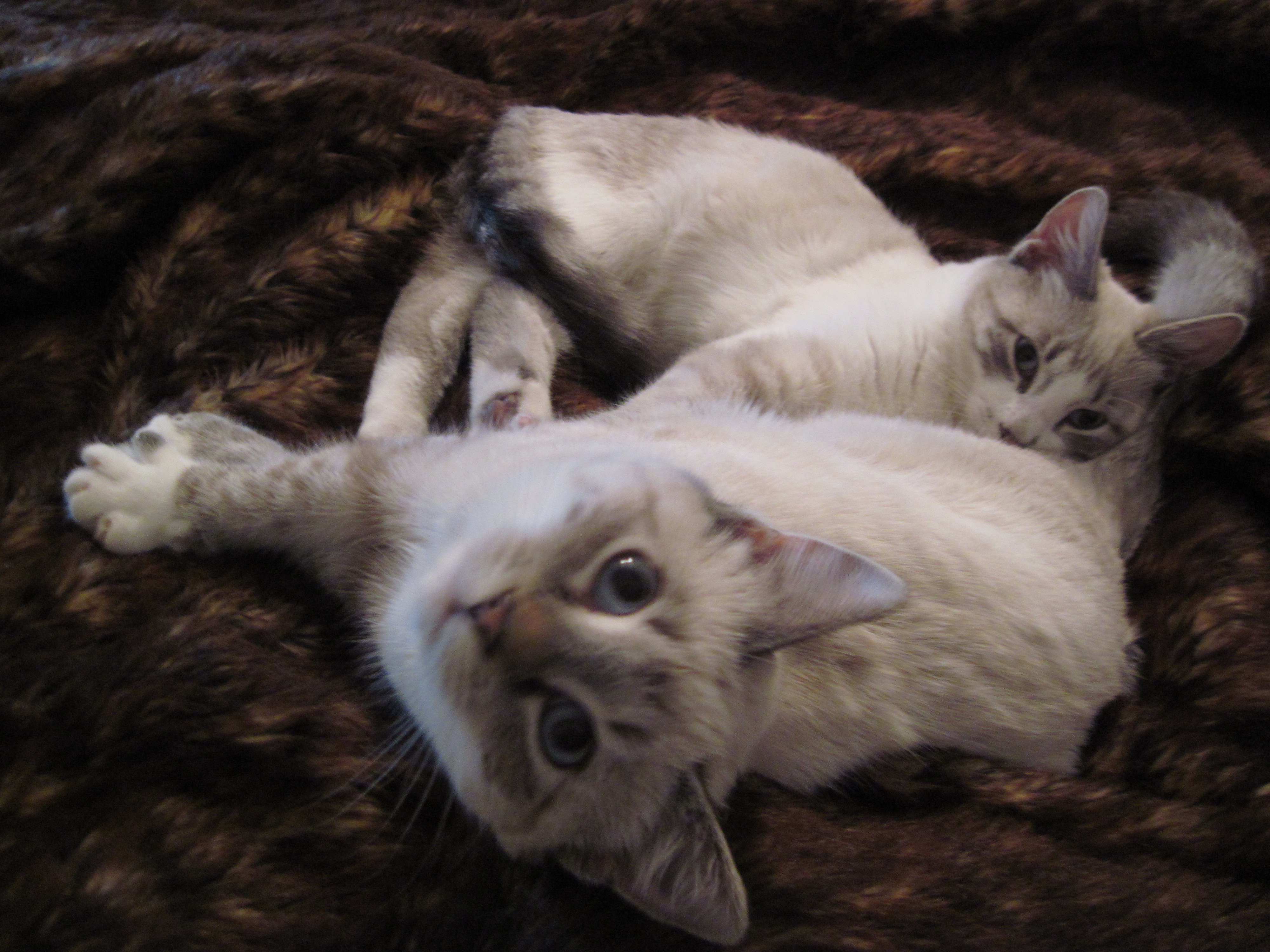
Broken hearted after Willow’s death, I determined that there were more kitties in need of a home, and that I needed them.  Searching the adoption data bases, I discovered that an adoption center in Maine, near where I was living at the time, was having difficulty finding a home for two snowshoe Siamese kittens (a brother and sister) that were highly bonded and that the center did not want to split up.  This was the perfect situation in my mind, and I gratefully welcomed Samantha and Devon into my life. They moved with me back to Washington, and have recognized Nigel as another kindred nurturer.

Devon & Samantha, Snowshoe Siamese

Several months have passed since Dougal’s death, and Nigel is ready to consider another collie, one that he would like to train as a visitation dog, which is what I had trained Bonnie to be (she accompanied me on visits to hospice patients when we lived in Indiana).  Nigel would like another blue merle collie, and I am torn between adopting a second collie for myself or going toward a working companion that is a little smaller, lighter and easier to manually maneuver for bathing, grooming and travel.

As Nigel researches reputable collie breeders, I have been trying on the idea of adopting a miniature long-haired dachshund.  They may be small, but they have big dog likeability and a good temperament.  All dogs, big or small, require healthy social training from their earliest days in order to be good service partners. I have been in serious reflection about what dogs to bring into the family.  Willow and Sylva as cats were very tolerant of Bonnie and Dougal as dogs, while the latter were very respectful of the former.

Miniature Long Haired Dauchshund, Likely Candidate

So, with optimism and caution, we are preparing to soon welcome two dogs whom we do not yet know into our midst.  We know that our lives will be both richer and more complex.  I hope that we will be good for them as they for us, and that we will be a family of partners enjoying life together and bringing one another much love, genuine companionship and many new happy memories of life with those who are beloved.

Domestic Harmony Requires Patience from All Species

The Stuff of Life

2 Comments

The Wooly Green

Whenever I know that I’m going to travel anywhere, I ask people if there’s anything they would like me to try to find or pick up for them where I’m going.  I mean anywhere I’m going and anything someone might like to have.  Whether I’m headed to Safeway in Freeland on Whidbey Island or going to the Basilique du Sacré-Cœur in Paris, France, I’m ready and willing to try to find that little something you’ve been secretly hoping for but feel too bashful to ask.  Most of the time, my keen hunting persistence pays off, and I’m able to bring back the desired trophy like a cat with a very annoyed, soggy mouse.

I make my hunt-shopping offer for two reasons. Firstly, I fondly remember how wonderful it felt as a little girl when my father would return with a little gift for me from an exotic business trip (“Chicago” and “Sante Fe” sounded like very exotic places to me at the age of five), and in turn I now enjoy being able to surprise someone with an item they wouldn’t be able to find at home.  Secondly, having an excuse to shop my way across continents contributes to a deeper exploration of my environment and the experience of novel (sometimes outrageous!) adventures that I wouldn’t have otherwise. Ultimately, hunt-shopping is a form of play for me.

Perhaps considered a fool’s errand by some, hunt-shopping helps me engage the world and the people in it in ways that introduce me to what is foreign within a familiar context.  Ostensibly, through the social exercise of shopping I’m looking for stuff.  However, on a whole other level, I’m seeking adventure and knowledge about where I am. Also, my tastes (like my bank account) are modest, if somewhat oddly balanced between the ridiculous and the sublime.

True to my usual invitation, I asked friends and folks at large if there was anything in particular I could bring back for them from Ireland specifically or Great Britain in general.  I was gratified by requests for tea biscuits, loose teas, a cross, music books and rocks.  It’s always interesting to me what speaks of “place” to different people. Some vicarious pilgrims quite literally want a piece of place; I always get requests to bring back rocks – as though I might be going on an Apollo mission to the moon.  Airport luggage handlers are consistently amazed at the weight of my carry on, “Such little bags, good for bench pressing!”

Chris Lubinski selling her wools & yarns

One request that particularly engaged my sense of exploration came from a friend of mine, Chris Lubinski, who seems to have arrived in this time from another era.  Chris and her husband, Jerry, live on a wonderful wooded farm on Whidbey Island where they care for a large menagerie of animals including cairn terriers, mules, horses, and Shetland sheep.  Their place is called Whoamule Farm, and you can find them here:  http://www.whoamulefarm.com/.

Chris is a fiber artist, working the wool of her sheep through all the stages of cleaning, carding, roving, dyeing and spinning.  She asked me if I could bring back some “rovings” of Irish wool.  Rovings are cleaned and carded wool that has yet to be spun.  Chris had been trying for many years to locate a woolen mill in Ireland that would sell and ship un-spun wool, but she had not been able to locate a willing source.

[Enter international hunt-shopper extraordinaire – me!]

Our fourth day in Ireland finally afforded me the time to hunt for the elusive wool rovings.  By then, my husband and I had travelled from northern to southern Ireland and happened to be staying near Killarney.  After stopping into several stores that sold wool products, I located a knitting supply shop where the owner had no idea what I was attempting to describe…”Rovings…you know, the fluffy phase of wool making…before it’s spun…the stuff little woolly art animals are made of…like little sheep!”

She peered over the reading glasses perched on the end of her nose and observed, “Well, yes, sheep do tend to be made of wool.  Especially the fluffy kind of wool.”

“The Kerry Woolen Mill”

Actually quite charmed by her, I proceeded to compliment the fineness and interesting blends of the yarns in her shop.  I chatted happily and sincerely about the wonderfulness of all things Irish.  I bought a knit cap. Eventually, after 25 minutes, she owned as how the woolen mill on a side road of town might have what I was hunting for, though she still seemed to question the physical nature of “fluffy” wool and assured me that Irish sheep grow wool for a cold, dank climate – wool not at all “fluffy” but course and scratchy.  I thanked her genuinely, pulling my new wool cap over my ears and headed out of the store and back into the cool misty rain of an Irish summer evening.

“The Machine Loom”

The 17th century Kerry Woolen Mills is located about 8 miles west of Killarney in Country Kerry on the Ring of Kerry.  The mill is one of the last surviving traditional mills still manufacturing in Kerry. Originally founded over 300 years ago to alleviate local poverty, the mill drew hydro power from the nearby River Gweestin in order to drive its machinery and provide the water necessary to wash and dye its wool. The mill was bought in 1904 by the Eadie family, who had previously been in the wool business in Fermangh and Scotland.  The family is now in its fourth generation of ownership of the Kerry Woolen Mills, producing everything from scarves and sweaters to blankets and rugs.

The old buildings of the mill were a treasure trove of wooly exploration to me.  Entering first by way of the gift shop area, my senses were delighted by the textures and colors hanging and draped over every possible surface and shelf, burgeoning in the close quarters of long floor-to-ceiling wooden hall.  After the few timid moments it took me to overcome my concern of being intrusive, I asked the clerk behind the large wooden counter if they sold wool rovings.

At the sight of her initially puzzled look I had a fleeting moment of despair, but I persisted with a rather ludicrous description of wool processing (something I have never done myself and which the clerk undoubtedly knew intimately).  Nonetheless, when I reached the point in my tale when I was pantomiming what I  hoped was at least a gross approximation of manipulating fluffy wool between two wooden hand paddles, the clerk exclaimed, “Oh! You’ll be wanting carded wool!  We have lots of carded in many colors, Dearling.  Would you want to have a look in the mill building to choose what you will?”

Oh, boy, would I?  Yes-sir-ee-bob!

Like a service guide to the woolenly challenged, the cheerful clerk wove me through the back rooms connecting the gift-shop to the expansive mill area.  I was in fuzzy heaven.  Cautioned by the clerk to be mindful of the moving parts of the machine loom currently in action across the full breadth of the warehouse, I was threaded at last to the eye of bliss – the massive collection of giant open bags of carded wool.

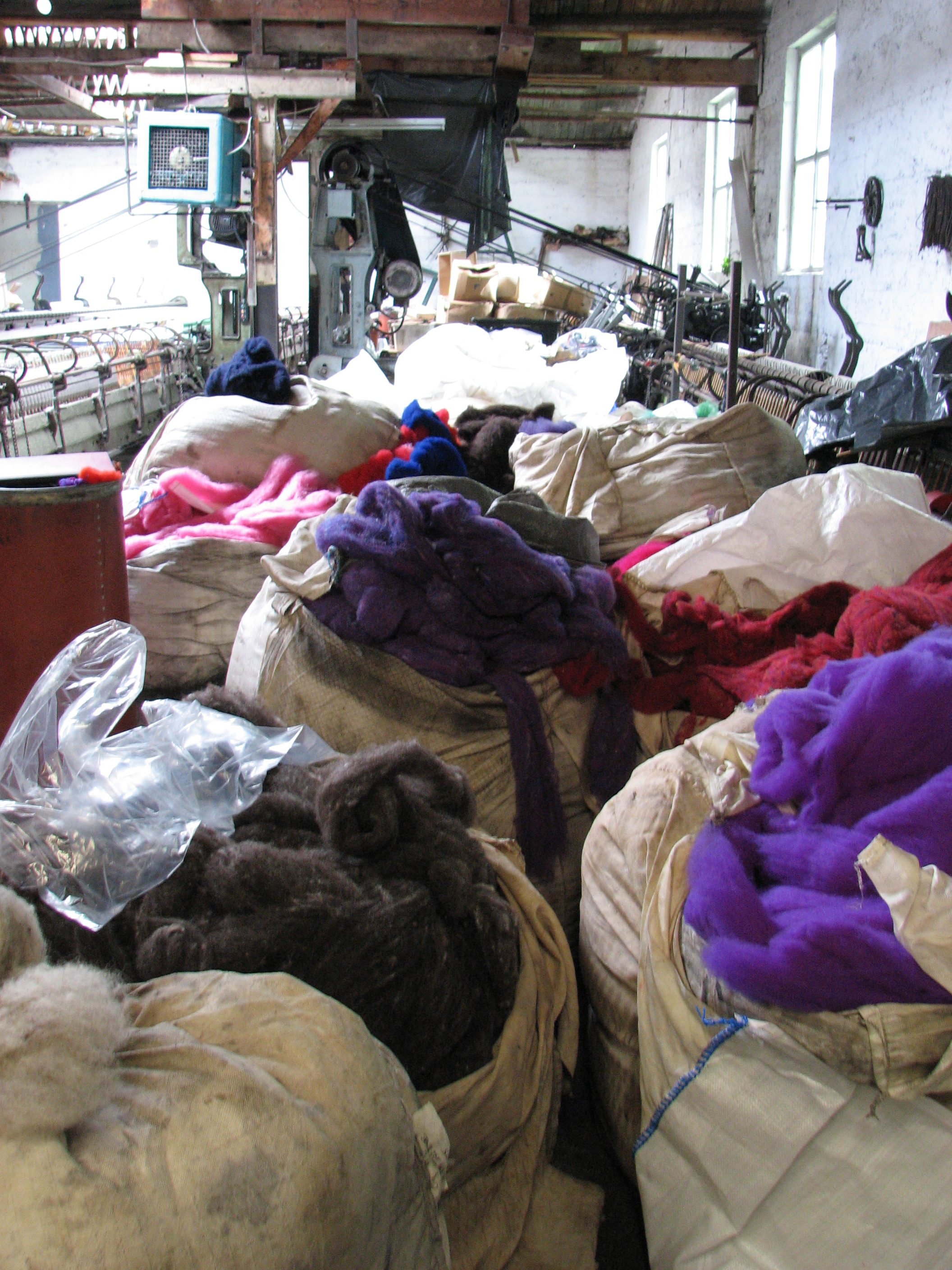
“Giant Blooms of Carded Wool”

Before me bloomed rounded pods of several natural (un-dyed wool) hues as well as jewel toned wool of bright oranges, reds, greens and blues.  I filled two large, clear plastic bags with puffy rainbows of wool gauze – delighted with the successful outcome of my hunt-shopping expedition.

However, my real reward was being able to surprise Chris Lubinski with what I was able to procure for her.  If you should ever have need or want of carded Irish wool (or yarns), you can order directly from Kerry Woolen Mills by visiting their website at: http://www.kerrywoollenmills.ie/index.php

I should also mention that I came across something quite wonderful that the Eadie family made on their magical cloth loom and shipped to me.  You see, after stuffing my plastic bags with colorful wool, I returned to the gift shop area to discover one of the family owners of the mill working behind the counter.  Our conversation revealed that he was an active lay Eucharistic minister in the Church of Ireland and that his mill had recently produced fine wool cloth in all the liturgical colors for new cathedral vestments ordered by the Roman Catholic Church of Ireland, who subsequently purchased the wool cloth in every color except white.

“Would you like to see it?” asked the mill owner.

Holy smokes, would I?

“White Wool with Gold Accents”

The white wool cloth was extraordinary, appealing to my sensibilities in every possible way – from its supple softness to its modest pattern of fine golden threads.  I asked reverently if a liturgical stole could be made of it and sent to me across the pond.  “Absolutely!” was the pleased answer. Someday, perhaps, I will be able to order a set of altar cloths and vestments in the same wool, but I am very happy to wear my soft, wooly stole and remember Ireland and the successful hunting trip in Kerry County.  I found so much more than “stuff” there that I will keep in my heart, all the days of my life.

Of Mists and Revelations

2 Comments

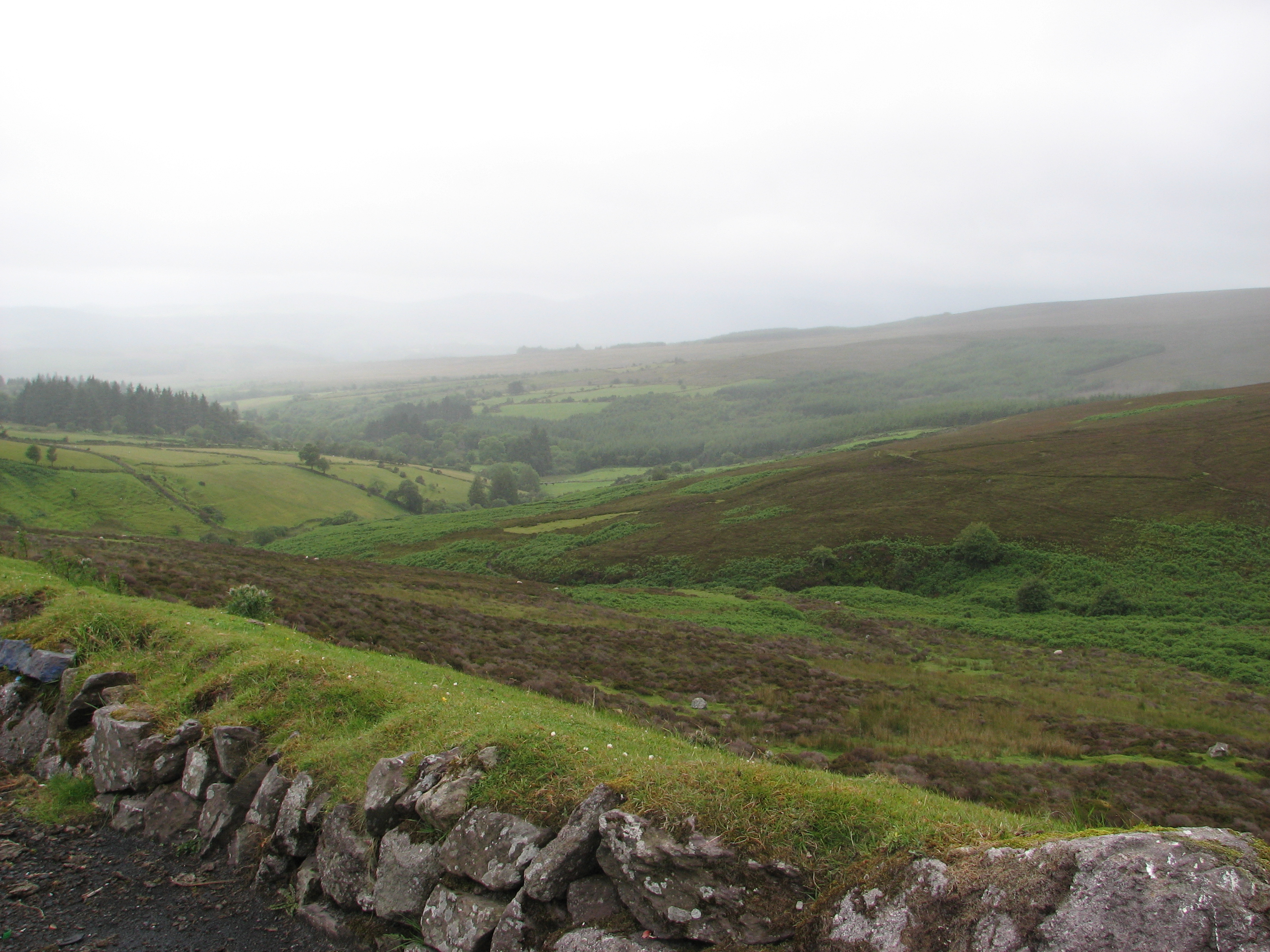
“Misty Vale of Ireland”

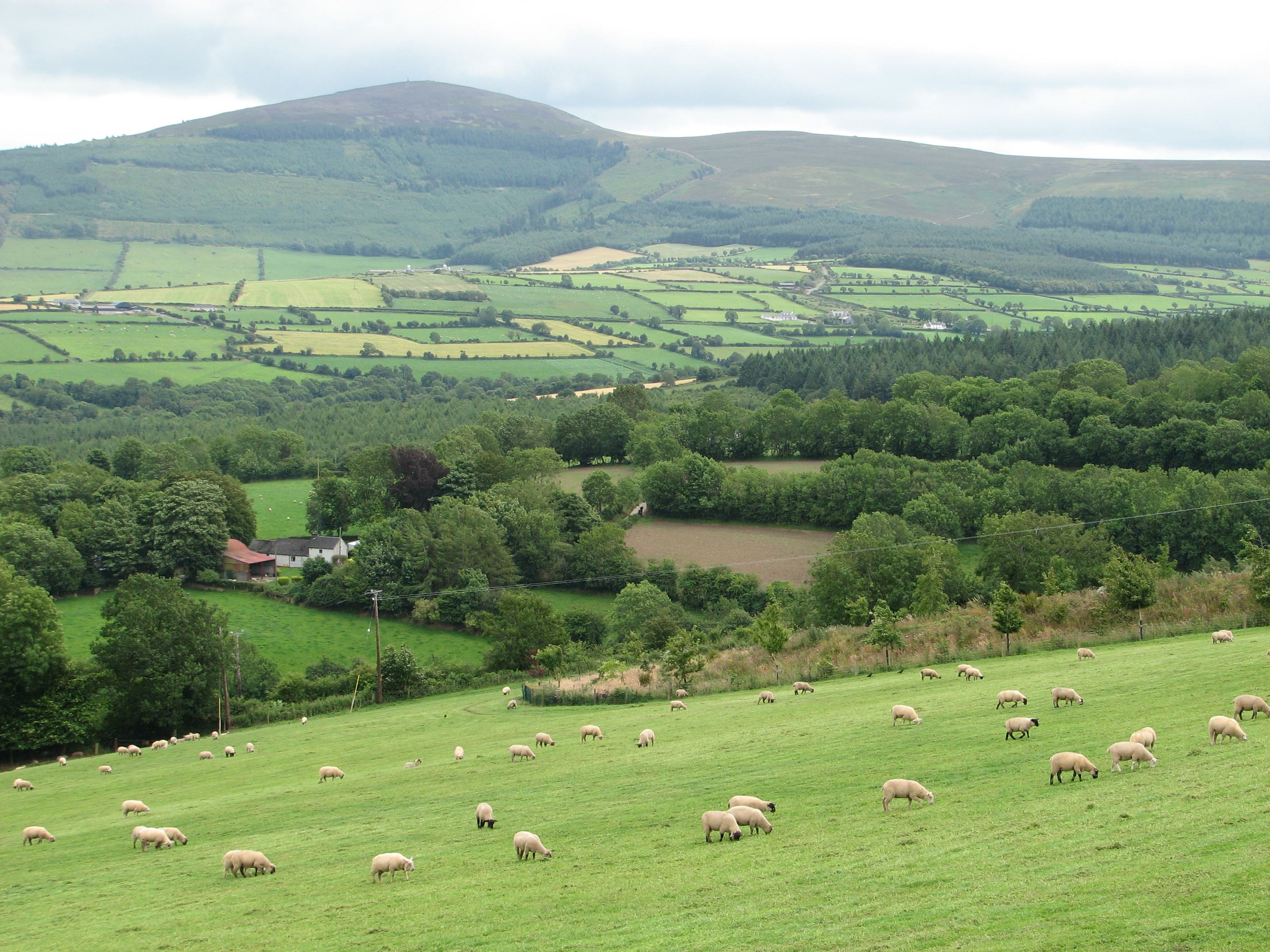
As my husband and I drove through the Irish county side, the rainy mist drew back from time to time to reveal startling glimpses of Ireland’s past.  I can well believe the legends of those who have stepped into that temporal mist, never to return.  In some very important ways, the past is still very much alive in Ireland.  Stony ruins and oral lore share equal social commerce with internet cafes and university libraries.  And yet, an exploration into Ireland’s unique history of law, religion and society reveals a world in many ways far more progressive than the future it would know.

6th-7th century saints such as Aidan of Lindisfarne, Brendan (the Navigator) of Clonfert, Brigit of Kildare, Gobnait of Ballyvourney, Colum Cille (Columba) of Iona and Hilda of Whitby founded religious communities built as much from Irish pre-history as from Irish stone. They lived at a time when all that had gone before was only just beginning to be entered into written form.  Transitioning from “pre-history” to “history”, law and doctrine as well as their interpretation and application had been until then a matter of oral tradition.

“St. Gobnait of Ballyvourney”

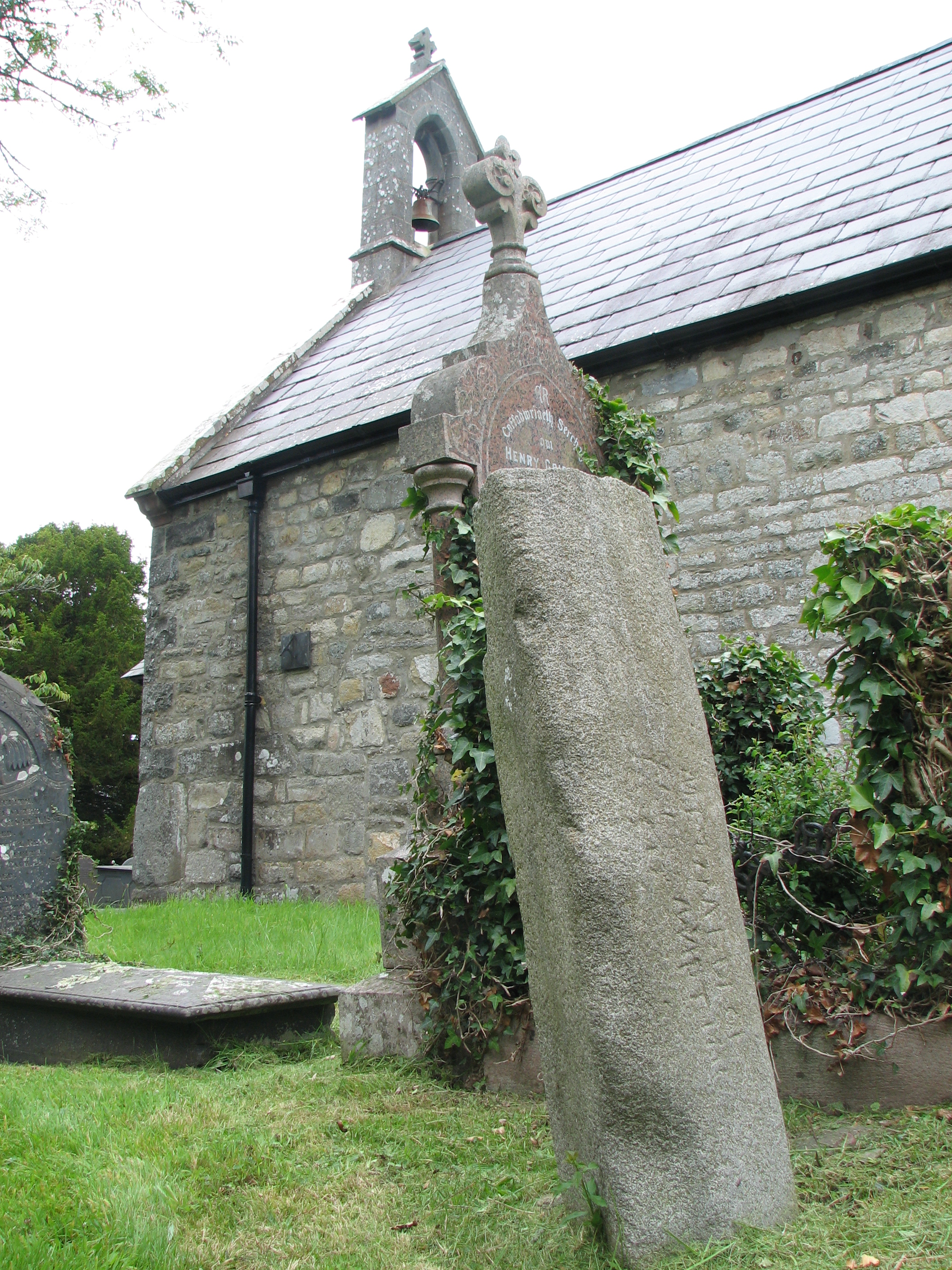
However, Christianity was a tradition of the book, as was its religious ancestor of Judaism.  Consequently, carvings and illuminations of early Irish saints frequently depict them as either holding a book or as writing in one.  Not coincidentally, the first written Irish appeared in the fifth century, around the same time as the initial Christianization of Ireland. Called Ogham script, written Irish is formed of a series of grooves carved on the corner edge of a shaped stone. Each combination of grooves represents a different letter of the Latin alphabet, and a number of Ogham stones have been found in both Ireland and Wales.

“The Ogham Stone of St. Beuno’s”

Being long before the printing press, the only way to acquire an early Christian book was to hand-copy it.  In fact, it is said that the first instance of copyright law can be traced to Colum Cille (St. Columba).

As the story goes, Colum Cille was known to be an avid copyist and illuminator. His former teacher and friend, Finnian, had just returned from Rome with a highly-desirable copy of Jerome’s Latin translation of the bible created some 100 years earlier.  Though Finnian was agreeable to Colum Cille studying the book, he clearly did not want Colum Cille to copy it.

“Case for the Bible Belonging to Colum Cille”

Finnian’s resistance seems to have been in part because the commentaries and later illuminations apparently included some gnostic interpretations and symbolism considered to be out of step with the emerging orthodoxy.  Perhaps religious leaders in Rome thought it just as well to have the valuable but challenging manuscript removed from the country.  At any rate, the bible went with Finnian to Ireland, and Colum Cille wanted a copy of it.

Refusing to be thwarted by Finnian’s reserve, Colum Cille copied the manuscript surreptitiously at night. Employing the practice of creating text pages from vellum (specially prepared calf skin), Colum Cille applied his art until the manuscript was fully copied. However, his secret was eventually outed, and an outraged Finnian took Colum Cille to legal arbitration in the court of Diarmaid, the High King of Ireland.  Finnian argued that the book was his property and that copying it was a violation of his rights.

“Christ Enthroned” Book of Kells

Colum Cille’s counter argument is said to have included something of the following:

Learned men like us, who have received a new heritage of knowledge through books, have an obligation to spread that knowledge, by copying and distributing those books far and wide. It is wrong to hide such knowledge away or to attempt to extinguish the divine things that books contain. I acted for the good of society in general.

King Diarmaid ultimately forced Colum Cille to return the copy to Finnian with the conclusion that, “Arbitrators have always described the copy of a book as a child-book. This implies that someone who owns the parent-book also owns the child-book. To every parent its child, to every cow its calf. The child-book belongs to Finnian.”

“St. Columba in his Coracle Boat”

In making his ruling, Diarmaid applied an ancient oral code of legal tradition now known as Brehon Law. Within Irish culture throughout the Iron Age, Brehon Law reflected an ancient and existing social equality of gender that placed women at the head of any profession and able to hold Clan leadership equally with men.  Though reflective of highly localized needs and practices, Brehon Law was the guiding force in Ireland for all relationships between individuals, social and moral.  To orally agree to a social contract was binding to one’s personal honor.  Any breach of contract could be seen as a mark not only against an individual but of an entire clan.

Finally, Brehon Law was a tradition formed over hundreds of years by the people to serve the people.  It was memorized and applied by professional arbitrators (both male and female) who studied the law for many years before being examined to become a Brehon (a combination of being a walking oral law library and legal representative). The highest level Brehons were considered to have rank equal to the High King – be that Brehon a man or a woman.

“6th Century Ireland, A Living History of Equality”

From the mists of Ireland’s history emerges an early tradition of law and social conduct based on personal honor, a quality about which little is spoken or commonly culturally transmitted in our time. In the global economy and politic in which we currently find ourselves, a little old-fashioned integrity called “honor” could go a long way.

It certainly couldn’t hurt.

Living on The Edge

4 Comments

“Pondering Puffin”

My husband, The Rev. Nigel Taber-Hamilton, had a three-month sabbatical this  Summer.  Episcopal priests are encouraged to take sabbaticals every 5 years, even if they have to go kicking and screaming or even if they leave folks behind who are kicking and screaming about it.  Since Nigel has been the Rector of St. Augustine’s in-the-Woods since 2000, this was his second sabbatical.  Though I had just became Rector of Trinity Episcopal in February of this year, I was very grateful to have been able to use my two weeks of continuing education, plus two weeks of vacation in order to join him for some research and relaxation in Great Britain.

We mapped out our journey based on significant remains of mostly 6th century Celtic Christian communities.  Consequently, our trail wandered from north to south Ireland, to Wales, England and then to Scotland. Being good pilgrims, we saw many holy sites and did a great deal of shopping – a fine pilgrim tradition, don’t doubt it.  We also saw many things we hadn’t planned on seeing such as cows larger than most economy cars, the mummified remains of several “bog people,” and the slanted view of an Irish dirt road from the perspective of the Irish dirt-road ditch we drove into.

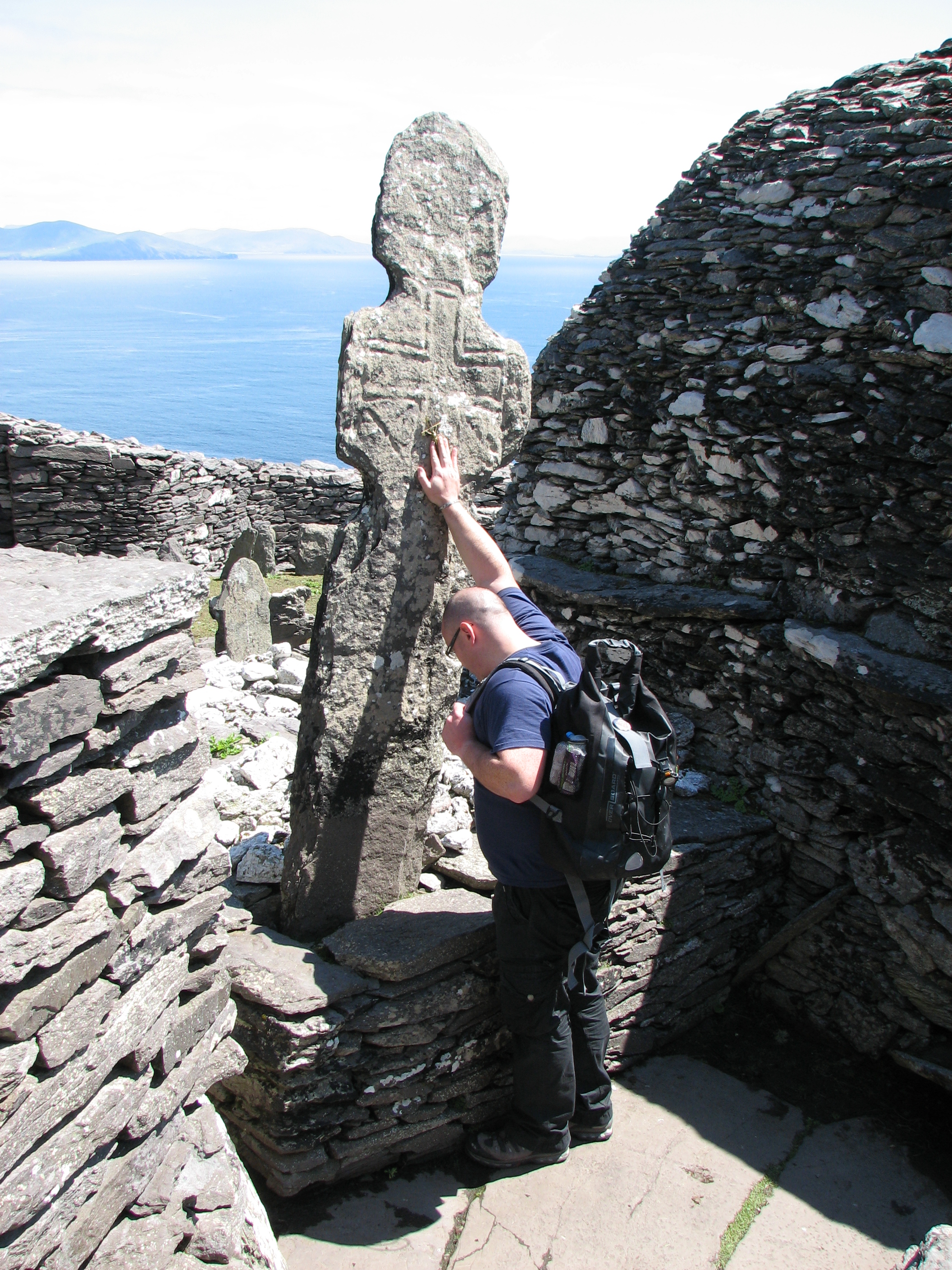
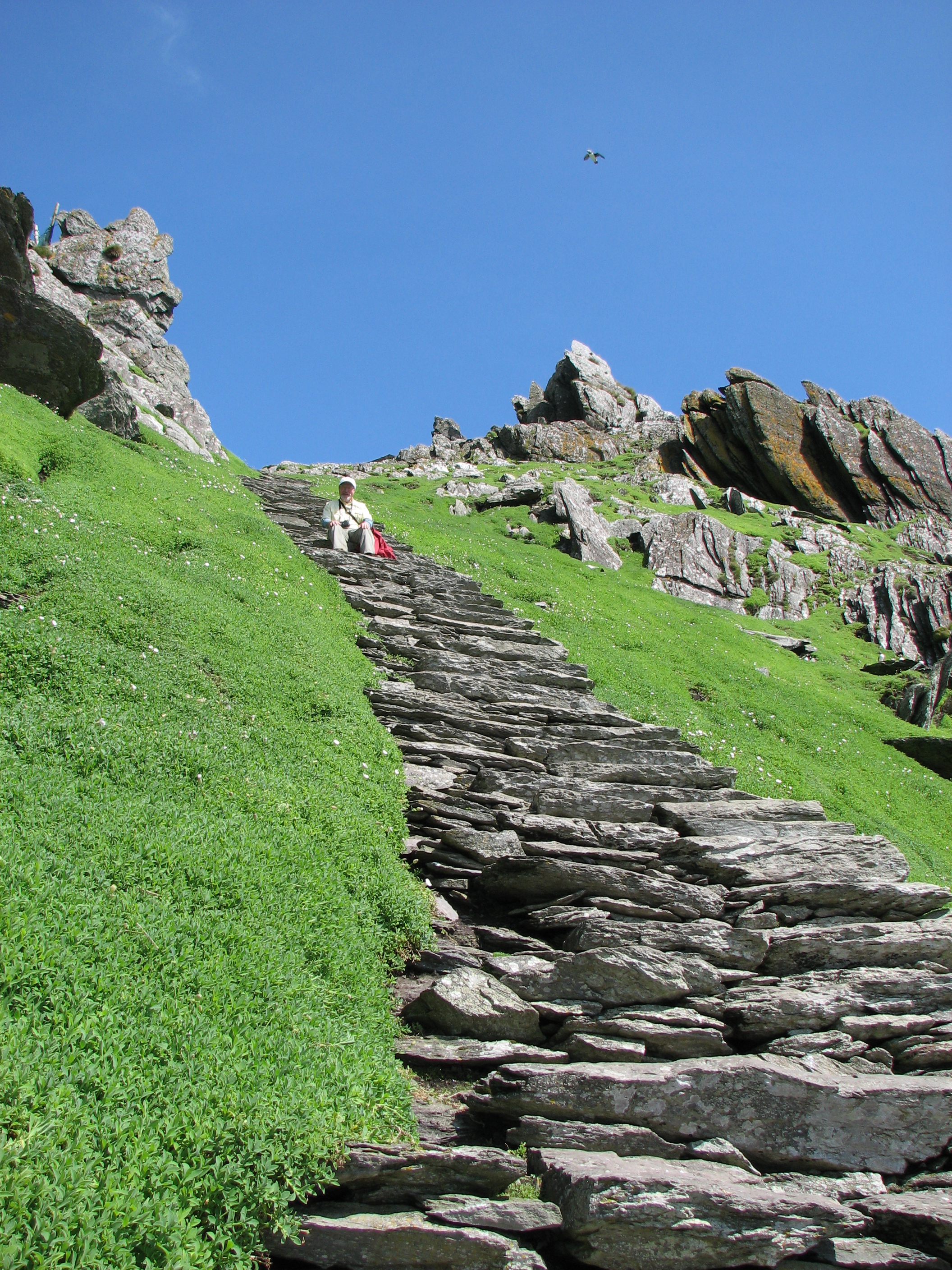
A place that I hope to remember for the remainder of my life are the two Skellig islands off the Iveragh Peninsula in Country Kerry, Ireland.  Little Skellig is closed to the public, since it is home to the second largest colony of Northern Gannets (seabirds) in the world.  The second island, Skellig Michael, serves as a popular nesting ground for puffins and is also designated as a World Heritage Site for its the remains of 6th century monastic community perched at 160 meters above sea level.

“Climbing the flights of stone steps on Skellig Michael”

The remains of the site include beehive shaped oratories (monastic cells built of stone) and a church. St Michael’s Church is rectangular in form, unlike the oratories, and would originally have had a timber roof. The date of the founding of the monastery  is not known. However, there is an oral tradition that it was founded by St Fionan in the 6th century. It was dedicated to St Michael somewhere between 950 and 1050.  The site was occupied continuously until the later 12th century, when several factors caused the community to move to the mainland.  It is likely that the community was very small, perhaps around 6-8 monks lived on the island where they kept a small kitchen garden and harvested fish and eggs for food.

The park interpreter assigned to the island the day we were there shared that the monks didn’t come to the island so much to get away from civilization, but rather to live on the edge of the known world in order to be closer to what was beyond it, namely – heaven.  Skellig Michael was held to be a “thin place,” a place nearest the realm of the Sacred.

After a  50 minute boat ride and climbing 650 terraced flights of rock-shelf steps, Nigel and I reached the monastic site.

“Oratories on Skellig Michael”

The temptation to slip into a romantic reverie on how wonderful it would have been (would be) to live a simple life on the island was tempered by the awareness that a good gust of wind on a rainy day could quickly end one’s prayer life on this side of the Divide.

Yet, coming to the edge of the world and of life can bring a helpful, even needful, perspective to decision making and prioritizing one’s time, choices and energy.  The puffins play and nest on the sheer sides, you know.  After a good beak-wrestling contest and tumble down the soft ground foliage, they fly away to eventually settle down again.  It’s not scary to them; it’s a familiar home.

“Puffins Beak-Wrestling on Skellig Michael”

What Skellig Michael reminds me of is that the distance between the life we have and the life we may want to have is not a matter of distance traveled or summits climbed but a matter of attitude, not altitude.  How we orient ourselves within a given moment or situation can diffuse danger, focus priorities and redirect us to new heights and perspective.

“Still a Pilgrimage destination, since the 500’s AD”